In this article, we will break down the amusement park lottery problem and solve it easily using C++.
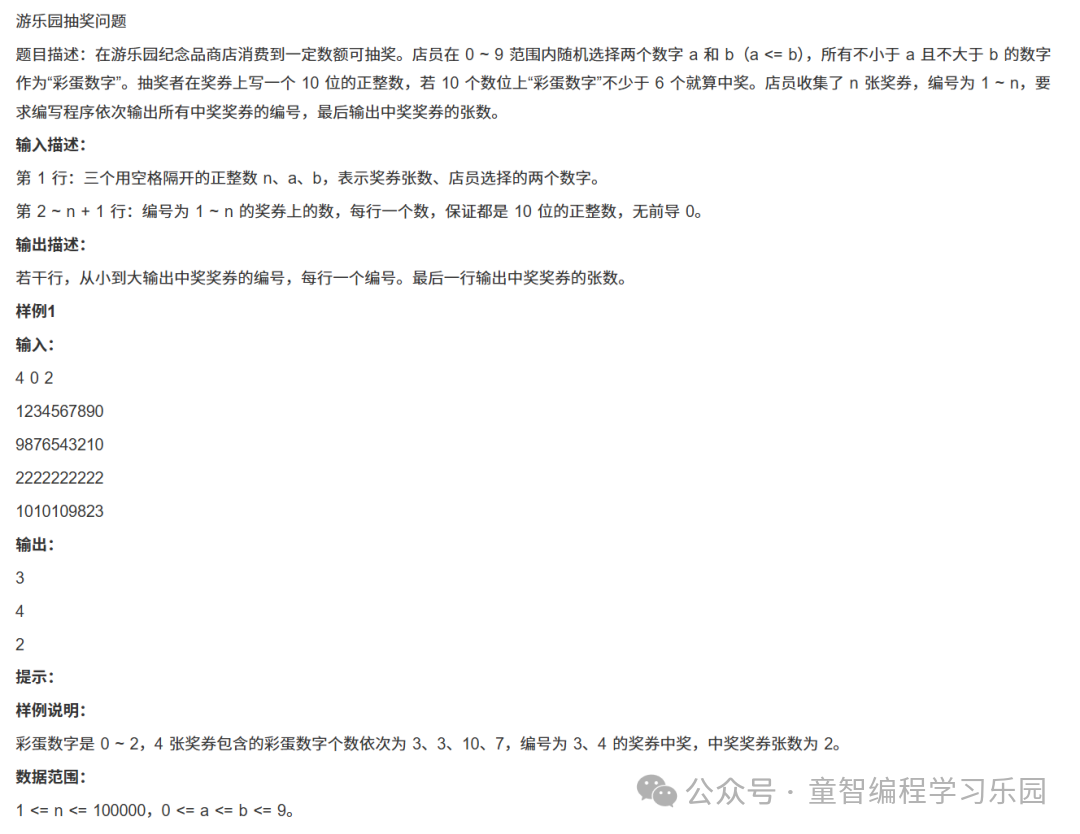
1. Understanding the Problem: Grasping the Core Rules
The problem states:
- The staff selects two numbers
<span>a≤b</span>, and the “lucky numbers” are those between<span>a~b</span>(inclusive of a and b). - Each lottery ticket consists of 10 digits, and if there are 6 or more “lucky numbers” among the 10 digits, it is considered a winning ticket.
- Input n lottery tickets, output the winning ticket numbers (starting from 1) and the total count of winning tickets.
2. Steps to Solve the Problem: Three Steps
Step 1: Read Input Data
- First, read 3 integers: the number of tickets
<span>n</span>, the range of lucky numbers<span>a</span>, and<span>b</span>. - Then read
<span>n</span>strings (since the 10 digits are stored as strings for easy traversal of each digit).
Step 2: Check Each Ticket for Winning Status
For each ticket (numbered starting from 1):
- Traverse each character, convert it to a number (
<span>digit = c - '0'</span>). - Count whether this number is within the range of
<span>a~b</span>: if it meets the criteria, then<span>count+1</span>. - If
<span>count ≥6</span>, it means this ticket is a winner, so store its number.
Step 3: Output Results
- Output all winning ticket numbers in order (one per line).
- Finally, output the total number of winning tickets (i.e., the count of winning ticket numbers).
3. Code Logic (Corresponding Steps)
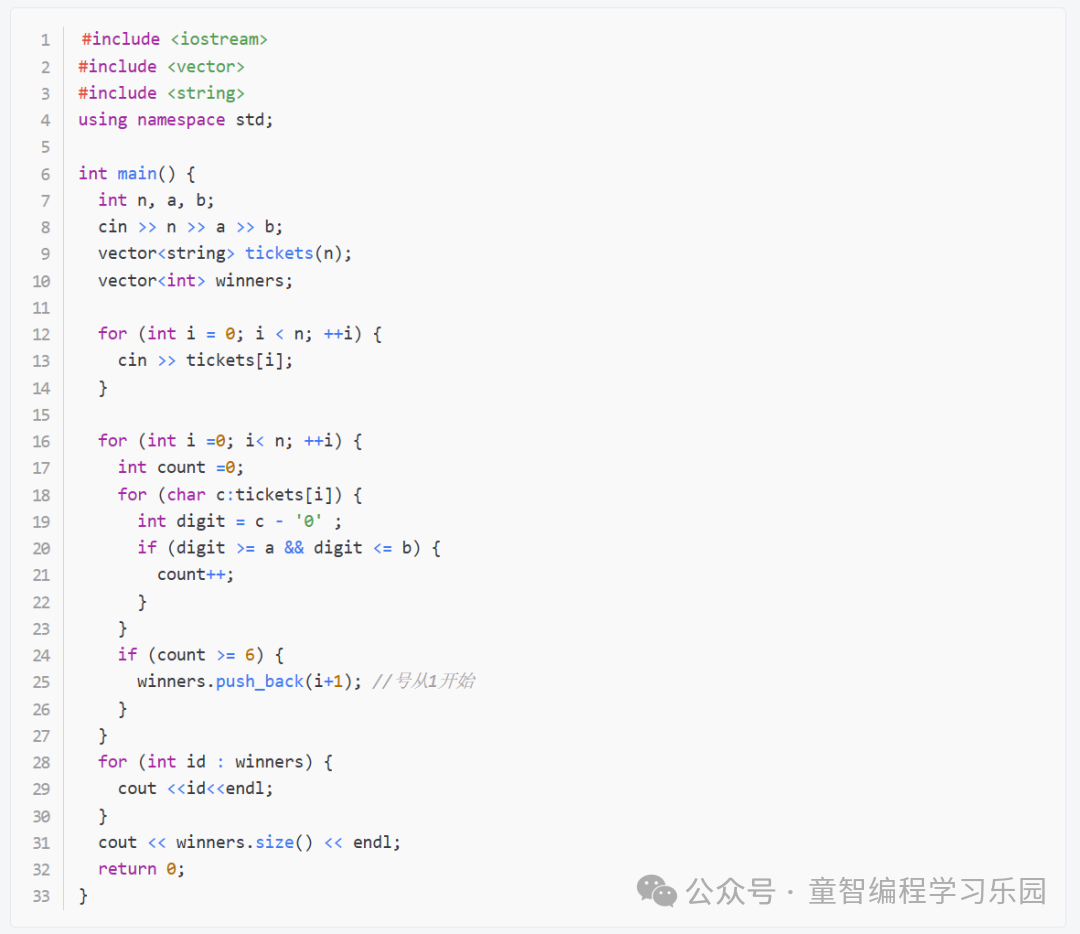
4. Key Points to Note
- Numbering starts from 1: The loop variable
<span>i</span>starts from 0, so the winning ticket number should be written as<span>i+1</span>. - Digit Processing: Store the 10 digits as strings, traverse each character and convert it to a number (
<span>c-'0'</span><code><span> is a common technique for character to number conversion).</span> - Efficiency Issues: The maximum value of n is 100000, and each ticket traverses 10 digits, resulting in a total computation of around 1e6, which will not exceed the time limit.