What is Simulation Thinking
Simulation, as the name suggests, is the use of computer programs to mimic the development process of a real-world system or process. Its core idea is:to analyze the descriptions of processes or rules in the problem, identify the key steps, and then directly reproduce them step by step through code to obtain the answer.
Simulation is not a specific algorithm, but a powerful and intuitive programming thought. When faced with a problem that has clear steps and well-defined state changes, simulation is often the most straightforward and least error-prone solution.
Characteristics of Simulation Thinking
1) Process-oriented: Focus on the changes in steps and states;
2) Rules first: Understanding the rules determines whether the code is correct;
3) Intuitive and easy to implement: As long as the steps, states, and transformation rules are sorted out, the transition from thought process to code is very direct.
Understanding Simulation Thinking through Examples
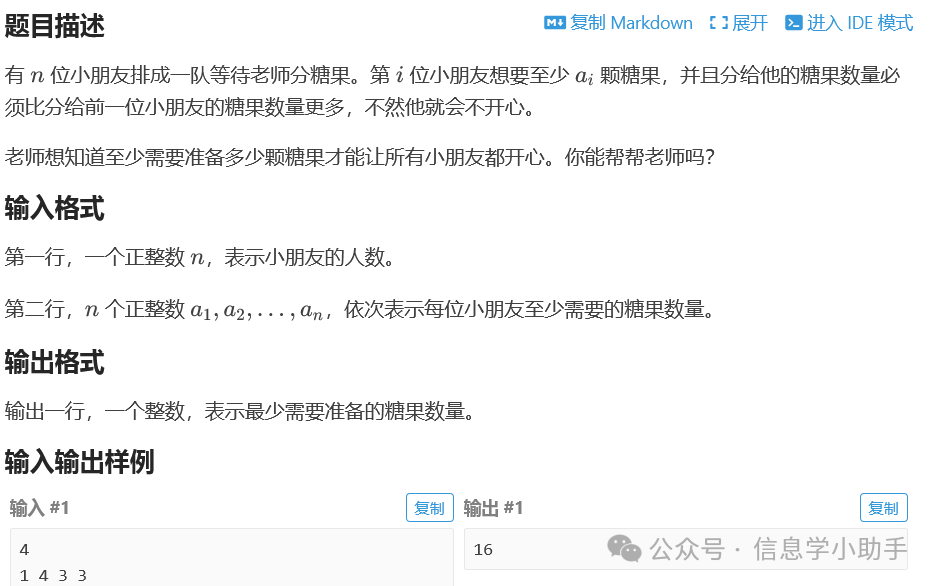
Example 1: Distributing Candies
GESP-3 202506 T2
https://www.luogu.com.cn/problem/B4359
Problem Breakdown
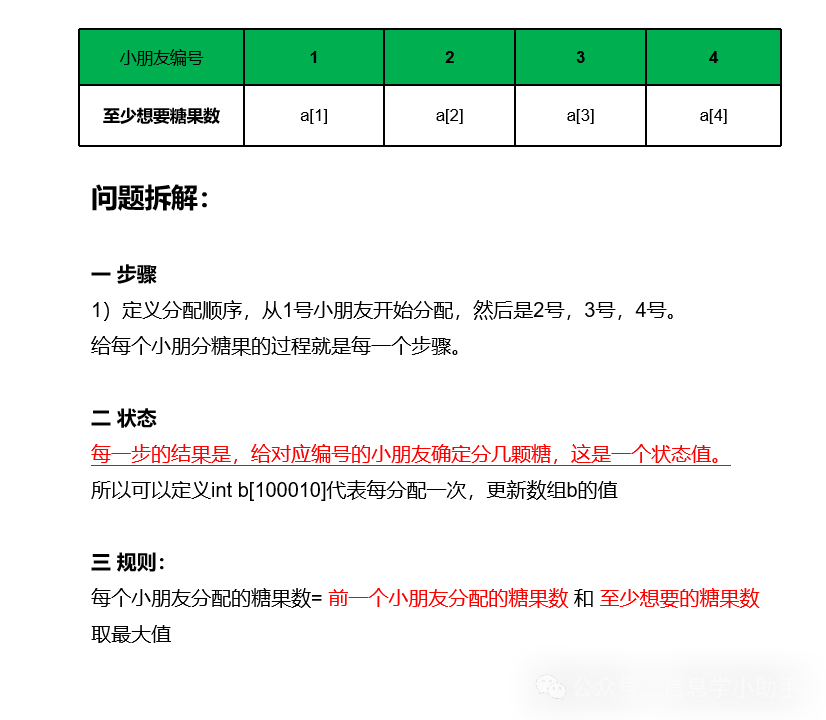
Steps to Solve
1) Construct the distribution process from child 1 to child n using a loop, assigning candies to the child with index i each time.
2) The process of assigning to child i is to rewrite the state of b[i].
3) The distribution rule is b[i] = max(a[i], b[i-1]+1)
#include <bits/stdc++.h>using namespace std;
int a[100010], b[100010];int main(){    int n;    cin >> n;    long long sum = 0;    for(int i=1; i<=n; i++) {        cin >> a[i];    }    for(int i=1; i<=n; i++) {        b[i] = max(b[i-1]+1, a[i]);        sum += b[i];    }    cout << sum;    return 0;}
Example 2: Spring Outing
Luogu B3842
https://www.luogu.com.cn/problem/B3842
For simulation problems, think about how similar situations are solved in real life. The problem will become simpler.Problem Breakdown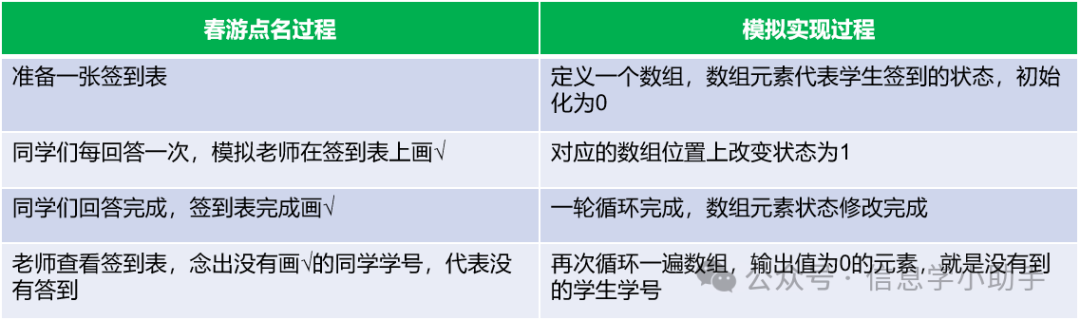
Steps to Solve:
1) Set up an array to represent the attendance sheet.
2) Loop through to read the student ID information, then use the ID as an index to update the corresponding student’s status in the attendance sheet;
3) Read the attendance sheet again and output the information of students who did not attend.
#include <bits/stdc++.h>using namespace std;
int a[10010];int main(){    int n, m;    cin>>n>>m;    while(m-- > 0) {        int v;        cin>>v;        a[v]++;    }    // All students present    bool flag = true;    for(int i = 0; i<n; i++) {        if(a[i]==0) {            cout<<i<<" ";            flag = false;        }    }    // If all students are present, output n    if(flag) {        cout<<n;    }    return 0;}
Conclusion
Simulation thinking is a strategy that uses the “computational advantage” of computers to reproduce the problem process step by step, thus solving complex problems in a “simple-minded” way. It is widely used in programming competitions, game development (physics engines, AI behavior), and system simulation (traffic, queuing).
When using simulation thinking to solve problems, learn to start from the scenario, clearly sort out the three key elements: steps -> states -> rules, and many problems will be easily resolved.
Follow the Informatics Assistant for economical and practical C++ introductory solutions. If you want to learn C++, you can leave a message on the public account or contact the Informatics Assistant.
Join my Luogu team for free, learn, communicate, and spar together.https://www.luogu.com.cn/team/108017
Author Bio: Master’s degree from Huazhong University of Science and Technology, former Huawei engineer, currently a teacher of algorithm courses in big data at a university. Committed to making learning simpler.