“ In 1991, Linus released the Linux kernel under the guidance of Stallman’s free software movement, thus giving birth to the GNU/Linux operating system. As one of the longest-standing Linux distributions, Debian has addressed the survival challenges of free software through community collaboration and open-source initiatives, showcasing the unique vitality of the open-source ecosystem with its 50,000 software packages and annual election mechanism.”
Review of GNU/Linux OS
1. Project Progress
-
In 1983, after Stallman initiated the GNU project, despite his exceptional talent shining in the GNU/GCC compiler chain, the kernel was not officially released for a long time.
-
In 1990, members of the GNU project contributed the Mach microkernel, known as GNU Hurd.
-
That same year, Microsoft released the first widely accepted GUI operating system based on MS-DOS, Windows 3.0. This was a significant irony, as Stallman had publicly stated that MS-DOS was a “toy” (compared to the Unix shell of the Unix-like operating system GNU). This may reflect certain market and progress advantages of commercial software.
-
In 1991, Finnish student Linus, under the leadership of Stallman’s “free software movement,” released the Linux kernel under the copyleft (not to be confused with copyright) GPL protection model. Thus, the GNU/Linux OS was officially born.
-
Note 1: Although Linus used the GNU/GCC compiler chain and adhered to the GPL license, the Linux kernel is not part of the GNU project that Stallman is passionate about. The Linux kernel is Linus’s personal contribution.
-
Note 2: This may have led to the widespread recognition of Linux, often used to refer to the GNU/Linux operating system (from a certain perspective, this understanding is not incorrect, as the Linux OS can be seen as the process of porting various mature GNU tools to the Linux kernel).
-
Note 3: Since Richard Stallman has led the “free software” movement throughout his life and creatively invented the GPL license (copyleft), and considering that C language was invented by Ritchie and rewritten (truly created) Unix, C language and compilers have become inseparable from Unix-like systems. Therefore, it is common to refer to it as the “GNU/Linux operating system”.
2. Functional Modules
-
Stallman’s GNU/GCC toolchain and other GNU tools
-
Linus’s Linux kernel
-
Unix shell: command line interpreter for user interaction
3. “Mainline Tasks”
As mentioned above, borrowing the term “task” from games to describe the development of Unix/Unix-like operating systems, we can outline the “mainline tasks” of GNU/Linux as follows:
-
System V family (Unix): “Sectarian Task” (a closed loop for a few companies)
-
BSD (Unix-like): “Hall Task” (BSD license, Apple MacOS branch can be a closed loop)
-
GNU/Linux (Unix-like): “Mainline Task” (GPL protected)

01
—
Debian GNU/Linux Operating System (Debian OS)
Creating a GUI “desktop window” operating system similar to Windows and MacOS is now the primary task of GNU/Linux (the hardware environment of the 1990s has also matured).
Debian includes the following main modules:
-
Desktop environments: supporting XFCE, GNOME, KDE, MATE, Cinnamon, LXDE, and LXQT.
-
Office tools: LibreOffice, Firefox web browser, Evolution mail, K3b disc burner, VLC media player, GIMP image editor, and Evince document viewer.
-
APT package (download) management tool.
As a “mainline task,” the Debian GNU/Linux operating system is one of the longest-standing Linux distributions and one of the widely used OS for network servers.
At the same time, it is also the codebase for Ubuntu.
02
—
Debian Community Ecosystem
2.1 Large-scale GPL Project
As “free software,” the main issue for GNU/Linux (Unix-like operating systems) is how to survive and develop. This can be understood as: how to develop a GPL survival environment without capital support and without obvious profits.
In comparison: Windows, MacOS (iOS), Android OS, are inseparable from the support of large monopolistic multinational companies like Microsoft, Apple, and Google, while the aforementioned operating systems (or their associated hardware and software tools) are also important sources of revenue for these commercial multinational groups.
The difficulty and investment can be glimpsed through the following data:
-
Debian’s software repository contains over 50,000 packages.
-
The total code of all packages in Debian 5.0 exceeds 300 million lines.
-
In 2016, the Debian codebase exceeded 70 million lines.
2.2 Community-formed organization of thousands of “Debian Developers” and annual voting for Leader
Community Model
The following image is from Wiki:
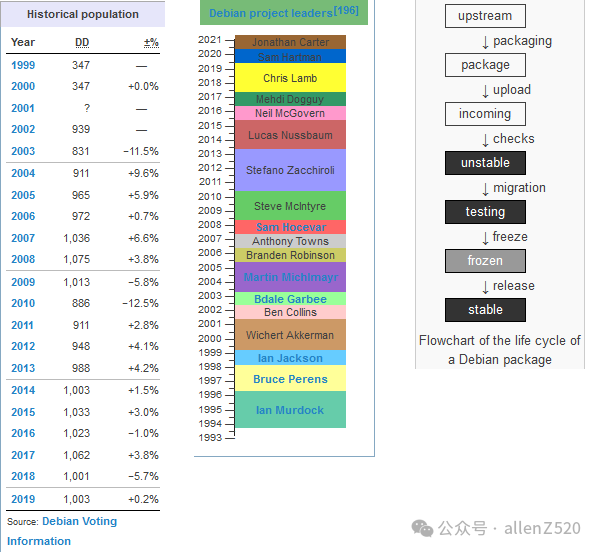
The image shows three lists representing: the number of voters, project leaders, and the life cycle diagram of Debian packages.
Behavior Guidelines
The “Debian Social Contract,” “Debian Free Software Guidelines,” and “Debian Constitution” guide the following behaviors:
-
About a thousand “Debian Developers” organize the community (but do not prohibit other developers from contributing to Debian).
-
Achieve project coordination among developers in official mailing lists and related meetings.
-
Debian project leaders are elected annually (since 1999).
-
One source of funding: leaders can authorize certain organizations (such as trademarks) to receive donations.
-
Important responsibilities of the leader include guiding the direction of Debian interests and maintaining version releases.
2.3 “Maintainer”
Each Debian software package has a “maintainer,” as seen in the package life cycle diagram above.
The maintainer’s work includes:
-
Tracking releases
-
Coordinating with other packages to ensure compliance with quality standards
2.4 Release Cycle
A new stable version branch of Debian is released approximately every two years (Note: Coupled with the stable version time of Ubuntu).
03
—
“Open Source Initiative” (Bruce Perens): Accepting Donations for Debian
As shown in the second leader diagram above, numerous leaders (project leaders) are listed.
Ian Murdock is the founder of the project. In 1993, Ian Murdock founded the Debian project, naming it after his girlfriend (now ex-wife) Debra Lynn, combined with his own name.
3.1 Bruce Perens
In 1996, Perens gained leadership of the project. He drafted the “Debian Social Contract,” “Debian Free Software Guidelines,” and distanced Debian from Stallman’s FSF (Free Software Foundation).
The file format transitioned from a.out to ELF format. Note 1: a.out typically contains debugging symbol information. In the Unix “sectarian task,” its transition was to COFF format, ultimately to ELF format. Note 2: It is said that the main issue with a.out was the complexity of shared libraries (related to the registered virtual address).
3.2 Open Source Initiative
Perens defined “open source” and officially released the “Open Source Declaration.” He is a co-founder of OSI (Open Source Initiative), which is distinctly different from Stallman’s FSF (Free Software Foundation).
Thus, he profoundly changed and reshaped the development model of GNU/Linux or the Debian project. This can be understood as the core issue: solving the significant question of how to survive in the market under the category of “free software” within the GPL (copyleft license).
Since then, starting from 30 years ago, or more accurately, entering the new century, “open source” has often replaced “free software” in market promotion, becoming a more familiar project concept.
Unlike Stallman’s seemingly “aversion” to commercial profit tendencies, Perens advocated that Debian could accept donations. Additionally, as mentioned above, he granted leaders the right to earn revenue through commercial naming.
Perens stated, “The vast majority of hackers know that free software and open source are two names for the same thing,” but, “open source,” as a successful marketing term, “diluted the importance of the free domain/free domain inherent in free software.”
Note: This view is not endorsed by Stallman (the leader of the “free software movement”). Additionally, Stallman’s FSF criticizes Debian’s no-free software packages for being too easily accessible to users (as mentioned above, Stallman’s GNU/Linux project consists entirely of free software).
The following illustration is from Wiki:
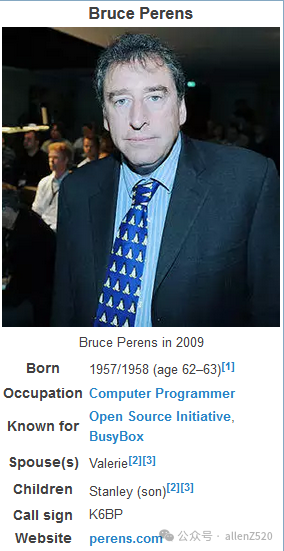
Extended Introduction: Perens was born with cerebral palsy and was misdiagnosed with developmental disorders during his schooling, and professors did not allow him to read.
04
—
Hardware Platforms
This illustration is from the Debian official website:
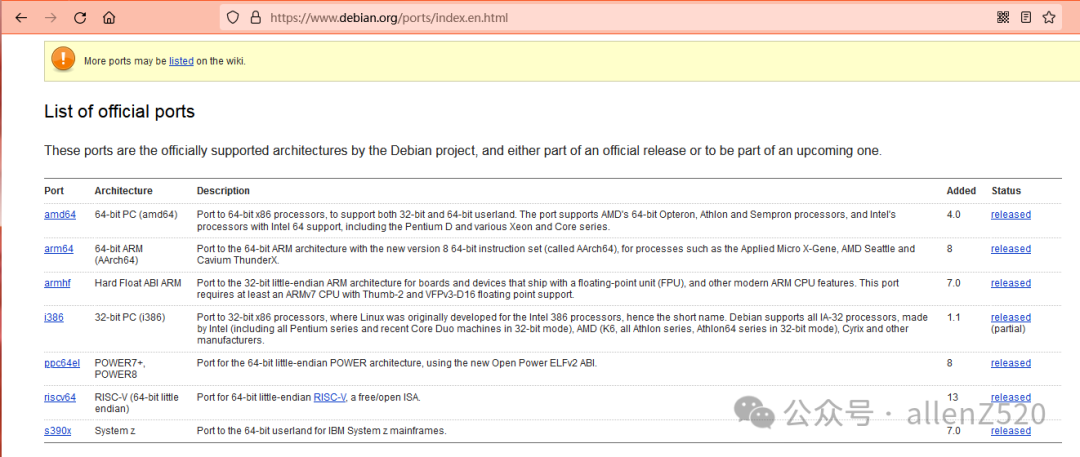
As can be seen:
-
Although it also supports Intel 64, the first supported architecture name remains “amd64.” This reflects the inherent “non-Intel-MS” characteristics of GNU/Linux distributions.
-
Both ARMv7 and ARMv8 (AArch64) architectures are supported.
-
The potentially popular RISC-V architecture is also supported.
05
—
Windows Support (WSL)
Starting from Win10 (2016), Microsoft provided WSL (Windows Subsystem for Linux), which can be used to provide Debian/Ubuntu subsystems.
The following content is from (Brendan Hesse, freelance columnist):
-
WSL is a natively accessible method (understood here as distinctly different from traditional Cygwin, Msys2, and other virtual environments).
-
Installing WSL takes no time (a few minutes).
-
WSL behaves like “bash for Windows,” running Ubuntu bash (the Unix shell introduced earlier) in the Windows platform’s PowerShell.
-
The almost sole benefit of WSL is that it is advantageous for developers (i.e., creating Linux software on the Windows platform). Therefore, WSL is a powerful development tool.
-
Since WSL is one of the Windows processes, it means that various Windows tools can still be used, and Linux processes can be terminated using task manager-like tools.
-
WSL does not support the GUI version of Linux by default; it is only a command-line environment (GUI software cannot be installed or run). Microsoft has no plans for official support of Linux GUI.
-
WSL can simultaneously use both Windows and Linux file systems.
-
WSL is neither an open-source project nor the Linux kernel; it is merely a framework from Microsoft.
Installing WSL will not be covered here; it can be easily searched online. Typically, it involves two steps: enabling WSL and downloading Linux (such as Debian or Ubuntu).
06
—
Conclusion
-
Following the development of the “mainline task” discussed above, this article introduced the Debian GNU/Linux OS.
-
Perens was the first to introduce the concept of “open source” into the Debian project (which allowed the project to gain revenue through donations and paid licensing).
-
It pointed out the scale of the Debian community and the special annual leader election mechanism. In the management of packages, the development method ensures the release of each package and system compatibility through “maintainers”.
-
It discussed the main online hardware platforms.
-
It briefly introduced WSL in Win10, including the main features of the GNU/Linux distribution subsystem, including Debian.