Imagine a football match where the participants are not players, but robots that rely entirely on AI intelligence, running autonomously and making decisions on their own—this is not science fiction, but a real demonstration recently held in Beijing, China. Let us take you into this sensational ‘Robot Football’ event that has captivated both the tech community and the public.
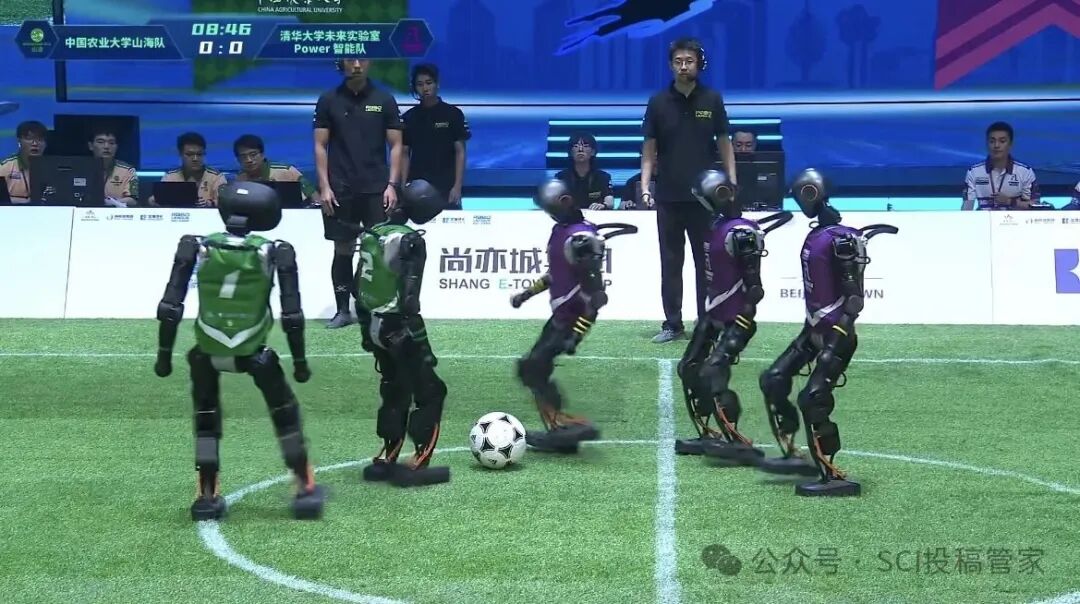
In a special event held in Beijing, four teams of humanoid robots engaged in an exciting 3v3 fully autonomous AI football match. The match was equipped with robot hardware provided by Booster Robotics, and each player on the field operated entirely on AI, without any human remote control or intervention, relying on AI for perception, judgment, and action execution.
-
Team Composition: Each team consists of three main robots and one substitute, playing two halves of 10 minutes each, with a 5-minute halftime break.
-
Perception Capabilities: The robots are equipped with advanced visual sensors that can identify spherical objects with over 90% accuracy from 20 meters away, as well as recognize teammates, opponents, goals, and field lines.
-
Technical Highlights: Not only can they kick and run, but they can also autonomously get back up after falling. While most robots successfully recover, some needed to be carried off the field by staff on stretchers, creating a scene that was both dramatic and real.
-
Final Score: The Tsinghua University THU Robotics team defeated the China Agricultural University ‘Mountain Sea’ team with a score of 5–3, claiming the championship.
Why Hold a Robot Football Match? This type of event is seen as an ideal testing ground for ‘AI + robotics’ technology. Cheng Hao, founder of Booster Robotics, stated that competitive sports can accelerate the collaborative optimization of perception algorithms, decision-making systems, and hardware platforms, laying the foundation for the safety and reliability of future robotic systems in real-world environments.
Event experts also pointed out that while robots are still not as agile as humans, their autonomy and technical complexity are continuously improving compared to traditional robot football events like RoboCup. Professor Subramanian Ramamoorthy from the University of Edinburgh remarked, ‘It is very encouraging to see how much progress the robots have made this year.’
Social Issue: How Safe is ‘Robots on the Field’?
For the future realization of ‘humans and robots competing together’, safety is a core topic. AI ethicists of the 21st century have long emphasized the potential for scenarios where machines and humans dance together, and such competitions serve as a testing ground for safety and trust. Cheng Hao candidly stated:
‘In the future, we may allow humans to compete alongside robots—this interaction must be absolutely safe.’The GuardianAP News
After the match, there were many excited and amazed voices among the audience, raising public awareness that robots are not just cold technological products, but social members that can be understood, accepted, and cared for.
#RobotFootball #ArtificialIntelligence #AI