Generative AI has entered the daily work and life of many people. Nowadays, with just a simple input on a computer, users can generate answers or media content to their questions or needs through DNN models (typically using a large language model, LLM). However, the drawback of this application scenario is the overly simplistic operation, where one output equals one input. To produce a more comprehensive answer or result, users may need to input multiple times, analyze each output, and summarize to obtain the final result. The continuous advancement of large language models seems to be limited by this singular application scenario.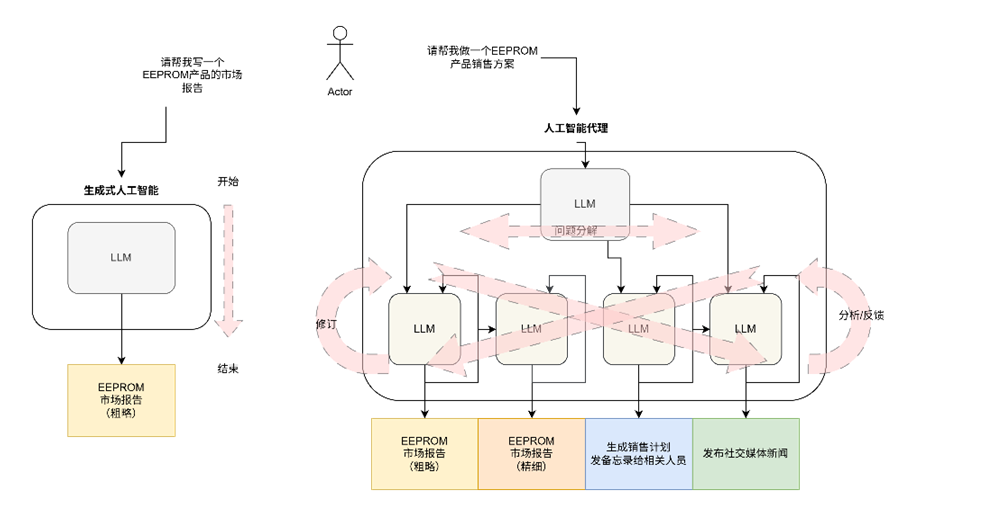
Figure 1 Generative AI vs. Agentic AI
The concept and research of Agents began in the 1990s, but before the widespread rise of LLMs, researchers were limited to using methods like Reinforcement Learning (RL) to explore the automation of intelligent Agents. Due to the limitations of RL algorithms in data efficiency, generalization, and complex problem reasoning, there have always been significant challenges in practical application scenarios. After the widespread rise of LLMs, research has shown that LLM-based Agents can leverage the rich internal knowledge acquired during LLM pre-training to effectively address these issues.
From Figure 1, we can see a simple framework of an Agent. The Agent can actively classify the output of the LLM through question categorization, perception, feedback, and revise and correct answers, executing specific tasks based on the results. It is evident that the Agent is a fully automated system based on artificial intelligence models, capable of perceiving the environment, decomposing questions, and logically analyzing to achieve decision-making and execution tasks. In this workflow, it can utilize various DNN or LLM models to achieve optimal decision-making and execution methods.
Currently, there is no precise definition for “artificial intelligence agents” in the industry. Dr. Andrew Ng, a globally recognized figure in the AI field, has provided four design patterns to distinguish AI Agents:
1.Reflection: The Agent can analyze its own outputs and identify areas for improvement.
2.Tool Use: The Agent can access and use tools to enhance its capabilities.
3.Planning: An intelligent entity capable of thinking ahead, considering multiple options, and making informed decisions.
4.Multi-Agent Collaboration: Multiple intelligent entities working together to solve complex problems.
To demonstrate the practical advantages of AI Agents, Dr. Ng’s team used an AI Agent based on GPT-3.5, which outperformed a generative AI based on GPT-4 in code generation applications. The industry generally believes that “AI Agents” represent a major direction for the future development of new applications for large language models (LLMs) and will drive further advancements in artificial general intelligence (AGI).
The rapid development of AI Agents has already begun to impact many people’s lives. Starting in 2025, some companies have introduced the concept of “digital workforce” in human resources. Marc Benioff, CEO of Salesforce, stated that the total addressable market for digital workforce could soon reach trillions of dollars. In the near future, companies must consider “hybrid” teams when planning work and teams, consisting of humans and their digital teammates (an emerging talent group). To maximize the potential of these new teammates, company leaders need to start developing entirely new operational plans and workforce strategies. This strategy will not only enhance efficiency but also bring about more scalable and flexible team collaboration methods.
PCM storage technology (including memory, CAM, and in-memory computing) has obvious advantages in AI applications based on Agents:
1) The upgrade of AI applications will no longer rely solely on the size of LLM models; the Agent architecture can utilize multiple smaller LLM models to perform better than a single large LLM model, leading to more diverse computing power requirements.
2) The scalability of AI Agents allows AI applications to be used in more scenarios, from small robots to large enterprise customer call centers. The computing power required for the LLM models used must be implemented through different levels of hardware, such as in-chip computing (CIM), which is an efficient and low-power processing unit. When the LLM architecture used by the Agent belongs to offline LLMs (with computing power within 100 TOPS), it can be achieved more efficiently through CIM.
3) AI Agents require new storage architectures for learning, which must provide a fast storage and retrieval mechanism for “long-term memory.” Intel’s Optane products based on PCM have already demonstrated the application of PCM in high-speed memory. Since PCM is a non-volatile memory (NVM), it can be used for long-term memory storage. Fast memory retrieval cannot rely on addressing methods to search through large amounts of storage; instead, it needs to use data relationships, employing Content Addressable Memory (CAM) to quickly find the storage areas associated with the current context and match the data within this smaller area.
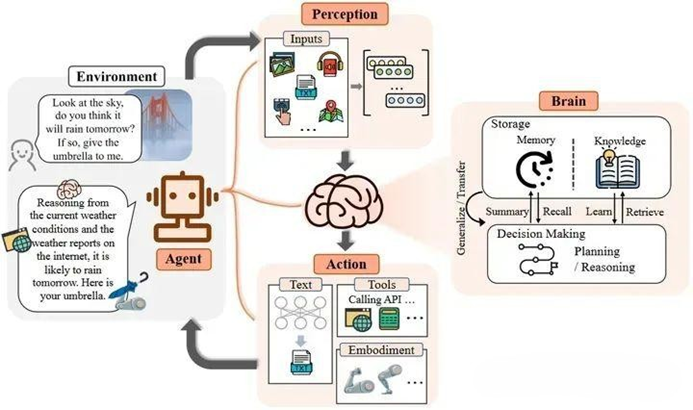
Figure 2 is a more detailed schematic diagram of the AI Agent architecture, showing that storage is a very important part of the Agent architecture. The main components of the Agent’s brain are DNN/LLM and the storage system.
Many believe that AI Agents will bring about the Fourth Industrial Revolution, significantly changing human society and the economy. The future proliferation of AI Agents will depend on and drive new semiconductor technologies and products, and the software stack used by Agents will require not only GPU/CPU but also other hardware technologies to provide more efficient computing and storage methods.
Notes:
1.https://www.andrewng.org/
2. https://www.forbes.com/sites/bernardmarr/2025/05/09/why-ai-agents-will-trigger-the-biggest-workplace-revolution-in-25-years/