(By Swetha Toshniwal, Senior Marketing Manager, Arm Automotive Division, and Robert Day, Marketing Director, Arm Automotive Division) The transformation of future mobility is not only disrupting the automotive industry but also intensifying the complexity of vehicles. AI-driven driving experiences, vehicle-to-cloud connectivity, and cloud-native development are reshaping the design, manufacturing, and experience of automobiles.
The rapid integration and continuous deployment of advanced software and AI capabilities in vehicles present numerous challenges for increasingly complex systems: how to ensure seamless integration, real-time performance, functional safety, and cybersecurity? Additionally, coordinating updates across different platforms, achieving cross-platform interoperability, and meeting global market compliance requirements add multiple layers of difficulty for automakers.
Recently, Arm launched the Arm Zena Computing Subsystem (CSS)—a transformative, pre-integrated, and pre-validated computing subsystem designed to accelerate the development cycle of AI-defined vehicles. As a key component in the automotive industry’s shift towards centralized computing architecture, Zena CSS supports large-scale deployment from smart cockpits to Advanced Driver Assistance Systems (ADAS), focusing on high performance, functional safety, and cloud-native readiness, helping automotive innovators create industry-leading driving experiences.
Zena CSS: A Platform Born for Collaboration
Zena CSS brings together a world-class ecosystem of partners—covering software, middleware, development tools, and AI—to help create the next generation of AI-defined automotive experiences. The Arm community collaborates to build a framework for cooperation, transforming vehicles into dynamic intelligent platforms through innovation breakthroughs, system interoperability, and scalability. With partners spanning the globe and various fields of expertise, the Arm ecosystem exemplifies the global nature of the automotive industry’s transformation. Meanwhile, Arm’s modular platform allows partners to flexibly customize innovative solutions based on regional regulations, market demands, and customer expectations.
Automotive Software Solutions Based on Zena CSS
Arm’s software partner ecosystem is showcasing how their solutions run on Zena CSS—leveraging virtual platform solutions for pre-silicon software development and building cloud-native development and collaboration frameworks based on the SOAFEE methodology. Typical application scenarios include over-the-air (OTA) updates, AI-defined driving experiences, enhanced infotainment systems, and safety-critical communication synchronization, all while ensuring compliance with industry standards and utilizing standardized DevOps frameworks.
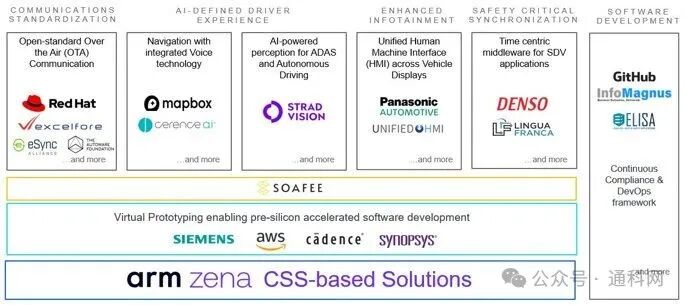
Collaborative Ecosystem Achieving Next-Generation AI-Defined Experiences on Zena CSS
Standardized Communication: Achieving Seamless OTA Updates
Automotive software must evolve continuously and securely. To this end, Arm’s partners, such as Amazon Web Services (AWS), the Autoware Foundation, the eSync Alliance, Excelfore, and Red Hat, are making this goal possible by advancing open OTA communication standards. Among them, Excelfore’s leading position in eSync OTA standardization, combined with Red Hat’s certified automotive operating system, provides automotive developers and manufacturers with a stable technological foundation, interoperability in an open ecosystem, and exceptional flexibility. Additionally, leveraging example applications from the Autoware Foundation’s “SOAFEE Open AD Kit Blueprint,” Arm successfully demonstrated how to develop and deploy autonomous driving software workloads in real-world scenarios.
AI-Defined Driving Experience
SAIC Motor, Mapbox, and StradVision are enhancing the in-vehicle user experience through their respective areas of expertise. StradVision provides lightweight, high-performance perception AI solutions, enabling real-time object detection and enhanced environmental awareness for driver assistance systems; Mapbox’s modular navigation SDK and API offer rich customization features, facilitating the creation of branded, map-centric interactive interfaces; and SAIC Motor focuses on intelligent natural language interaction, providing developers with a flexible multilingual voice platform deeply integrated with automotive functionalities. These technologies collectively build a scalable, developer-friendly foundation for creating intelligent, responsive, and user-centered automotive software on Zena CSS.
Enhanced In-Vehicle Infotainment (IVI) Systems
Panasonic Automotive Systems Co., Ltd. (PAS) has developed an application based on the VirtIO standard device virtualization framework to present a unified human-machine interface (HMI) across multiple displays in vehicles. This unified HMI is a display virtualization framework that abstracts the physical displays in the vehicle into virtual display resources, allowing applications to display content anywhere without being constrained by physical screens. As a SOAFEE blueprint solution, this framework has been open-sourced on Unified HMI GitHub (source code available here). This SOAFEE blueprint solution will be deployed on Zena CSS, providing strong support for enhanced IVI systems and smart cockpit applications.
Safety-Critical Synchronization
Denso demonstrated a time-centric middleware for modeling, developing, and runtime monitoring of software-defined vehicle (SDV) applications to ensure deterministic execution of workloads. This middleware uses an open-source time coordination language called “Lingua Franca,” which allows precise definition of application behavior through scheduling mechanisms and related time primitives. This solution has been released as a SOAFEE blueprint and, in conjunction with the Autoware Foundation’s open-source automated valet parking (AVP) application software, demonstrated this deterministic behavior in real-world scenarios. The AVP application itself is quite complex, requiring timely coordination among multiple distributed software workloads, all of which can stably run on Zena CSS.
Software Development Methodology
Arm is collaborating with GitHub and InfoMagnus to provide future-proof technological support for AI-defined driving experiences. These two partners will help ensure that every layer of the Zena CSS platform supports continuous evolution and AI-driven adaptability. Arm’s native GitHub runner, along with ongoing compliance integration with the ELISA project, provides software development teams with an end-to-end toolchain and compliance framework tailored for AI-defined vehicles.
SOAFEE: Cloud-Native Automotive Development Methodology and a Vibrant Collaborative Community
SOAFEE has entered its fourth year of development, with over 150 members, and has become a key industry collaboration initiative driving SDV development. By introducing core methodologies and technologies from the cloud-native domain, SOAFEE provides automotive software developers with opportunities to leverage mature and advanced technologies.
Within the SOAFEE framework, the SOAFEE blueprint program is a key initiative to accelerate this process. This program allows members to showcase applications or technologies running in the SOAFEE environment, helping developers quickly grasp how to utilize SOAFEE. Furthermore, this program promotes collaboration through the SOAFEE member system—many blueprint solutions are co-developed by multiple member organizations, fully embodying the spirit of ecological collaboration. The various automotive solutions detailed above are all demonstrated through the SOAFEE blueprint program, vividly illustrating this collaborative model.
Shifting Software Development Left: Initiating Zena CSS Development Early with Virtual Prototypes
Virtual platforms play a critical role in supporting the collaborative innovations showcased in the Zena CSS ecosystem. Arm, in collaboration with AWS, Cadence, Siemens, and Synopsys, has created a hybrid virtual prototyping environment that models Zena CSS and achieves equivalence of the instruction set architecture (ISA), enabling development teams to validate AI-driven workloads, simulate infotainment system interactions, and optimize system behavior before hardware is ready. This not only accelerates the integration process across the ecosystem but also encourages developers to adopt a “software-first” development model, ensuring that each component is production-ready, secure, and high-performing from the outset—even in the absence of physical chips. The various use cases mentioned earlier are being explored as potential validation cases on the Zena CSS virtual platform, vividly demonstrating how ecological technology can achieve integration and evaluation early in the development cycle.
Building the Future Together with Ecological Partners
The successful technical validation examples and application scenarios mentioned above are just the beginning, yet they clearly present the strong momentum generated by the ecosystem built around Zena CSS. As SDVs and AI-defined vehicles continue to evolve, Arm is committed to expanding the boundaries of collaboration—bringing in more partners, exploring new domains, and accelerating innovation in the automotive industry.
Arm is working with partners to build the next generation of AI-defined automotive ecosystems! Whether it is vehicle manufacturers, tier-one suppliers, software vendors, or developers, Arm collaborates closely with all parties to explore the Zena CSS virtual platform, linking the ecosystem to create validation solutions or building entirely new in-vehicle innovative applications from scratch.