According to a report from Electronic Enthusiasts Network (by Zhang Ying), the recent news of Xiaopeng Motors entering the RISC-V intelligent driving chip market has attracted industry attention, as Xiaopeng announced a recruitment demand for RISC-V architecture IP design engineers on its official website.Industry insiders believe that RISC-V, as a reduced instruction set architecture, with its customizable architecture and high configurability, is naturally suitable for resource-constrained embedded and control chips.From 2024 to 2025, a significant change is expected in the automotive MCU field, with multiple RISC-V architecture products entering the automotive MCU sector, including Microchip’s RISC-V architecture PIC64, Great Wall Motors’ automotive-grade MCU chip Zijing M100, and the latest EAM2011 automotive-grade MCU based on a self-developed RISC-V core launched by Beijing Yiswei Computing, which has passed rigorous functional design evaluations and product testing, obtaining the ISO 26262:2018 automotive functional safety product certification issued by the National New Energy Vehicle Technology Innovation Center, marking that this product meets the ASIL-B functional safety level requirements.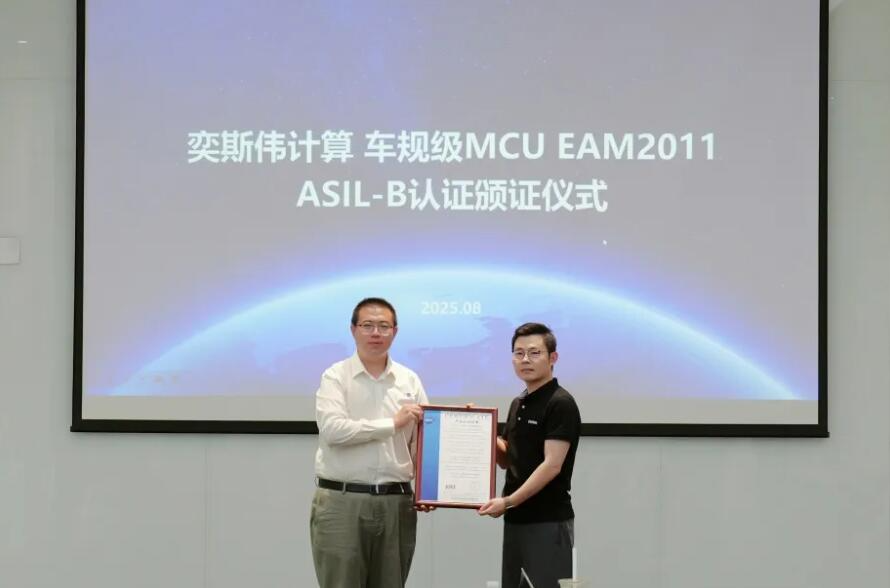 Image from Yiswei Computing’s official WeChatThis article focuses on the automotive chip field, specifically the RISC-V processors and automotive-grade MCUs, summarizing the latest products launched by companies such as Alibaba Damo Academy, Great Wall Motors, Xinlai Technology, Silergy, and Beijing Yiswei Computing.
Alibaba Damo Academy Reveals R908A Processor, Great Wall Motors Launches Zijing M100
With the acceleration of electrification and intelligence trends in the automotive industry, the unique advantages of RISC-V architecture in automotive electronics, including its openness, customizability, and rapid iteration capabilities, are of significant value in accelerating the localization of automotive chips. The customizability and openness of RISC-V enable it to accelerate the implementation of automotive AI platforms, gradually providing power for the future development of automobiles as AI large models are integrated into vehicles.On February 28, 2025, Alibaba Damo Academy announced at the 2025 Xuantie RISC-V Ecosystem Conference that the Damo Academy brand Xuantie will begin delivering the highest performance processor C930 in March. The C930’s general computing performance reaches 15/GHz on the SPECint2006 benchmark, with a 512-bit RVV1.0 + 8 TOPS Matrix dual engine, and opens up DSA expansion interfaces. This indicates that Chinese manufacturers have integrated general computing with AI acceleration natively, entering the high-end chip design camp, targeting high-performance application scenarios at the server level.Additionally, another significant announcement is that Damo Academy will launch a new family of Xuantie processors. The development plans for new members of the Xuantie processor family, such as C908X, R908A, and XL200, will continue to evolve towards AI acceleration, automotive applications, and high-speed interconnects.Damo Academy also disclosed the roadmap for three new products: C908X supports 4096-bit ultra-long data width, specializing in AI model training, directly competing with NVIDIA’s A100 and H100 series; R908A meets the high reliability requirements for automotive applications.On September 20, 2024, Great Wall Motors officially announced that its jointly developed RISC-V automotive-grade MCU chip—Zijing M100 has completed development and successfully powered on, marking the first automotive-grade chip in China developed based on the open-source RISC-V architecture, representing a new path for China’s automotive chips and promoting the process of autonomous and controllable automotive chips.
Xinlai Supports Silergy in Launching RISC-V Automotive-Grade MCU
On July 28 of this year, Xinlai officially announced that the domestic semiconductor company Silergy, China’s leading RISC-V processor core IP supplier Xinlai Technology, and Li Auto’s Xinghuan OS have jointly announced that their core product—the Silergy SA32D series automotive-grade MCU (based on Xinlai Technology’s NA900 series high-performance RISC-V CPU IP) has begun deep adaptation and optimization with Li Auto’s fully self-developed integrated operating system “Li Auto Xinghuan OS”.It is reported that Xinlai’s NA900 automotive-grade processor is the world’s first RISC-V CPU IP to pass ISO26262 ASIL-D product certification, and has been installed in Dongfeng Motor’s models.This time, the Silergy SA32D series (using Xinlai Technology’s NA900 series high-performance RISC-V CPU IP) is a 32-bit high-reliability automotive-grade MCU specifically designed for automotive three electrics, chassis, and body domain control applications.This product series has three core advantages: 1. Excellent reliability, strictly adhering to AEC-Q100 automotive certification standards, with outstanding ESD, EMC, and anti-interference capabilities, meeting the complex and harsh operational environment requirements of vehicles; 2. Strong real-time control: providing rich peripheral interfaces (CAN FD, LIN, UART, SPI, I2C, ADC, etc.) and high real-time performance (Xunlian architecture motor control IP), accurately controlling power distribution, energy management, and various actuators in the body domain (ZCU/BMS/EPS, etc.) and cockpit domain; 3. Focus on intelligent integration, this product integrates high-precision analog front-end and power management modules, forming a minimal system with Silergy’s already mass-produced ASIL-D PMIC chip, simplifying system design and improving energy efficiency.Dr. Peng Jianying, CEO of Xinlai Technology, stated that as the trend of automotive intelligence and electrification continues to deepen, the RISC-V architecture will bring more innovative possibilities to the industry, revolutionizing the automotive industry that requires flexible, open, and efficient computing with its open and flexible architecture, especially in terms of functional safety and information security, the customizable features of RISC-V enable it to quickly adapt to the evolving needs of automotive electronics.She also pointed out that the successful application of the Xinlai NA900 series IP on the Silergy SA32D MCU not only verifies that the RISC-V architecture fully meets the most stringent automotive requirements but also opens up a new path for the development of domestic automotive chips. In the future, both parties will continue to deepen cooperation to jointly promote the application of RISC-V in automotive electronics.Silergy’s chairman’s assistant and China market officer Xu Chaobing has stated that the rise of China’s new energy vehicles has brought tremendous opportunities for supply chain development. Based on the increase in end users of Chinese new energy vehicles in recent years, domestic OEMs have increased their market share. OEMs have significant choice in the supply chain, and it is noteworthy that domestic OEMs and local supply chains support each other.Silergy’s automotive chip business started in 2015, and by 2024, Silergy’s automotive chip business global market size is expected to reach $60 million, with automotive chip sales accounting for over 10% of the company’s total sales. In the medium to long term, the target revenue share of the automotive chip business is expected to be around one-third.
Yiswei Launches RISC-V Core Automotive-Grade MCU
Since its establishment in 2019, Yiswei Computing has positioned itself as a provider of “next-generation computing architecture chips and solutions based on RISC-V for the AI era,” focusing on data display interaction and computing connectivity as its core business direction, building a core technology base of RISC-V + AI, accumulating dedicated computing (DSC) capabilities in the RISC-V field, and focusing on smart terminals, smart vehicles, and smart computing scenarios to provide customers with innovative chips and solutions.Recently, at the AIoT conference held in Shenzhen, Yiswei Computing’s Chief Marketing Officer Liu Shuai stated that Yiswei Computing’s typical AIoT product solutions mainly include four categories, targeting personal, home, automotive, and industrial applications. Focusing on the intelligent cockpit domain, intelligent driving domain, and body control domain, Yiswei Computing provides global OEMs and component manufacturers with more reliable, safer, and smarter automotive chips and solutions.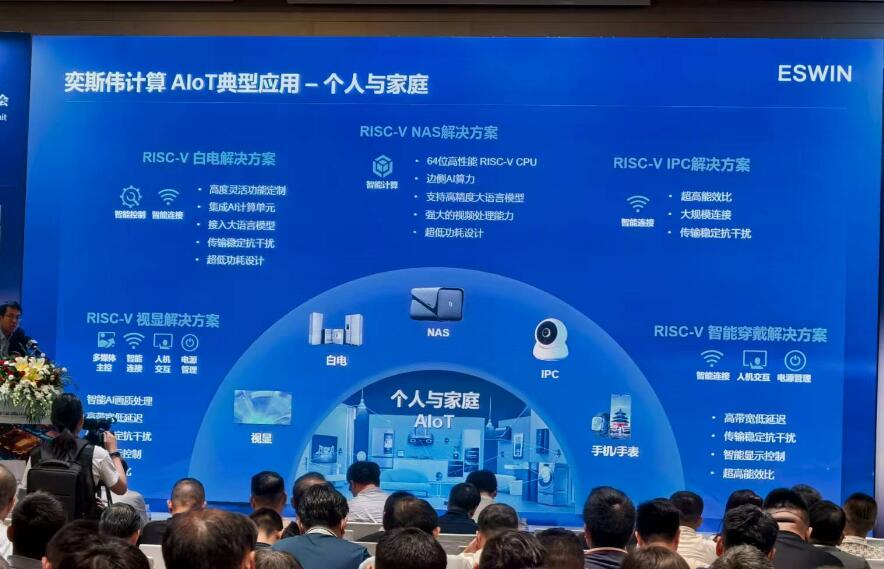 Yiswei Computing has launched the EAM2011, which is an automotive MCU based on a domestic process platform, using a self-developed RISC-V processor, and has a complete software ecosystem based on the RISC-V core. As a general-purpose automotive MCU, it supports multiple communication interfaces and has passed AEC-Q100 Grade 2 automotive certification. Recently, this product has obtained the ISO 26262:2018 automotive chip functional safety product certification issued by the National New Energy Vehicle Technology Innovation Center, indicating that this product meets ASIL-B functional safety level requirements.Yiswei introduced that the EAM2011, with its rich peripheral interfaces, high real-time control accuracy, strong fault tolerance and safety assurance, and lightweight AI applications, can be widely used in automotive intelligent control scenarios such as doors, windows, seats, electronic tailgates, body control, lighting control, air conditioning control, automotive instruments, and central control.Liu Shuai pointed out: “The Chinese new energy vehicle industry is booming, presenting a new industrial development opportunity for both China and the global market. We see opportunities for market growth. In the automotive and transportation fields, the company has a series of product layouts in the automotive sector, collaborating with leading customers, top domestic automotive brands, and leading Tier 1 suppliers, providing customers with RISC-V-based intelligent control solutions for CMS (automotive electronic rearview mirror systems), including AI seats and AI control for windows and doors. Additionally, Yiswei Computing has launched an integrated solution for vehicle-road-cloud based on the RISC-V instruction set architecture, and we have customized a RISC-V V2X chip with leading domestic customers.“
In Conclusion
Consulting agency SHD data shows that by 2025, global shipments of RISC-V chips will exceed 3 billion units, with a market size reaching the billion-dollar level. The RISC-V market in China is booming, and the penetration rate of RISC-V in the global chip market is rapidly increasing. Currently, there are over 40 billion chips with cores globally, and by 2025, RISC-V shipments are expected to reach 3 billion units, with a penetration rate approaching 10%. Based on this year’s development trend, by 2030, the penetration rate of RISC-V is expected to exceed 20%.Automotive-grade RISC-V chips are gradually increasing in volume. This year, Infineon launched a new automotive microcontroller based on RISC-V, while domestic chip companies Silergy, Great Wall Motors, and Beijing Yiswei have all launched automotive-grade MCUs, and in the future, automotive manufacturers and Tier 1 suppliers will have more suppliers and new product options.

Disclaimer:This article is original from Electronic Enthusiasts Network, please indicate the source above when reprinting. For group discussions, please add WeChat elecfans999, for submission of reports and interview requests, please send an email to [email protected].
More Hot Articles to Read
-
Huawei Breaks HBM Dependency! AI Inference Black Technology UCM Launches, Open Source in September
-
Known as the “BYD of the Robotics Industry”, Zhiyuan Secures Millions in Orders! Yushu Rushes for IPO!
-
For the First Time in History! AMD Server CPU Market Share Reaches 50%
-
General Motors: Hard to Bear High Tariffs, Buying Chinese Batteries Still Profitable
-
GPT-5 Shocking Release: A Major Leap in the AI Field
Click to Follow and Bookmark Us
Set us as a bookmark to not miss any updates!