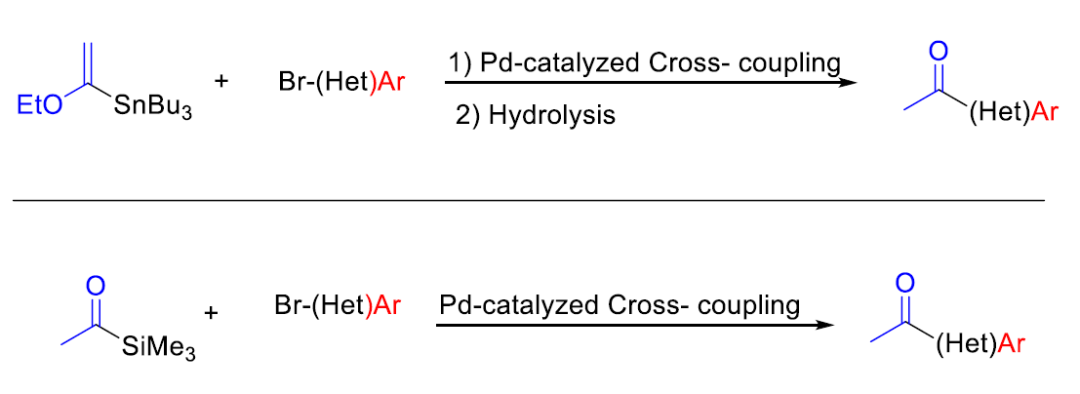
 Aryl methyl ketones are very useful organic synthesis intermediates. The traditional method introduces the acetyl group directly through Friedel-Crafts acylation, but this method requires an electron-rich aromatic ring to proceed smoothly. Another method involves the reaction of derivatives of aryl carboxylic acids (such as the commonly used reagent – Weinreb amide) with organometallic reagents to prepare aryl methyl ketones, but this method has low functional group tolerance.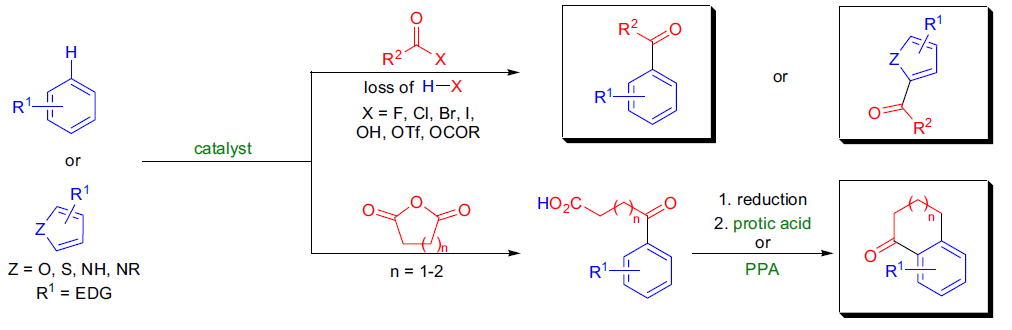
If aryl halides are used to prepare aryl methyl ketones, one can first insert a carbonyl to obtain aryl carboxylic acid derivatives, which can then react with organometallic reagents. Transition metal-catalyzed coupling reactions have also been developed, such as the Stille carbonylation coupling reaction, but this method uses CO as a substrate, is complex to operate, and both CO and organotin reagents are toxic. Another approach is to directly use the Stille coupling reaction, where aryl bromides react withtri-n-butyl(1-ethoxyethenyl)tinto obtain (1-ethoxyvinyl) aryl compounds, which can then be hydrolyzed to yield aryl methyl ketones.
Alternatively, one can use acyl chlorides and aryl tin reagents to perform the Stille coupling reaction to obtain aryl methyl ketones, but the aforementioned methods all involve toxic organotin reagents, which limits their application range.
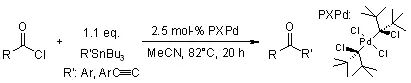 【 J. Org. Chem., 2005, 70, 8601-8604.】
Another method involves the Heck reaction, where aryl halides react with vinyl n-butyl ether to yield (1-n-butoxyvinyl) aryl compounds, which also require hydrolysis to obtain aryl methyl ketones. However, the Heck reaction has low reactivity, and many substrates do not achieve high yields.
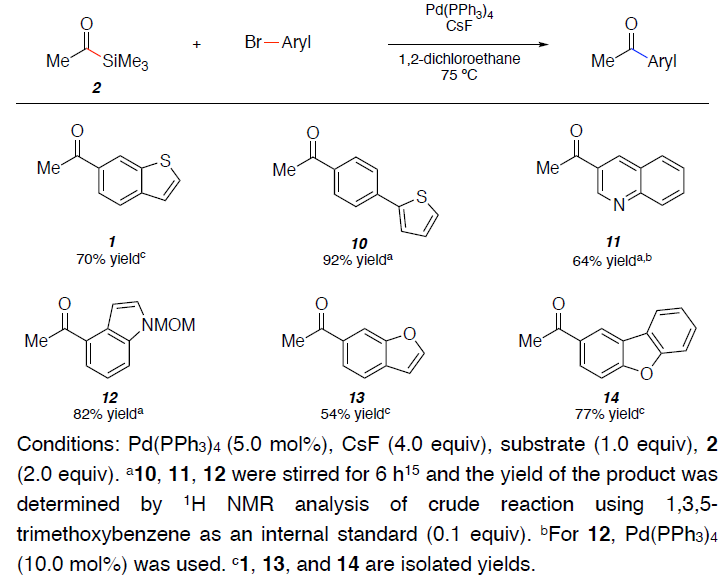
 Recently, Professor Neil K. Garg’s research group at the University of California, Los Angeles reported a method for the coupling of acetyltrimethylsilane and aryl bromides under palladium catalysis to obtain aryl methyl ketones in one step【Org. Synth., 2021, 98, 68-83】. This reaction is mild, environmentally friendly, low in toxicity, and has high functional group tolerance, allowing both electron-donating and electron-withdrawing aromatic rings to react smoothly. Heteroaryl bromides can also react.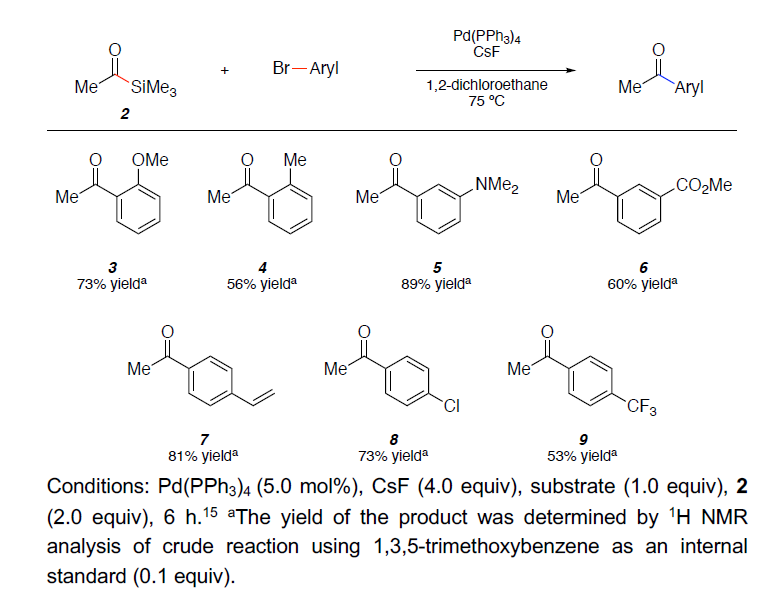
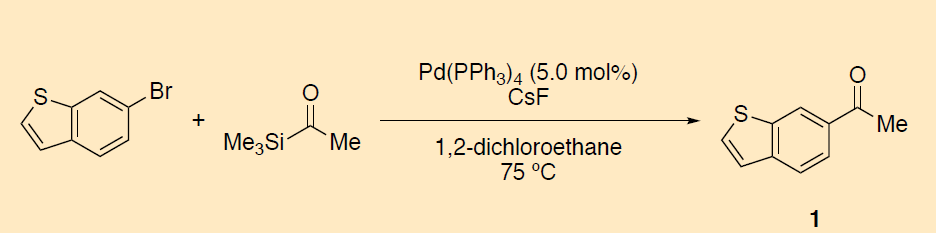
6-Acetylbenzothiophene (1). A single-necked (24/40 joint) 250 mL round-bottomed flask is equipped with a Teflon-coated magnetic stir bar (4.0 x 1.5 cm, football-shaped). The apparatus is flame-dried under vacuum, then cooled to 23 ºC under an atmosphere of argon (Note 2). The flask is charged sequentially with 6-bromobenzothiophene (8.00 g, 37.5 mmol, 1 equiv) (Note 3), cesium fluoride (22.8 g, 150 mmol, 4 equiv) (Note 4), and tetrakis(triphenylphosphine)palladium(0) (2.17 g, 1.88 mmol, 0.05 equiv) (Note 4) through the neck of the flask in singular portions. The neck of the flask is then fit with a rubber septum. An argon inlet needle and a purge needle are placed in the rubber septum, and the flask is purged for 5 min (Figure 1A). After 5 min, the vent needle is removed, and acetyltrimethylsilane (10.8 mL, 75 mmol, 2 equiv) (Note 5) is added in one portion over 1 min via a plastic syringe fit with an 18 G x 1.5’’ needle. 1,2-Dichloroethane (38 mL, 1 M) (Note 6) is then added to the flask via a plastic syringe fit with an 18 G x 6’’ needle in a single portion over 1 min (Figure 1B). The rubber septum is quickly removed and replaced with a separately flame-dried air condenser with a 24/40 joint (Note 7). The reaction apparatus is then placed in an oil bath preheated to 75 ºC. The reaction mixture is stirred vigorously (800 RPM) for 24 h under positive argon pressure (Figure 1C).
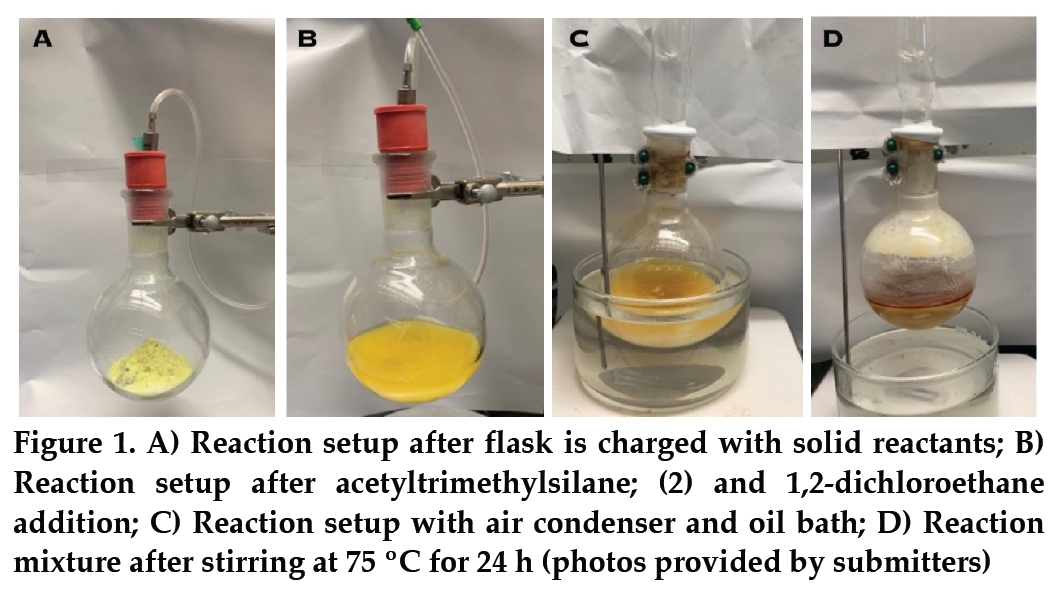
After 24 h (Note 8), the reaction flask is removed from the oil bath and
allowed to cool to 23 ºC (Figure 1D). Once the reaction mixture is cooled to 23 ºC, the reflux condenser is removed, and the heterogeneous mixture is diluted with heptane (75 mL) (Note 9). The solution is then filtered through a plug of silica gel (50 g, pre-wetted with 100 mL ethyl acetate) (Note 10) in a fritted Büchner funnel (Note 11) into a 1000 mL round-bottomed flask using ethyl acetate as eluent (500 mL) (Notes 12 and 13). The filtrate is then concentrated under reduced pressure (31 °C, from 100 mmHg to 50 mmHg).
The resultant brown solid is purified via column chromatography using
an OD 7.5 x 12 cm column of 250 g silica gel (Note 14) and eluted sequentially with 1400 mL 14:1 heptane:EtOAc and 2000 mL 9:1 heptane:EtOAc. The eluate is collected using 25 mL test tubes to provide the product in fractions 78–106 (Note 15). The fractions are combined in a collection flask and concentrated by rotary evaporation under reduced pressure (31 ºC, 90 mmHg). The material is then transferred to an 8-dram vial and dried under high vacuum for 30 min (<1 mmHg) to afford 6-acetylbenzothiophene (1) as a yellow powder (4.15 g, 63% yield) (Notes 16, 17 and 18).
References
Org. Synth.2021, 98, 68-83; DOI: 10.15227/orgsyn.098.0068