Emerging memory manufacturers are no longer solely emphasizing the potential of MRAM and ReRAM to replace existing memory technologies; instead, they are focusing more on highlighting their reliability in specific applications and environments.
MRAM manufacturers Everspin Technologies recently announced the launch of a new MRAM product that meets the AEC-Q100 standard; meanwhile, Weebit Nano has completed the ReRAM module’s AEC-Q100 150°C operational certification.
AEC-Q100 is a standard established by the Automotive Electronics Council (AEC) to create a universal component certification and quality system standard for automotive electronic products, which also includes a set of certification testing processes for integrated circuits (IC).
Everspin’s latest high-reliability discrete MRAM products expand its PERSYST EMxxLX series, adding two new models—EM064LX HR and EM128LX HR. These two products have an operating temperature range of -40°C to +125°C, making them very suitable for automotive applications, while also meeting the growing demand for durable high-speed memory in aerospace, defense, and extreme industrial environments.
In an interview, Everspin’s Senior Marketing Director Joe O’Hare stated that, in addition to the automotive industry’s demand for reliable memory devices that can withstand extreme temperatures, the rapid deployment of low Earth orbit (LEO) satellites is also driving the demand for MRAM, as these satellites also require memory that can cope with extreme operating conditions (including radiation resistance).
He pointed out that Everspin’s PERSYST MRAM has a history of application in critical storage applications for nearly twenty years due to its excellent durability and reliability, and it is the fastest MRAM within its temperature range. Its 64Mb and 128Mb capacities are particularly suitable for mission-critical systems. O’Hare also added that Everspin has been producing memory that meets the AEC-Q100 standard for nearly 15 years, and PERSYST MRAM is currently the highest density product offered by the company.
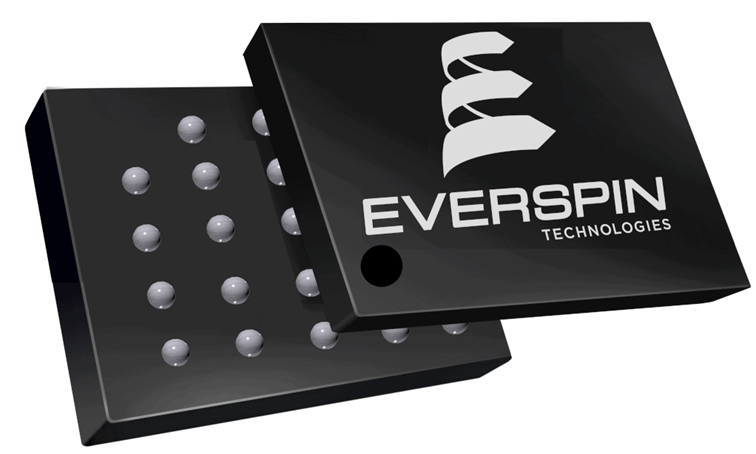
MRAM manufacturers Everspin Technologies recently announced the launch of a new PERSYST MRAM product that meets the AEC-Q100 standard.(Source: Everspin)
O’Hare stated that the most likely replacement for MRAM is NOR flash memory, as the latter has encountered bottlenecks in further expansion or providing higher density. In contrast, MRAM offers faster write speeds, thereby reducing system overhead in real-time applications, and has a simpler structure.
He also added that the current focus of MRAM is to try to fill the gaps in non-volatile memory applications. Although AEC-Q100 certification has been recognized by the automotive industry, Everspin is more focused on applications in space exploration—these customers are driving the specifications for the latest generation of PERSYST MRAM products. “Frankly, our level of involvement in the space sector is even higher than in the automotive sector,” O’Hare said.
Additionally, he mentioned that from a capacity perspective, the market has seen a turnaround, with technological feasibility now in place, and there is also emerging demand from aerospace and military sectors.
Meanwhile, Weebit Nano is focusing on the automotive market, positioning its embedded ReRAM as an alternative to NOR flash memory. The company recently completed the ReRAM module’s AEC-Q100 150°C operational certification using the 130nm CMOS process adopted by semiconductor manufacturer SkyWater Technology.
Weebit Nano’s Vice President of Marketing and Business Development Eran Briman stated in an interview that JEDEC has established corresponding standards for non-volatile memory at different temperature grades and durability levels, but in the automotive sector, AEC-Q100 is regarded as the gold standard. Weebit Nano has set a “mission overview” for its ReRAM products that covers all application scenarios in automotive environments.
He stated that the motivation for pursuing AEC-Q100 certification lies in the fact that, compared to IoT and other connected devices (which typically use processes ranging from 28nm to 16nm), automotive companies are progressing faster in the required process nodes. Briman stated that the adoption rate of automotive MCUs is particularly rapid. “When the process reaches 28nm and below, traditional flash memory alternatives will become unfeasible.”
He also pointed out that embedded non-volatile memory can serve multiple markets, but currently, the demand for process nodes in the automotive industry is the most clear. Briman added that as long as it meets the requirements of the automotive industry, it means that the memory can also meet the demands of other application areas such as consumer electronics, industrial, and IoT.
He stated that the opportunities for ReRAM in the automotive sector mainly lie in the trend of software-defined vehicles, which require regular wireless updates. “It’s like a mobile PC with powerful processing capabilities.” Briman added that these frequent updates require non-volatile memory with higher durability to support them.
Objective Analysis’s Chief Analyst Jim Handy stated in an interview that reliability is crucial for automotive memory customers. “But the question is, are they willing to pay a higher price for greater reliability?” he asked.
He pointed out that in most cases, from a cost perspective, NAND flash memory remains the optimal choice. However, if MRAM can achieve multi-source supply, it will also become a viable alternative to NOR flash memory. Handy stated that for MRAM to break into the automotive market, it still faces challenges, “Currently, the number of MRAM suppliers remains limited.”
He added that aerospace applications not only value the reliability of MRAM, but also its radiation resistance; while ReRAM also has high reliability and performs well under extreme temperatures.
Handy pointed out that the significant opportunity for automotive memory lies in the various MCUs widely used in modern vehicles. “Reducing the sensitivity of these MCUs to temperature changes will be key.”
He believes that Weebit Nano is in a more advantageous position in the ReRAM field because it has multiple technology licensors and licenses the relevant technology to foundries that are manufacturing microcontrollers.
Handy concluded that the challenges faced by emerging memory are consistent: while they are technically superior to existing solutions, the cost of existing technologies is lower. “The biggest challenge for these emerging memory technologies is whether they can at least match the cost of competing technologies.”
(Editor: Franklin)