Click the blue text to follow us
When it comes to popular majors for college entrance exams, computer science majors are definitely among the top choices. With the advent of the Internet of Things and the 5G era, computer science majors are becoming increasingly popular.
What majors are included in computer science? How are the various majors structured? What are the employment prospects? What jobs can graduates do? This article compiles relevant information for parents and students to reference!
Introduction to Computer Science Majors
The computer science major is a broad category that includes: Computer Science and Technology, Software Engineering, Network Engineering, Information Security, Internet of Things Engineering, Digital Media Technology, Intelligent Science and Technology, Spatial Information and Digital Technology, Electronic and Computer Engineering, Data Science and Big Data Technology, Cyberspace Security, New Media Technology, Film Production, Confidentiality Technology, Service Science and Engineering, Virtual Reality Technology, Blockchain Engineering, Cryptography Science and Technology, totaling 18 majors.
01Computer Science and Technology
Overview:This major is the most fundamental within the computer science category, focusing more on theoretical and software design research. It includes a significant number of mathematics and basic computer courses, such as Mathematical Analysis, Discrete Mathematics, Modern Algebra, Introduction to Computer Science, Microcomputer Principles, etc. This also means that the employment or further study directions afterward will be relatively broad, allowing for careers in research or as programmers, essentially anything is possible.
This major has a high requirement for mathematics and is suitable for students interested in computer learning and development, who are good at logical reasoning and analysis.
Future Development:This major will continue to have a high demand in society in the short term, with a broad job market outlook. As the number of computer science graduates increases, employment competition will become more intense, and the increasing selection options for employers will lead to higher requirements for graduates. This major is suitable for further studies.
02Software Engineering
Overview:Unlike Computer Science and Technology, which requires knowledge of both hardware and software, the Software Engineering major primarily focuses on software-related work, such as the development and maintenance of applications. Although this major may not have as high a requirement for mathematics, being good at math is a fundamental skill for an excellent software engineer.
It involves programming languages, databases, software development tools, system platforms, standards, design patterns, etc. Typical software includes email, embedded systems, human-computer interfaces, office suites, operating systems, compilers, databases, games, etc.
Disciplinary Requirements:This major has a high requirement for mathematics and is suitable for students interested in software learning, research, and development, who love software applications.
Future Development:In addition to pursuing graduate studies at prestigious universities, the main employment destinations for graduates are computer software companies, information consulting firms, and other wholly-owned or joint venture enterprises in finance.
03Network Engineering
Overview:This major primarily involves designing, developing, and solving problems related to network systems. Besides traditional IT companies, many graduates from this major also work in the IT departments of non-IT companies, such as network design, optimization, and maintenance in banks or financial companies. Network engineering is somewhat related to network management or data center work, which is a relatively lower-end position. It differs somewhat from the common perception of programmers.
For example: designing and developing corporate websites, maintaining game servers, troubleshooting network failures (e.g., inability to connect to the network), handling trojans and other network viruses, etc.
Disciplinary Requirements:This major has a high requirement for computer knowledge and is suitable for students interested in network engineering and who love communication fundamentals.
Future Development:Network engineering is a national strategic project. Network engineers say that network security issues relate to national security and social stability. In today’s rapidly developing network information technology, the importance of network security is increasingly magnified, and addressing existing security issues has become very urgent. Its importance is growing as the pace of global informationization accelerates. From a micro perspective, network security relates to the development of an organization. In enterprises and institutions, whether it is research data, financial data, or even human resources data, all need to be processed through computer networks, especially with the promotion of office automation. Many tasks in enterprises and institutions have become inseparable from networks, but networks cannot exist without security support. Once security issues arise, the consequences can be very serious. In network engineering, the application of security technology occupies a very important position.
04Information Security
Overview:As the name suggests, this major is primarily responsible for ensuring user information security on online shopping and social platforms. Therefore, in addition to mathematics and basic computer courses, the curriculum also includes courses related to cryptography, security authentication technology, firewall principles, etc. This is an interdisciplinary field that intersects computer science, communication, and mathematics. Besides internet companies, similar industries such as Huawei, mobile, Unicom, and electric power are also quite relevant. Overall, employment prospects are very good, especially in many medium to large companies where demand is very high.
For example: building computer firewalls, designing intrusion detection systems, detecting and analyzing network viruses, developing antivirus software, monitoring and troubleshooting internal networks, and discovering and fixing software vulnerabilities, etc.
Disciplinary Requirements:This major has a high requirement for mathematics and is suitable for students with a strong mathematical foundation and practical skills.
Future Development:In today’s rapidly developing network information technology, information security has become crucial. It has become a hot topic in information science. China is still at a relatively low starting point in information security technology, with very few higher education institutions offering “Information Security” majors, leading to a severe shortage of information security technology talent. Graduates from this major can engage in research, design, development, and management of various information security systems and computer security systems in government agencies, national security departments, banks, finance, securities, and communication fields, or work in IT fields.
05Internet of Things Engineering
Overview:This major requires a good foundation in mathematics and physics. The Internet of Things refers to the internet that connects everything, such as ride-hailing, online shopping, and QR code payments, which are all applications of the Internet of Things. Future applications like AI assistants and smart communities also fall within this category. The Internet of Things, cloud computing, and big data are recognized as the representative technologies of the third wave of informationization. Although the Internet of Things Engineering major has only started enrolling students since 2010, with the development of 5G, the future demand for this major will certainly be very large, with excellent development space.
Interconnectivity:Connecting the physical world and the information world.
For example: online searching and listening to music on NetEase Cloud Music, searching for various products on the Taobao app, uploading video and image data from personal computers to Baidu Cloud, etc.
Disciplinary Requirements:This major has a high requirement for mathematics and physics and is suitable for students interested in the theory and application of the Internet of Things and who are enthusiastic about internet technology.
Future Development:Graduates mainly work in enterprises and industries related to the Internet of Things, engaging in the design, development, management, and maintenance of communication architecture, network protocols and standards, wireless sensors, information security, etc. They can also work in universities or research institutions for research and teaching.
06Digital Media Technology
Overview:Digital Media Technology is a multidisciplinary field that combines digital technology, media, and art design. It emphasizes creativity and utilizes media technology to conduct research and creation in areas such as games, mobile internet, interactive entertainment, and film animation. It focuses on cultivating high-level application-oriented professionals who can skillfully apply modern computer technology to engage in digital media production, graphic image processing, animation design, etc. Digital Media Technology is an interdisciplinary field that intersects digital technology, media, and art design.
For example: scene design for animations, character design, game programming, VR technology development, etc. Compared to Digital Media Art, Digital Media Technology leans more towards programming development, while Digital Media Art focuses more on artistic design.
Disciplinary Requirements:This major has a high requirement for mathematics and is suitable for students interested in the research, development, and application of digital media, with strong logical thinking abilities.
Future Development:The application of digital media is no longer limited to the media industry. It can be applied in various fields such as market promotion in retail, diagnostic image management in the pharmaceutical industry, data management in manufacturing, video supervision management in government agencies, multimedia distance education in the education sector, wireless content distribution in the telecommunications industry, and customer service in the financial industry. Currently, Fortune 500 companies globally have applied digital media technology to varying degrees in advertising and corporate collaborative work management.
07Intelligent Science and Technology
Overview:This major can be understood as focusing on artificial intelligence. The future prospects for the development of artificial intelligence are well known. In addition to mathematics and computer-related courses, this major also includes specialized courses such as artificial intelligence, brain science, machine learning, and human-computer interaction, with a relatively heavy course load. Additionally, this major is still in its infancy both domestically and internationally, so many specialized courses will use English textbooks, requiring students to keep pace with the times and learn cutting-edge technologies.
This major involves robotics technology, intelligent systems based on next-generation network computing, micro-electromechanical systems (MEMS), and various intelligent technologies and systems closely related to the national economy, industrial production, and daily life, as well as next-generation human-machine system technologies.
For example: artificial intelligence, VR technology, intelligent robots, human recognition, motion-sensing games, autonomous driving technology, etc.
Disciplinary Requirements:This major has a high requirement for mathematics and is suitable for students interested in computer technology and passionate about studying intelligent science.
Future Development:Undergraduates in this major can apply for master’s degrees in related fields such as artificial intelligence, computer science and technology, software engineering, pattern recognition and intelligent control, control engineering, etc. Graduates can engage in research, design, development, and technical management in fields such as intelligent manufacturing technology, intelligent network technology, intelligent detection technology, intelligent robots, intelligent transportation, and intelligent monitoring, or engage in teaching and research in intelligent science and technology and related disciplines.
08Spatial Information and Digital Technology
Overview:Currently, the Spatial Information and Digital Technology major in China mainly has two connotations: one is the (geographical) spatial information and mathematical technology pioneered by Wuhan University, which studies remote sensing, geographic information systems, and conducts digital, networked, visualized, and intelligent management of urban information, such as GPS technology and digital maps on mobile phones;
The other is the technology offered by Xi’an University of Electronic Science and Technology, which focuses on outer space spatial information, such as satellite communication and lunar exploration projects. Although these two models share the same major name, the content of study is vastly different.
Graduates from this major can engage in research, design, and manufacturing of information and communication systems, digital land, and digital cities. They can work in government management departments, military economic scientific research departments, and are employed in domestic IT companies, telecommunications operators, and research institutions, which differ slightly from the more familiar roles of programmers.
Disciplinary Requirements:This major has a high requirement for physics and mathematics.
09Electronic and Computer Engineering
Overview:This major is a special program established by the Ministry of Education, combining electrical engineering and computer science, primarily focusing on modern electronics, automatic control, electronic engineering, and software development for intelligent devices, with very good development prospects. It integrates software design and hardware design, combined with power electronics. Students need to master the basic theories and technologies of modern electronics, automatic control, power engineering, and computer technology, and can engage in the development and design of modern electronic systems, process control, software and hardware development for intelligent devices, and design of power electronic systems.
For example: research and development of industrial equipment control systems, design of automatic door control systems, circuit design for computers and other electronic products, etc.
Disciplinary Requirements:This major has a high requirement for physics and mathematics.
Future Development:The electronic information industry is currently one of the fastest-growing fields both domestically and internationally. In the strategic plan for scientific and technological development aimed at the 21st century, the development of electronic and information technology has been prioritized.
Graduates have a wide range of employment opportunities, not limited by industry, and in recent years, graduates have consistently ranked among the top in national talent demand, with an employment rate exceeding 90%.
10Blockchain Engineering
Overview:This major is an emerging field urgently needed for national strategic development. First, blockchain is a term in the field of information technology.
Essentially, it is a shared database where the data or information stored within has characteristics such as “non-falsifiable,” “traceable throughout the process,” “publicly transparent,” and “collectively maintained,” with broad application prospects.
From a technical perspective, blockchain involves many scientific and technological issues, including mathematics, cryptography, the internet, and computer programming.
From an application perspective, simply put, blockchain is a distributed shared ledger and database characterized by decentralization, immutability, traceability, collective maintenance, and public transparency.
It requires the ability to design and implement blockchain systems, manage and implement blockchain projects, and conceive, design, implement, and operate systems in enterprise and social environments, playing an innovative linking role in the fields of blockchain project system design and development, blockchain project management, and blockchain system services.
Future Development:Graduates can work in IT companies, financial institutions, government agencies, and related enterprises and institutions, engaging in blockchain engineering technology, application design, and operational management.
11Service Science and Engineering
Overview:The Service Science and Engineering major is a product of the interdisciplinary integration of software engineering, computer science and technology, management science, and socio-economics, focusing on cultivating compound service innovation talents. Graduates mainly find employment in the IT field, financial institutions, and service-oriented manufacturing enterprises, with good employment prospects.
12Confidentiality Technology
Overview:This is a modern confidentiality technology discipline based on computers and networks, primarily training professionals with a foundation in computer and network knowledge, mastering confidentiality technology, confidentiality management, and confidentiality law, capable of engaging in research on confidentiality science and technology, developing confidentiality products, providing confidentiality technology education and training, and confidentiality technology protection.
Disciplinary Requirements:This major has a high requirement for computers.
Future Development:It mainly targets positions related to confidentiality technology in government agencies, large and medium-sized state-owned enterprises, military industrial units, and high-tech enterprises.
13Virtual Reality Technology
Overview:This is a new practical technology developed in the 20th century. Virtual reality technology encompasses computers, electronic information, and simulation technology, with its basic implementation method being computer simulation of virtual environments to provide an immersive experience. Virtual reality technology is an important direction of simulation technology, integrating various technologies such as computer graphics, human-computer interface technology, multimedia technology, sensing technology, and network technology. It is a challenging interdisciplinary frontier discipline and research field. Virtual reality technology (VR) mainly includes aspects such as simulated environments, perception, natural skills, and sensing devices.
14Data Science and Big Data Technology
Overview:This major primarily studies knowledge and skills related to computer science and big data processing technology, analyzing and solving practical problems from the three main aspects of big data applications (i.e., data management, system development, and massive data analysis and mining).
For example: Baidu on mobile matches personal preferences through algorithms, Taobao recommends products based on consumer purchasing behavior data, and electronic maps plan optimal routes for vehicles based on past traffic data.
15Cyberspace Security
Overview:This major is newly added, focusing on all security issues faced in cyberspace, including network complexity, the broad scope of information involved, hidden connectivity, and hidden correlations. It aims to cultivate professionals with solid foundational theories and basic technologies in cyberspace security, mastering knowledge in information content security, network security law, and network security management, with strong political ideology and good communication and writing skills in both Chinese and English.
For example: preventing cybercrime, maintaining national cybersecurity, developing antivirus software and other security products, and regulating the online world.
Disciplinary Requirements:This major has a high requirement for computers.
16New Media Technology
Overview:New Media Technology refers to media means based on modern digital technology, network technology, and communication technology, capable of providing users with the information services they need. It mainly cultivates high-level, innovative, and compound talents with professional technical knowledge in communication studies, computer science, artificial intelligence, big data, and media technology, aimed at meeting the application needs of new media and content industries.
After learning and training, graduates can work in various media units related to the media industry, engaging in media data mining, intelligent communication, digital product development and program design, content creation, production, and operational management.
For example: emotional computing in social media, public opinion monitoring, news recommendations, etc. In the media industry: data mining and analysis, technology development and program design, content creation, production, and operational management.
17Film Production
Overview:This undergraduate program is the standard major in film studies, learning the entire process of making a film: planning, screenwriting, shooting, cinematography, art, music, post-production, production, cinematography, editing, art, sound recording, etc. It emphasizes cultivating students’ ability to comprehensively utilize various knowledge, skills, and tools for audiovisual artistic expression and storytelling.
For example: making movies, TV shows, micro-movies, and creating online short films, with opportunities to become a film director, film agent, etc.
18Cryptography Science and Technology
Overview:This major is strategically emerging to meet the needs of building a strong cryptography nation, ensuring national political security, economic security, and national defense security, and accelerating the cultivation of high-level cryptography talent.
Employment Directions for Computer Science Majors
Computer science belongs to the high-tech industry, aligning with the direction of economic transformation, offering relatively high salaries compared to other industries, and experiencing faster growth, making it favored by many college students and parents.
Additionally, due to regional influences, over half of the professionals in computer science in Beijing, Shanghai, and Guangdong have a monthly salary exceeding 10,000.
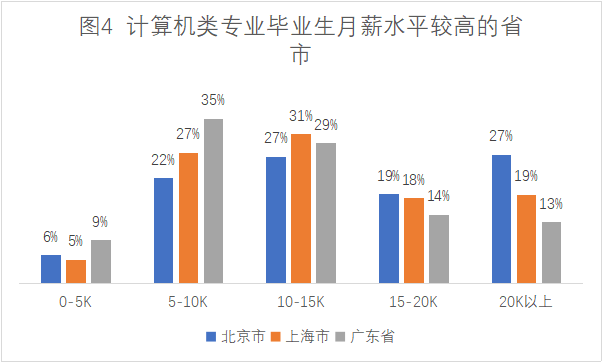
Currently, computer science majors in China are mainly divided into three categories: basic computer majors, computer majors intersecting with science and engineering, and computer majors intersecting with liberal arts and arts.
01Basic Computer Majors
Characteristics:Students are required to master basic theories and application development technologies in computer science, possessing a certain theoretical foundation while also having strong practical skills.
Employment Directions are mainly divided into the following categories:Hardware Engineer, PCB Engineer, FPGA Engineer, IC Engineer, Desktop Application Engineer, Network Application Engineer, Front-end Developer, Web Front-end (H5 Front-end), Android, iOS, Back-end Developer, Test Engineer, Architect, Deep Learning.
Employment Prospects:Can work in enterprises and institutions, government departments engaged in computer applications and the development and maintenance of computer network systems.
02Computer Majors Intersecting with Science and Engineering
➤ Mathematics and Applied Mathematics Major
Characteristics:This major serves as the foundation and platform for computer science, closely linked to computer science and technology.
Employment Prospects:Wide employment opportunities, applicable not only in the IT field but also in mathematics.
➤ Automation Major
Characteristics:This major integrates multiple fields of automatic control, serving as a core major in industrial manufacturing..
Employment Prospects:Strong employment foundation and advantages.
➤ Information and Computing Science Major
Characteristics:This major is formed by the intersection of information science, computational mathematics, operations research, and control science.
Employment Prospects:Employment opportunities cover teaching, business, network development, software design, etc.; employment rate exceeds 95%.
➤ Communication Engineering Major
Characteristics:Students are required to master basic theories and fundamentals of communication, as well as communication technologies such as microwave, radio, multimedia, and electronic and computer technologies.
Employment Prospects:Has significant advantages in the information age.
➤ Electronic Information Engineering Major
Characteristics:This major trains high-level IT talents in information technology, electronic engineering, and network system integration.
Employment Prospects:Can engage in research, design, manufacturing, application, and development of electronic devices, information systems, and communication systems.
03Computer Majors Intersecting with Liberal Arts and Arts
➤ Computer Art Design Major
Characteristics:Students are required to master the basics of art design and computer knowledge, proficiently using computers for advertising design, product modeling design, interior and exterior decoration design, and television 3D animation production.
Employment Directions:Can work in design departments, advertising companies, decoration companies, internet companies, software companies, animation companies, enterprise advertising departments, and schools, engaging in art design planning and production, computer painting, animation production, web design, and daily maintenance and management of computer systems.
➤ Web Design Major
Characteristics:Follows the development of the times, characterized by contemporary features.
Employment Prospects:Has a significant market demand in the internet era.
➤ Film and Animation Design Major
Characteristics:This major primarily studies the foundational knowledge and theories required for creating two-dimensional animations in film and television, receiving practical training in animation design, animation techniques, and animation production.
Employment Directions:Graduates can engage in original animation creation, animation design, advertising design, software development, film and television program production, and can also work in media design, management, and business.
➤ Environmental Art Design Major
Characteristics:This major is a creative discipline based on artistic modeling ability, using decoration and architecture as design references.
Employment Directions:Engaging in the design of living environments and commercial environments, as well as other related work in environmental art design and construction.
Shandong Examination Information Network
A one-stop multi-path higher education service platform
If you have questions about undergraduate comprehensive evaluation, strong foundation programs, research studies,
sports single enrollment, specialized single enrollment comprehensive evaluation,
graduate studies, etc., you can add the teacher’s WeChat for consultation.

Disclaimer: The above text and images are for sharing purposes, and the copyright belongs to the original author and source. If there are any infringements, please contact us promptly, and we will correct, delete, or handle it according to the law.