Abstract
This best practice utilizes the zData X appliance to run the MogDB database. The zData X configuration is 2 (compute nodes) + 3 (storage nodes) + 1 (management node), and MogDB is version 3.0.2. By executing TPC-C benchmark tests, simulating hard disk failures, and performing out-of-the-box deployments, tests were conducted to validate performance, availability, and usability:
-
The BenchmarkSQL based on TPC-C benchmark was used to test the performance of MogDB deployed on zData X compared to local disk deployment under the same test model. The results show that zData X outperforms local disk RAID10 and RAID6 storage modes, with a maximum performance improvement of 76% compared to RAID6.
-
In terms of high availability, zData X supports a three-replica mode, tolerating any two nodes failing simultaneously. During the disk removal simulation for hard disk failure, no data loss occurred, business was uninterrupted, and data quickly reconstructed to the three-replica high availability state.
-
Regarding ease of use, zData X provides quick installation deployment tools and unified system management capabilities, including the MogDB database.
ENMOTECH1. Testing Environment1.1 MogDB Database
MogDB is an enterprise-level relational database enhanced and launched by Cloud and Enmo based on the openGauss kernel. This product features financial-grade high availability, extreme security with full encryption computing, extreme performance for multi-core processors, and extreme intelligent capabilities for AI self-diagnosis and optimization, capable of meeting enterprise-level business needs from core transactions to complex calculations. The tested MogDB version 3.0.2 integrates all features of openGauss version 3.0.0, with enhancements in compatibility and functionality.
1.2 zData X Appliance
The zData X appliance is an integrated operating platform for databases that combines high-performance computing, high-performance distributed storage zStorage, RoCE network, and database management software. This product supports various types of commercial, open-source, and domestic databases, including Oracle, MySQL, PostgreSQL, MogDB, Dameng, Renmin University of China Golden Warehouse, openGauss, etc., and can be configured as needed to meet performance, reliability, and scalability requirements for different scale databases, suitable for core database performance acceleration and multi-heterogeneous database storage resource pooling deployment scenarios. This test used H3C UniServer R4900 G5 servers with dual CPUs totaling 48 cores. zData X fully utilizes the hardware multi-core advantages by binding CPU access objects, optimizing the memory access mechanism, and adopting a lock-free design to reduce lock contention and queuing overhead.
The hardware configuration details are as follows:
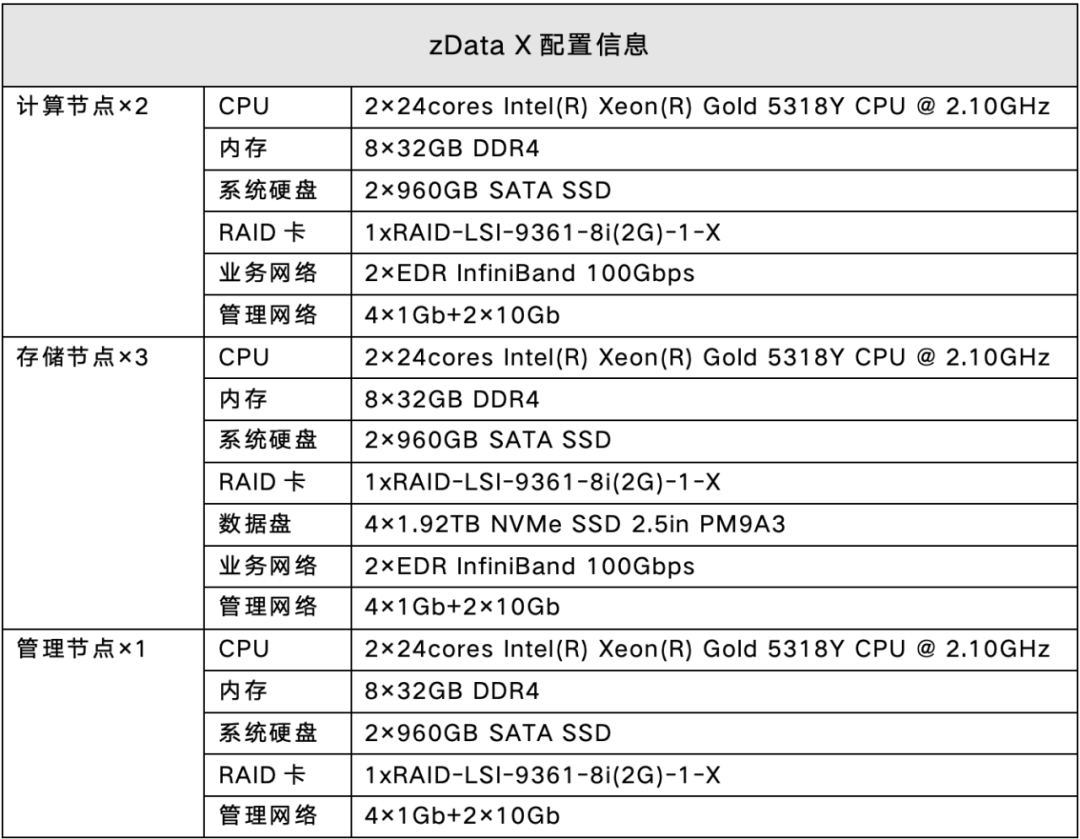
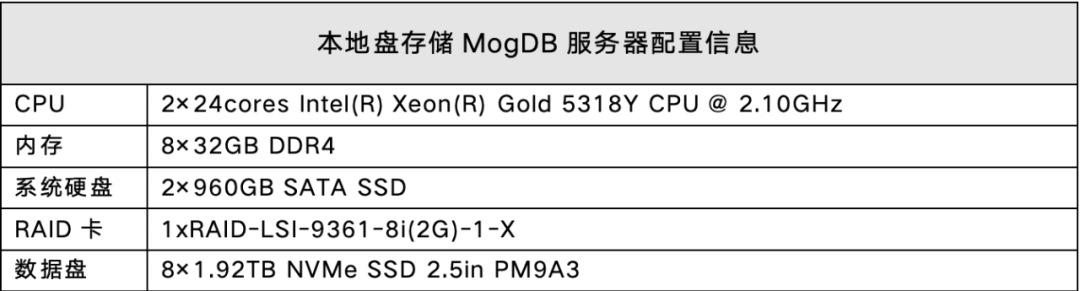
Since zData X uses a distributed storage architecture at its core, when comparing with local disk deployment mode, it is essential to select the same model of hard drives and the same available storage capacity to ensure comparability. Specifically, zData X has 3 storage nodes, each with 4 data disks, and in a three-replica mode, the available capacity is 4×1.92TB; while the local disk storage uses 8 data disks in RAID10 with the same available capacity of 4×1.92TB.
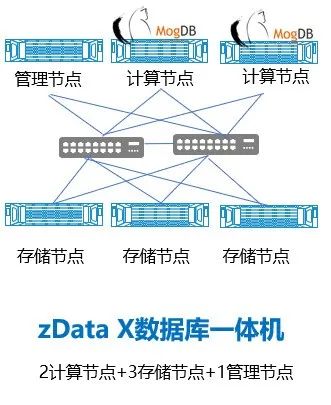
1.3 Test Networking
ENMOTECH2. Performance Comparison: MogDB on zData X vs. Local Disk Deployment
The tests used BenchmarkSQL based on TPC-C to simulate generating a data volume of 1000 warehouses, comparing the tpmC performance of MogDB 3.0.2 deployed on zData X in three-replica storage mode with that of MogDB 3.0.2 local disk deployment in RAID10 and RAID6 modes (both based on the same model NVMe SSD).
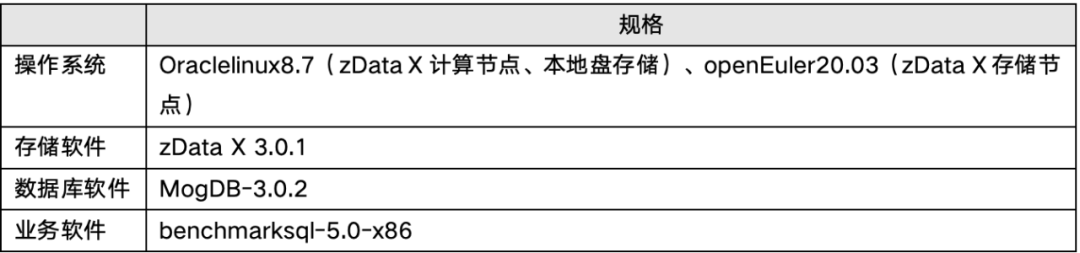
The software versions used in this test are as follows:
2.1 TPC-C Performance Test Comparison
- Using the BenchmarkSQL tool, generate a data volume of 1000 warehouses, testing the data issued by simulating business under the zData X compute node and local disk storage environment. The MogDB database has fsync and synchronous_commit enabled.
- Check the storage node binding cores, replica strategy, and multipath strategy of zData X, as well as the RAID strategy of the other environment, ensuring no degradation.
- After running for 5 minutes, by modifying the terminals value, test the performance under different concurrent access pressures, with tests conducted under 32/64/128/256 concurrent groups for tpm values.
The test results are as follows:
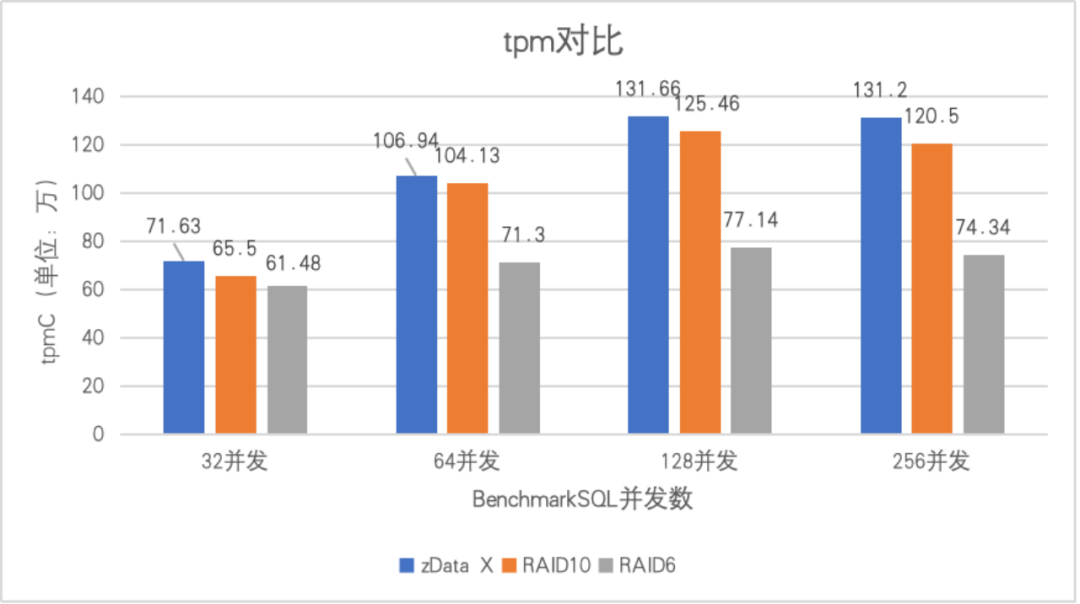
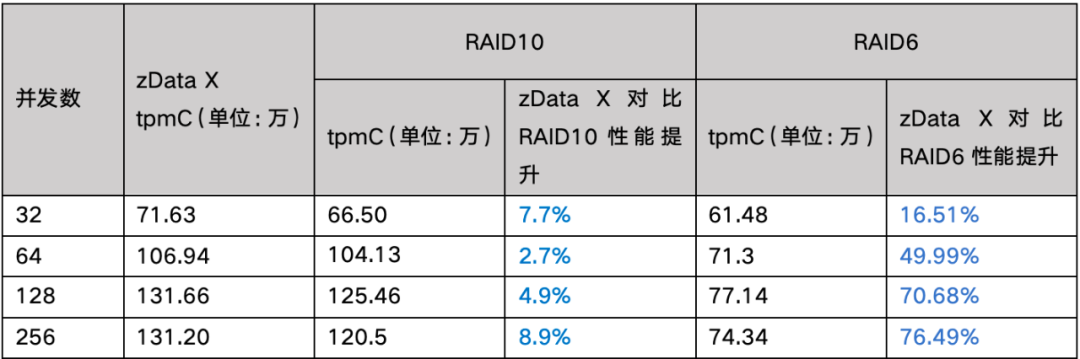
The data comparison shows that as the number of users increases, the tpm values under different storage models all show an increasing trend, but after reaching a certain threshold, they no longer increase and may even slightly decrease. Under the same testing method and hardware configuration, the three-replica storage performance of zData X is better than that of local disk RAID10 and RAID6 tpmC performance. zData X has slightly higher performance than traditional RAID10, and the maximum improvement over traditional RAID6 is 76%.
ENMOTECH3. Simulating Hard Disk Failure to Test System Reliability and Data Availability
The zData X configuration used consists of 2 compute nodes, 3 storage nodes, and 1 management node. The setup shows that the compute nodes, storage nodes, switches, and storage heartbeat links are all fully redundant designs, with no single point of failure.
In the three-replica mode used by zData X, compared to RAID10 and RAID6, the three-replica data not only supports the maximum loss of two disks without data loss but also supports the maximum failure of two nodes without business interruption, making availability relatively higher than that of local disk deployment. zData X also supports two-replica mode, where users can choose the replica redundancy mode and security level as needed when creating storage pools.
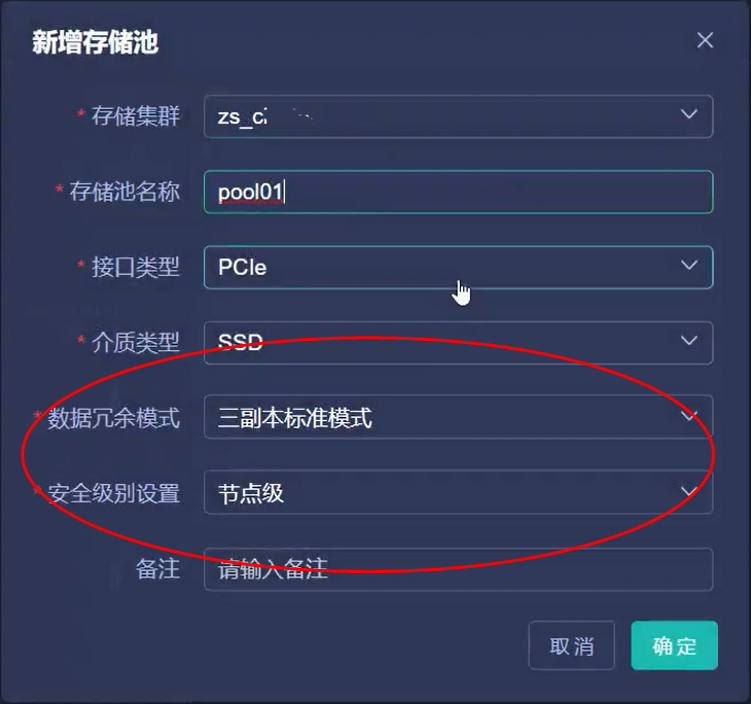
Additionally, the fast reconstruction of data based on the distributed storage of zData X provides an extra layer of assurance on data availability. By simulating a hard disk failure through disk removal, the data reconstruction of zData X can be tested.
- On zData X 3.0.1, divide 4 volumes of 1TB each, using the fio tool to sequentially write all volumes to full.
- Remove one hard disk from the storage pool, and after waiting 15 minutes, data reconstruction can be observed to begin (the default repair wait time for the reconstructed hard disk is 15 minutes).

The reconstruction speed can be seen at 4.38GB/S, with both the progress and speed of reconstruction visually displayed in zData X. During the simulation process, the default value of the reconstruction parallelism parameter for zData X 3.0.1 storage pool did notchange, which is set to 12 subprocesses by default. This can be maximally set to 31, meaning that the more reconstruction subprocesses, the faster the reconstruction speed. Once reconstruction is complete, zData X restores to the highest availability guarantee mode of three-replica data.
ENMOTECH4. Validating Installation Deployment and System Operation Management Usability from Out-of-the-Box
The installation and deployment steps for zData X and MogDB are as follows:
- Hardware Deployment: Complete hardware setup, followed by initializing settings for hardware IP, ports, time, etc.
- The management node system installation only requires configuring partitions and networks, installing zData X management software and related components, while other settings are already configured by default and do not require further setup.
- Subsequently, all installations and deployments are carried out using the zData X web page, which can guide the deployment of compute nodes, storage nodes, manage switches, initialize storage, set storage pools, install the MogDB database, etc.
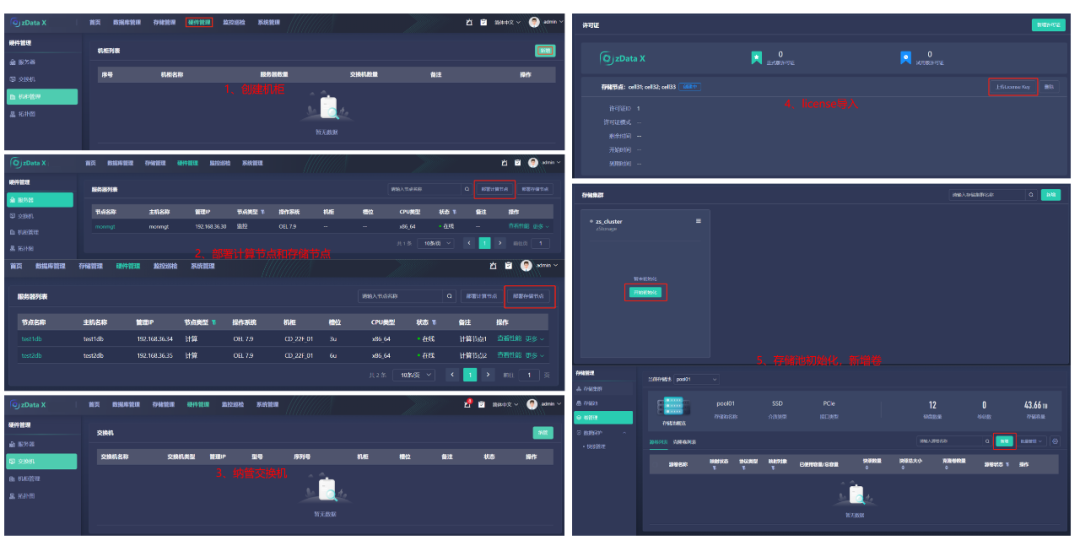
The entire deployment process is guided by a wizard. Taking path management services as an example, after the deployment of compute nodes is completed, zData X will automatically scan disks, generate multipath configuration files, refresh multipath configuration, and automatically check the number of volume mappings and multipath configuration status.
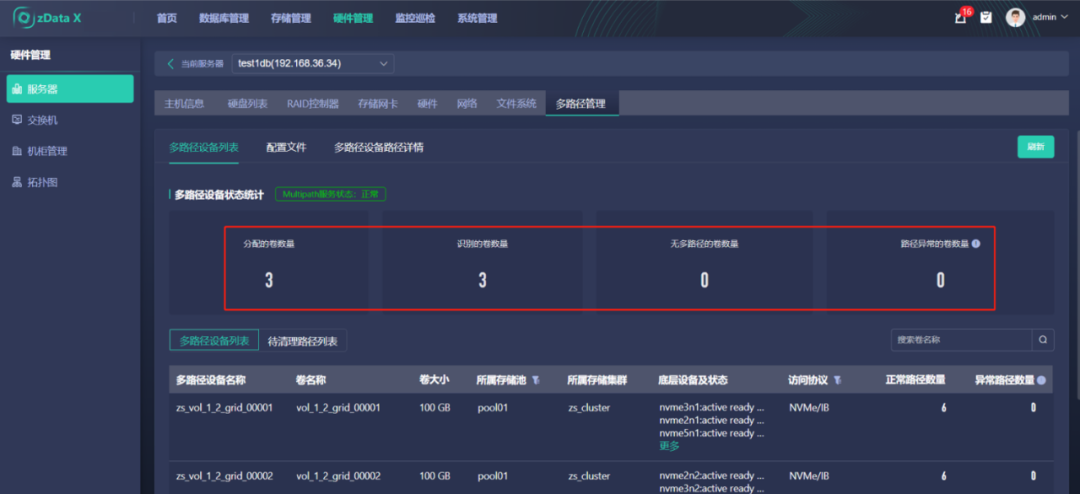
Once installation and deployment are complete, unified management of hardware and software can be performed, including storage resource, database, and service allocation, as well as permission management.
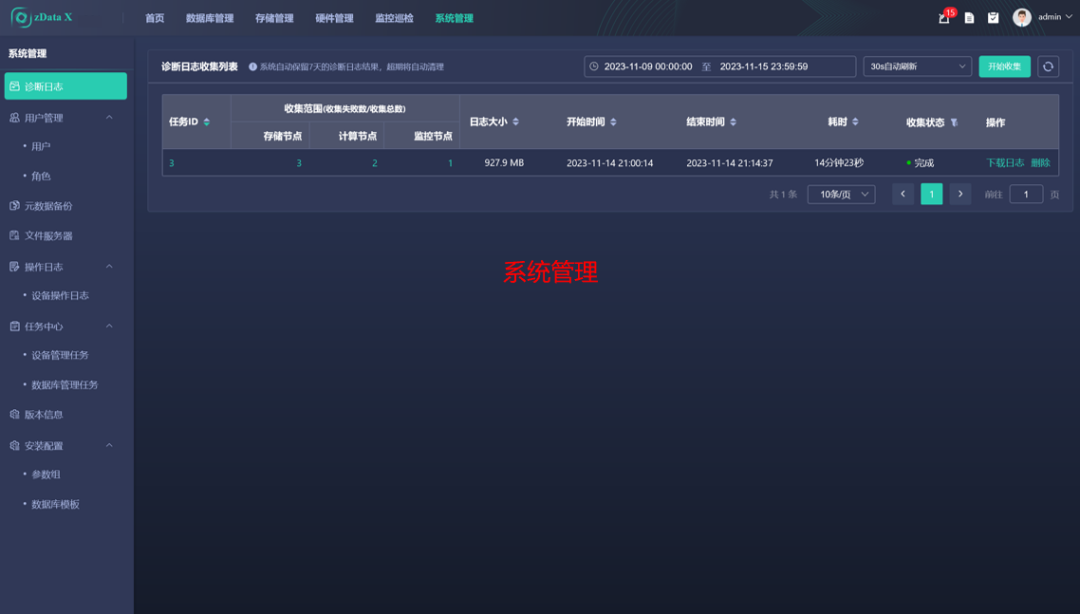
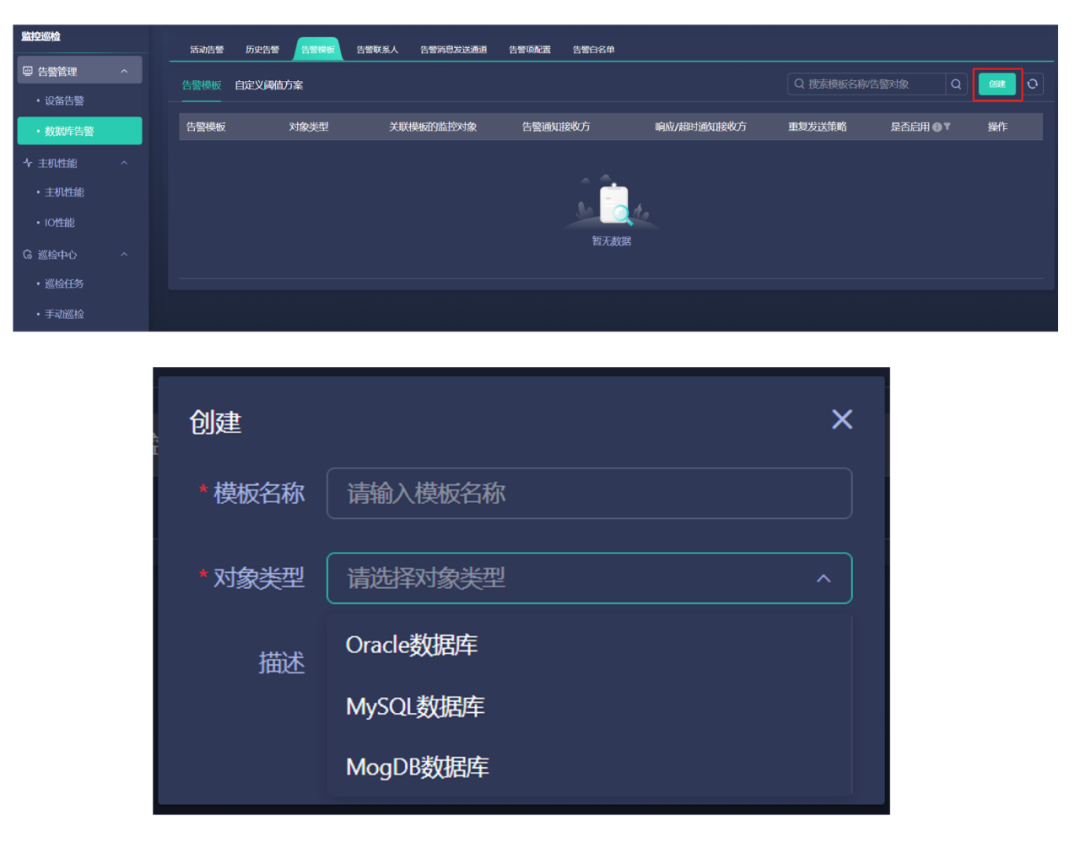
zData X also provides operational management capabilities for databases. In terms of database monitoring, the monitoring scope of zData X includes devices, host performance, and I/O performance, supporting users in setting alarm templates. After deployment, zData X will automatically add nodes and objects to the template object, and different databases also have corresponding alarm templates. Users can create corresponding templates based on the type of database currently installed, adjust the threshold for monitoring items in the template, and the alarm method, and simply add existing databases. Users can choose predefined alarm items that the system already has or custom add alarm indicators.
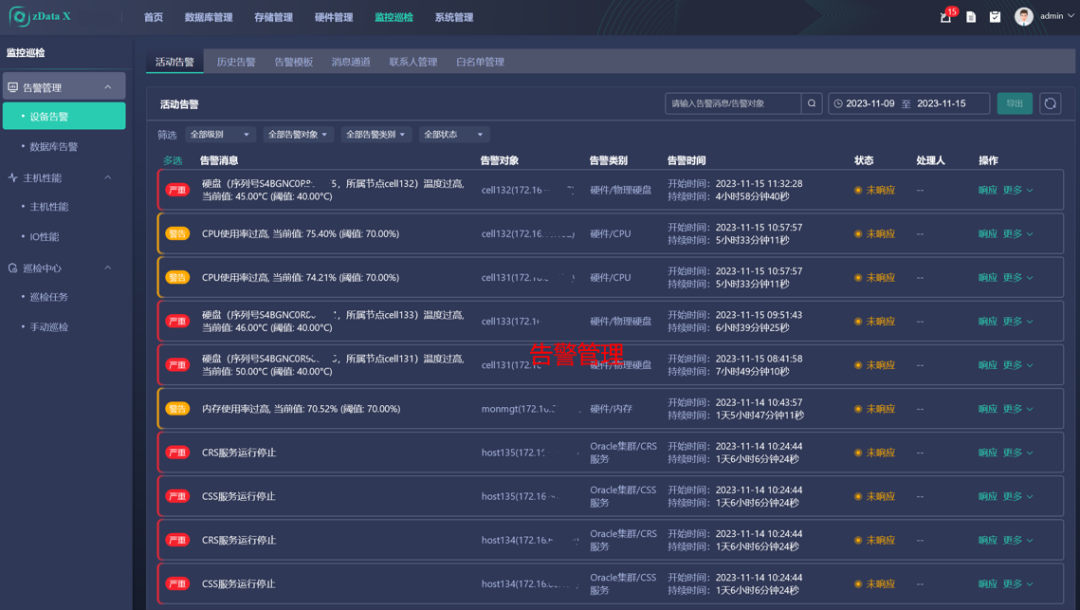
Alarm information is displayed centrally, and by clicking on the alarm information, deep issue drilling can be performed without needing to switch pages back and forth.
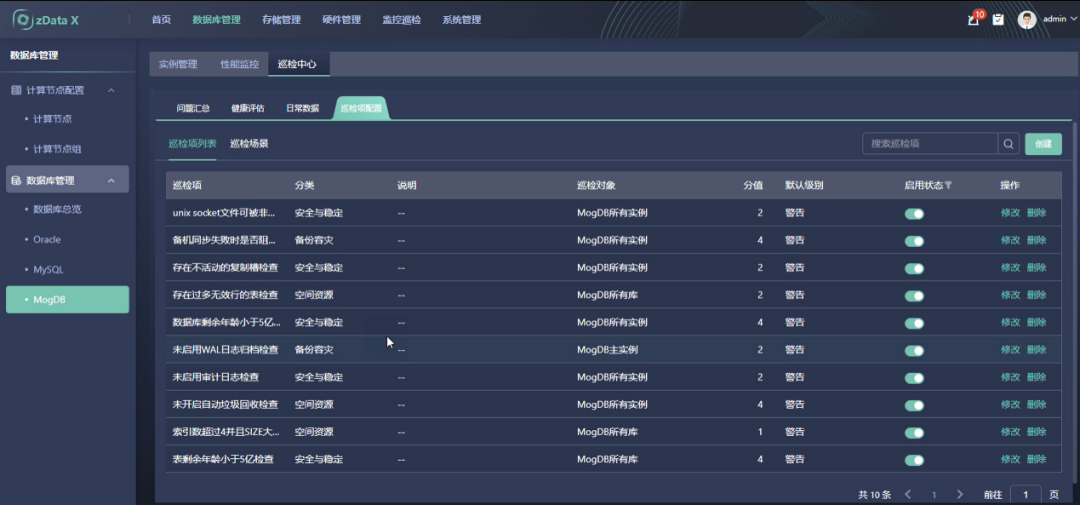
The inspection part can be set for manual or automated inspection, and zData X also has preset inspection items and supports exporting inspection reports. Automated inspection can set the inspection cycle to regularly perform health checks for the database.
Data-driven, achieving the future, Cloud and Enmo, living up to expectations!
Cloud and Enmo was founded in 2011 with the mission of “Data-driven, achieving the future” and is an intelligent data technology provider. We are committed to bringing data technology to every industry, every organization, and every individual, building a data-driven intelligent future.
Cloud and Enmo provides reliable products, services, and solutions in data carrying (distributed storage, data continuous protection), management (database infrastructure software, database cloud management platform, data technology services), processing (application development quality control, data model control, digital transformation consulting), and application (data service management platform, data intelligent analysis and processing, privacy computing) across various fields, continuously creating value for customers around user needs, stimulating data potential, and striving for an agile and efficient digital world of the future.