 Shenzhen’s 3D printers are rapidly capturing the global consumer-grade 3D printing market.According to the latest analysis by market intelligence firm CONTEXT, entry-level 3D printers performed exceptionally well in the first quarter of 2025, with global shipments exceeding 1 million units, a year-on-year increase of 15%, and Chinese suppliers accounting for 95% of the global shipments of entry-level printers in this quarter.Among them,Creality’s sales fell by 3%, but it remains the market leader with a market share of 39%;Bambu Lab showed the best growth, with shipments increasing by 64% year-on-year. Additionally, Flashforge and Elegoo also achieved strong growth.3D printing is not a new concept; it originated in the United States in the 1980s.In 1983, American engineer Charles Hull invented the world’s first 3D printer, and three years later, he founded 3D Systems and launched the world’s first commercial 3D printer, the SLA-250.For decades, 3D printing primarily served fields such as aerospace, medical, and industrial design, with machines costing tens or even hundreds of thousands of dollars, complex to operate, and the market was almost entirely dominated by European and American manufacturers.It wasn’t until 2005 that a British scholar initiated the RepRap project, releasing a fully open-source 3D printer design, giving people the first opportunity to print a part or toy on their desktop.European and American companies also began to launch more affordable desktop 3D printers, reducing prices from hundreds of thousands to tens or even thousands of dollars.However, at the same time, European and American companies realized that in the desktop 3D printer market, the deciding factors were no longer just technology, but hardware costs and supply chain efficiency. Entrepreneurs in Shenzhen keenly captured the opportunity in the desktop 3D printing market and quickly rose to prominence, establishing a foothold globally.
 Shenzhen’s 3D Printing Expedition TeamIn 2013, four young individuals, Chen Chun, Ao Danjun, Liu Huilin, and Tang Jingke, met at a 3D printing exhibition in Shenzhen. At that time, the desktop 3D printer craze had just begun, but the equipment was still expensive and the user experience was average.That was the “golden age” of hardware entrepreneurship in Shenzhen. Thanks to the highly concentrated electronic manufacturing supply chain in the Pearl River Delta, entrepreneurial teams could experiment with lower costs and faster paces.The following year, they rented a 20-square-meter office in Longhua, Shenzhen, and founded Creality, aiming to make 3D printers as easy to use and popular as 2D printers.It was in this 20-square-meter office that they developed their first printer, the CR-3.However, what truly made Creality famous was the CR-10 released in 2016. This printer had a large print size of 300 x 300 x 400 mm, but was priced at around $500, making it extremely cost-effective at the time, quickly gaining popularity in Europe and America and opening the door to the global market.In 2018, Creality launched the Ender-3, further lowering the price to around $200, which is still regarded as an iconic product in the 3D printing field, with millions sold to date.Subsequently, Creality independently ventured overseas under its brand, covering over 100 countries, with total shipments exceeding 5 million.Almost simultaneously, companies like Anycubic and Elegoo also targeted the desktop 3D printing market, leveraging independent websites, Amazon, eBay, and other cross-border e-commerce channels to win with cost-effectiveness, becoming significant forces in Shenzhen’s overseas expansion.As 3D printing gradually fell into price competition, several engineers who had left DJI also saw an opportunity.In November 2020, Dr. Tao Ye and several engineers left DJI, deciding to create something of their own. They filtered through several potential projects but ultimately decided to enter the 3D printing space, founding Bambu Lab.“This technology is difficult, but marketing might be easy. For us geeks, selling things to other geeks is easy because we happen to know a lot about them,” Dr. Tao wrote in his blog.In an inconspicuous building, Tao rented an office, recruited a group of old comrades, and raised seed funding. For a long time, they kept a low profile, with no roadshows, no public relations, and even no company sign outside their office.In the early stages of entrepreneurship, Tao also reached out to some top 3D printing YouTubers on YouTube to introduce their plans. However, at that time, only one YouTuber replied, as most did not believe in their proposal.Ultimately, 22 months later, after seven product iterations, Bambu Lab released its first product—the Bambu Lab X1 series high-speed multi-color 3D printer, priced at one to two thousand dollars, targeting the mid-to-high-end market.This product raised $7 million on the crowdfunding platform Kickstarter, becoming one of the most successful 3D printer crowdfunding campaigns in history. Time magazine named the X1 one of the best inventions of 2022.According to CONTEXT’s Q2 2024 report, in the global entry-level (under $2,500) 3D printer market, Creality and Bambu Lab hold approximately 47% and 26% market shares, respectively.Along with Anycubic and Elegoo, these four Chinese manufacturers control about 90.3% of the global shipment volume.
 Cracking the Code for Overseas Success“Is it just my illusion? Or are all the 3D printing creators on YouTube/TikTok/Instagram now using Bambu Lab printers?”In 2023, a Reddit user posted in the 3Dprinting community, and the comments section quickly exploded.Many overseas users found that Prusa, which used to be the mainstay for YouTubers in 3D printing, has now been replaced by Bambu Lab.One user wrote, “I’ve seen some small channels with fewer than 50,000 subscribers giving away a printer.”Another user added, “Bambu Lab’s marketing is quite aggressive; many creators with no obvious connection to 3D printing have also received a printer.”Social media marketing has become a crucial breakthrough for Shenzhen’s 3D printers in the overseas market. Creality, Anycubic, Elegoo, and Bambu Lab have almost universally directed resources towards YouTube, TikTok, and Instagram, continuously penetrating through reviews, gameplay, and application scenarios.As of now, Creality’s official YouTube account has 131,000 subscribers and has released over 1,300 videos; its TikTok account has about 2 million followers and over 6 million likes.Bambu Lab’s official YouTube account has 145,000 subscribers and has published over 200 videos; its TikTok account has 165,000 followers and has received 1.8 million likes.
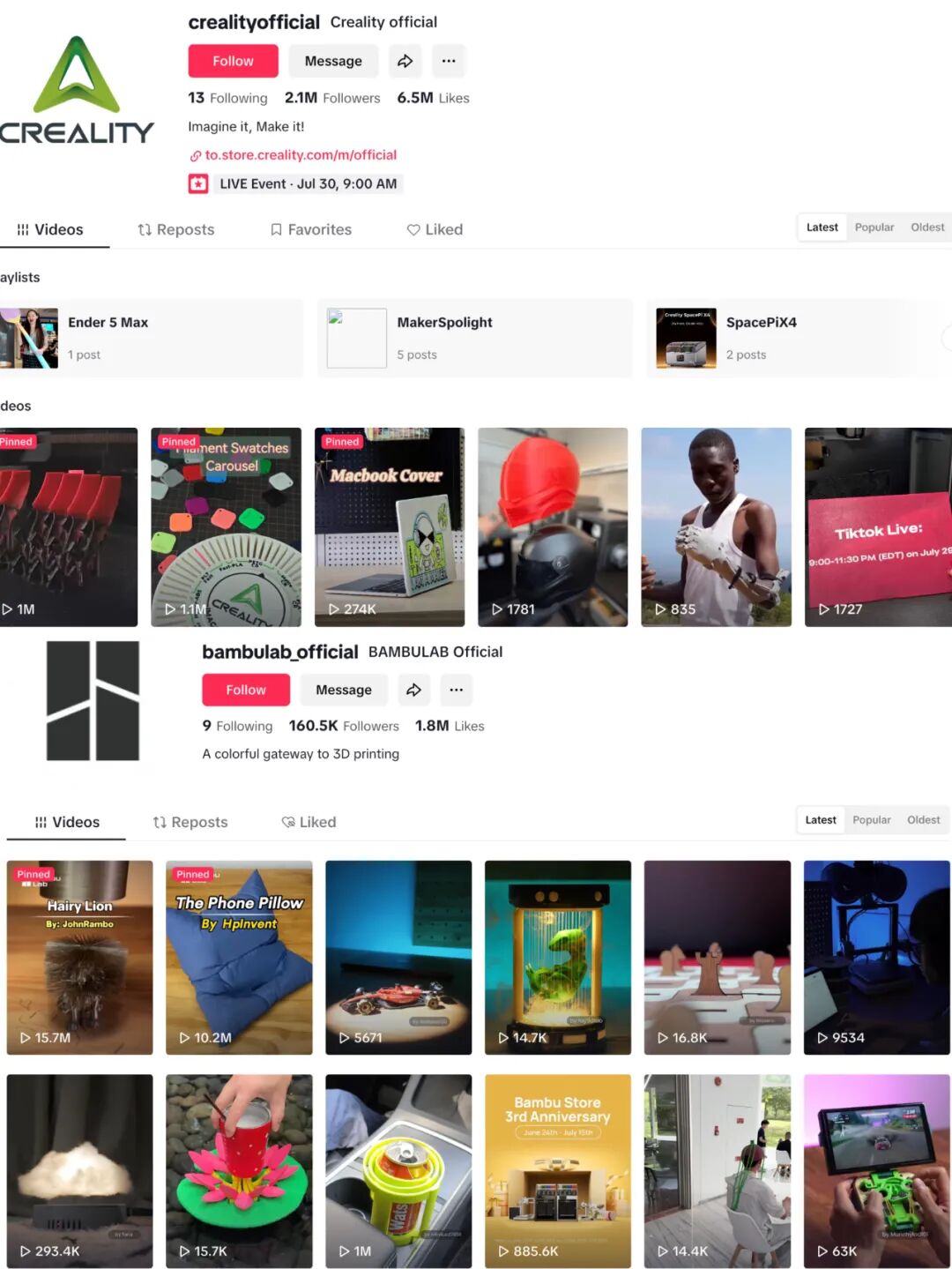 Top and mid-tier YouTubers are responsible for in-depth product reviews and functional tutorials, helping users understand machine performance and operational details; TikTok creators focus on showcasing visually striking high-speed printing videos and creative finished products, quickly attracting viewers with strong visual impact.By bombarding overseas users from all angles, Shenzhen’s 3D printing manufacturers have built a conversion path from awareness to purchase.Content marketing has gradually established brand power for Shenzhen manufacturers, ultimately leading to explosive sales through cross-border e-commerce platforms like Amazon and eBay.From 2016 to 2018, Creality’s CR-10 and Ender-3 sold exceptionally well in the European and American markets, with one of the key driving forces being the natural traffic and word-of-mouth effect on Amazon and eBay.For a long time, the Ender-3 consistently ranked in the Top 3 of Amazon’s 3D printer category.Anycubic and Elegoo also adopted similar strategies, quickly covering the DIY user base in Europe and America through price advantages and popular models.At that time, there was a scarcity of affordable and user-friendly desktop 3D printers in the European and American markets, allowing Chinese brands to rapidly increase sales through cross-border e-commerce.It is reported that in the Amazon best-selling 3D printer rankings, almost all of the top ten 3D printers come from Chinese brands.Additionally, these companies pay great attention to community building. For example, Bambu Lab has created an independent site, establishing a highly engaged user community called MakerWorld.The MakerWorld community offers over 100,000 commercial 3D models for free and encourages users to upload, download, print, and like through a points system, which can be exchanged for store gift cards or cash, creating a highly engaging creative ecosystem.Social media marketing + cross-border e-commerce + community operation have become the key codes for Shenzhen’s 3D printing companies to sweep the overseas market.When users scroll through stunning printing videos on TikTok, see reviews on YouTube, complete purchases on platforms like Amazon, and then download more models and share works in the community, a growth loop is formed.It is precisely through this complete operational system that Shenzhen’s 3D printing manufacturers have captured 95% of the global entry-level 3D printing market.
Author|Xiang Qing
Source|Growth Factory
The article represents the author’s independent views and does not reflect the position of Mantou Business School.
-END-
– Who We Are –
Mantou Business School is a practical business school that gathers 1.5 million new media and new marketing talents.We focus on practical training and consulting in corporate new media and digital marketing, paying attention to individual commercialization development and lifelong growth.
We provide services for enterprises and individuals:corporate training, consulting, media services, online courses, offline courses, and more.
Over the past 10 years,we have provided corporate services to over 1,000 industry clients in various sectors, including retail, beauty, food, services, education, automotive, health, finance, etc., such as Yili, Danone, Chow Tai Fook, Dongfeng Nissan, BMW, L’Oreal, Mars, and more.
If you are interested in Mantou Business School or want to collaborate,please scan the QR code below to add us as friends,and we look forward to discussing with you in depth.


Recommended Reading