Launching the C Language Micro Classroom

Launching the C Language Micro Classroom

Opening of the C Language Micro Classroom Senior Students Assist in Breaking Through Learning Bottlenecks Event Content On the evening of November 8, the first lecture of the C Language Special Tutoring Course was held in the Computer College, Room S303, led by student Ruan Hongyi. He focused on topics such as binary storage and … Read more

GESP: September 2024 C++ Level 2 Exam Questions and Analysis

GESP: September 2024 C++ Level 2 Exam Questions and Analysis

The teacher has prepared an electronic printed version for everyone. Friends who need the complete electronic version can check at the end of the article. 【Answer Analysis】 1. Explanation: The answer is A. This question examines the components of computer architecture. Memory in a computer is used to temporarily store data processed by the CPU … Read more

C Language Operator Precedence: A Comprehensive Guide to All Calculation Rules, Say Goodbye to Expression Calculation Errors!

C Language Operator Precedence: A Comprehensive Guide to All Calculation Rules, Say Goodbye to Expression Calculation Errors!

Introduction: Are you still confused about the order of operations in complex expressions? Are you encountering bugs in your programs due to incorrect operator precedence? Mastering the operator precedence in C not only allows you to write cleaner code but also helps avoid 90% of logical errors! This article uses a single diagram to thoroughly … Read more

C Language Learning Notes: 100 Articles – 23. Operator Precedence and Associativity: Just Remember This One Mnemonic, Which Is… Add Parentheses

C Language Learning Notes: 100 Articles - 23. Operator Precedence and Associativity: Just Remember This One Mnemonic, Which Is... Add Parentheses

“From today on, study hard and make progress every day” Repetition is the best method for memory; spend one minute every day to remember the basics of C language. “C Language Beginner’s Essential Knowledge Notes Series of 100 Articles“ 23. Operator Precedence and Associativity: Just Remember This One Mnemonic, Which Is Add Parentheses 1. Basic … Read more

C Language Learning Notes: Logical Operators – Simple Yet Common Mistakes Beginners Make

C Language Learning Notes: Logical Operators - Simple Yet Common Mistakes Beginners Make

“From today on, study hard and make progress every day” Repetition is the best method for memory; spend one minute each day to remember the basics of C language. “C Language Beginner’s Essential Knowledge Notes Series – 100 Articles” 20. Logical Operators: AND, OR, NOT (&&, ||, !), very simple, but there are two mistakes … Read more

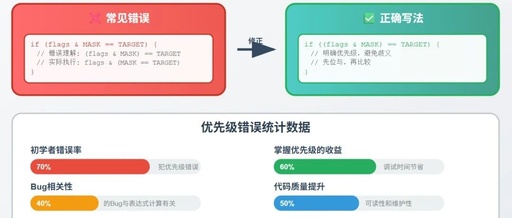
The Fatal Trap of if(a & 2 == 2) in C Language Operators

The Fatal Trap of if(a & 2 == 2) in C Language Operators

#include <stdio.h> In C/C++ development, the expression if(a & 2 == 2) is an extremely dangerous and common mistake that can lead to a complete deviation from the expected program logic. This seemingly simple expression hides a classic trap related to the operator precedence in the C language. 01ExampleLet’s first look at a set of … Read more

Understanding Macro Definitions in C Language: Common Errors and Solutions

Understanding Macro Definitions in C Language: Common Errors and Solutions

In some exam questions, macro definitions as shown in the following images often appear. Are these macro definitions correct? They are definitely wrong! This has caused considerable trouble for teaching and students when solving problems. This article will analyze the relevant knowledge of macro definitions, the side effects caused by similar errors, and provide guidance … Read more

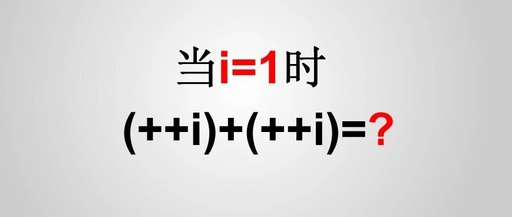
Why Does (++i) + (++i) Result in 6 When i=1 in C Language?

Why Does (++i) + (++i) Result in 6 When i=1 in C Language?

For this calculation, most programming languages yield a result of 5, but in C language, the result is 6. This article explains why. One explanation comes from the perspective of assembly language, which shows the corresponding assembly code for the relevant C statements, illustrating how the assembly code computes the result of 6 by performing … Read more