Detailed Explanation of Pointer Arrays in C++
Detailed Explanation of Pointer Arrays in C++

Arrays and pointers are closely related in C++. In C++, the name of an array is treated as a pointer, meaning the name of the array contains the address of the first element. C++ treats the array name as pointing to the address of the first element of the array. For example, if we create … Read more

Understanding C Language Pointers: A Practical Guide

Understanding C Language Pointers: A Practical Guide

When it comes to pointers, it is impossible to separate them from memory. People who learn pointers can be divided into two types: those who do not understand the memory model and those who do. Those who do not understand typically think of pointers as “pointers are the address of a variable” and are quite … Read more

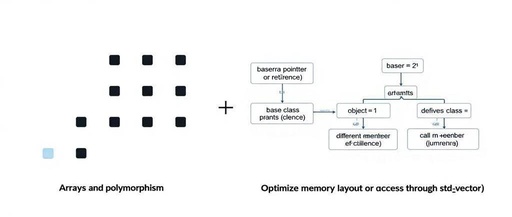
Decoding the Myths of Qt/C++ Arrays and Polymorphism: From Memory Layout to Container Optimization

Decoding the Myths of Qt/C++ Arrays and Polymorphism: From Memory Layout to Container Optimization

1. Basic Type Arrays and Caching Arrays are a contiguous block of memory, making them ideal for caching as they provide fast sequential access and allow O(1) time complexity random access when the index is known. Code Example:<span>int</span>, <span>char</span>, <span>byte</span> (i.e., <span>quint8</span>) arrays #include <QDebug> #include <QtGlobal> // For quint8 void basicArrayExamples() { // 1. … Read more

C Language Arrays: The Magical Container for Organizing Data

C Language Arrays: The Magical Container for Organizing Data

C Language Arrays: The Magical Container for Organizing Data Hello everyone! Today we are going to talk about a very important concept in C language—arrays. If you are learning C language, then arrays are definitely one of the fundamental knowledge you must master. Today we will learn about C language’sarrays—like putting data into “containers” to … Read more

Python Interview Notes: How to Choose Between Lists and Arrays?

Python Interview Notes: How to Choose Between Lists and Arrays?

📣 What Inspired This Series? The inspiration came from the real questions I encountered while preparing for Python interviews! 💡 I decided to use the Feynman Learning Technique— “learning by teaching”—to solidify my understanding through explanation. While organizing and sharing, I hope to: 🔹 Help myself└── Clear knowledge gaps → Strengthen theoretical foundations → Understand … Read more

Comprehensive Guide to C++ Arrays: Unlocking Efficient Data Storage from One-Dimensional to Multi-Dimensional!

Comprehensive Guide to C++ Arrays: Unlocking Efficient Data Storage from One-Dimensional to Multi-Dimensional!

In the world of C++, arrays are like the basic building blocks of Lego! Whether it’s a simple record of grades or a complex 3D game map, arrays are essential. Today, we will delve into the usage techniques of one-dimensional arrays and multi-dimensional arrays, guiding you to build efficient data structures with arrays! 1. Basics … Read more

Relearning C Language – Lesson 3

Relearning C Language - Lesson 3

Course Address: https://www.cc4e.com/ Learning C language programming is to understand the principles of computer operation from a historical perspective, which leads to computer architecture. The instructor does not teach us how to code in C language, but rather explains how computers work and how other languages utilize C language. Course Outline Chapters 1-4 mainly cover … Read more

Six Common Data Structures in Embedded Programming

Six Common Data Structures in Embedded Programming

Today, embedded systems are increasingly applied in various fields such as smart homes, smart healthcare, industrial automation, and intelligent transportation. In the development of embedded systems, data structures are an essential knowledge point. This article will introduce several common data structures in embedded programming, including arrays, stacks, queues, heaps, hash tables, and linked lists. 1. … Read more

C Language Exercise Class – Day 18

C Language Exercise Class - Day 18

01 (Multiple Choice) To define a one-dimensional array a with 10 int elements, the following definition statements arecorrect: A) #define N 10 int a[N]; B) #define n 5 int a [2*n]; C) int a[5+5]; D) int n=10,a[n]; Answer: ABC Explanation: For option D: In the C89 standard, the size of an array must be a … Read more