

As tourists interact with robots at Happy Coast and enjoy the technological light show at Talent Park, the dual charm of Shenzhen’s “technology + ecology” captivates, adding vibrant memories to their journey… Behind this dazzling display, a force injecting lasting energy into future intelligent entities is rising in Shenzhen – XINWANDA Electronics Co., Ltd., a global benchmark enterprise in lithium batteries, is quietly transforming the “vitality” of robots with its “smart” batteries.
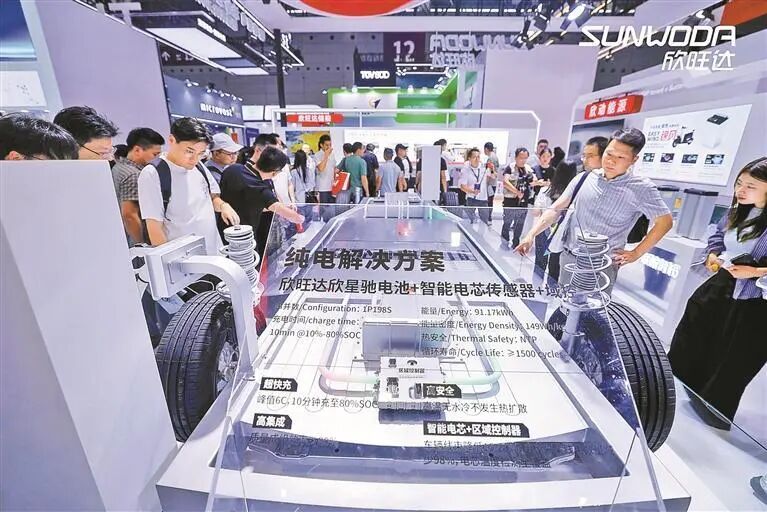
XINWANDA’s fast-charging battery. (Image provided by the interviewed unit)
 Innovative Genes Forge Shenzhen’s “Battery Business Card”
XINWANDA Electronics Co., Ltd. was founded in 1997, listed on the Shenzhen Stock Exchange in 2011, and successfully issued GDRs to enter the Swiss Exchange in 2022, becoming a leading global enterprise in lithium-ion batteries. After nearly 30 years of refinement, the company has not only formed a deep technical foundation in the lithium battery field, achieving industry-leading process technology, but has also diversified its business, becoming an invisible champion in the 3C consumer battery sector, ranking among the top ten globally in power battery installations and among the top ten Chinese companies in global energy storage cell shipments, with a top five global market share in energy storage systems (DC side).
XINWANDA’s breakthrough in robot batteries is rooted in its rich innovative soil. The company plans to invest over 3.3 billion yuan in R&D in 2024, with nearly 13 billion yuan accumulated over the past five years, and has a research team of nearly 10,000 people. From supporting mobile phones and computers as an “invisible champion” to driving electric vehicles and powering energy storage as a “versatile player”, and now empowering humanoid robots as a “pathfinder”, XINWANDA has always taken technology as its spearhead. In 2024, the company’s revenue is expected to exceed 56 billion yuan, with growth rates for power batteries and energy storage businesses exceeding 40% and 70%, respectively, forming a dual-driven model of “stable foundation from consumer batteries and strong growth from power storage”.
Three Major “Black Technologies” to Solve Endurance Issues
Walking through the Shenzhen Science Museum, agile humanoid robots have transitioned from science fiction to reality. They can guide and serve, but “endurance anxiety” follows closely – mainstream products generally can only operate for 3 to 6 hours, and heavy batteries further restrict their flexibility. “It’s like a tourist returning disappointed because their phone is out of battery; the potential of robots is similarly constrained by their energy core,” said Zhou Shuangjun, director of battery R&D at XINWANDA, in an interview.
How can we make robots “light as a feather” yet “enduring”? XINWANDA presents three major “black technologies”: the “slim and muscular” high-energy battery adopts an innovative all-tab design for ternary lithium batteries, improving endurance by over 30% at the same volume, allowing robots to work comfortably for most of the day; the “tailored” irregular structure breaks the limitations of traditional rectangular battery packs; and the “preventive health” smart BMS acts as a “health steward” for the battery, monitoring real-time impedance through EIS and proactively warning of anomalies. “This is like giving the battery a stethoscope, allowing for early detection and handling of safety risks,” Zhou Shuangjun said.
Humanoid robots, as high-tech products with human-like forms, intelligent decision-making, and multi-scenario adaptability, are predicted by institutions to see the global market scale reach 150 billion yuan by 2029, with China’s market share expected to increase from the current 20% to over 50%, becoming a core growth driver. As the energy core of humanoid robots, the current cost accounts for about 1% to 2%, with global shipments expected to reach 5 million units by 2030, leading to a demand for lithium batteries of 12.5 GWh, indicating significant market potential.
“Future battery technology will focus on strong energy, long endurance, lightweight, and intelligence development,” Zhou Shuangjun said. XINWANDA centers its customized R&D for humanoid robot batteries on material innovation, structural optimization, and intelligent management technology, focusing on high-frequency scenarios in industries and services, gradually building competitiveness in the high energy density and high reliability battery field by connecting with leading robot companies and policy projects, aiding the global industrialization of humanoid robots.
Business Report Offers Benefits
Leave many comments on the article
For a chance to win gifts from the Business Report
Don’t miss out, friends!
↓↓↓


Shenzhen Business Report · Reader Creation Client Reporter Li Jiajia
Editor Li Li Proofreader Hu Weihong
Supervisor Ma Qiang

Waiting for you to pick→
Breaking! 28 people have died, Vietnamese cruise ship capsized
Can’t eat instant noodles on the high-speed train? Netizens are arguing, 12306 responds
“Controlled explosion” occurs at US diplomatic facility in Baghdad