
In gaming, the humanoid robot Chloe slowly states, “Humans have something that androids do not, and that is a soul”; in films, there are sci-fi stories about humanoid robots; in real life, the American humanoid robot “Sophia” has been granted citizenship…
In recent years, humanoid robot technology has made rapid advancements, entering human sight in various fields, thanks to the rapid development of artificial intelligence technology, which relies on ingenious bionic structural design and ever-evolving drive control technology.
So, when humanoid robots collide with military operations, can they lead the future battlefield? Can their military applications be realized as hoped? Today, let us explore the military applications of humanoid robots together.
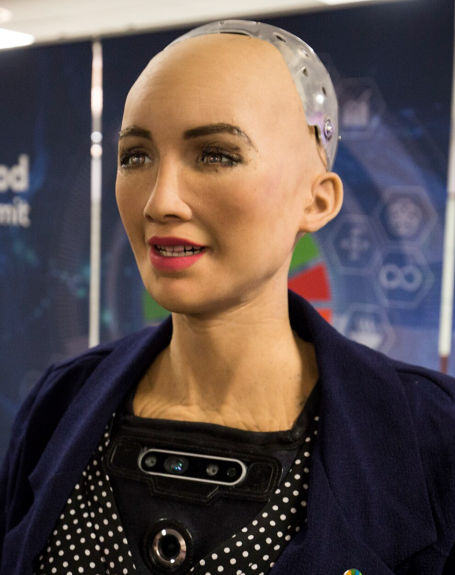 Sophia the robot, image source: Wikipedia
Overview of Humanoid Robot Development: Fully Equipped
Humanoid robots, also known as anthropomorphic robots, are bionic robots capable of mimicking human bipedal walking. They possess a certain level of intelligence and have a more complex structure, sensing, driving, and control systems than ordinary robots. A reasonable bionic design is the foundation for humanoid robots to perform their functions. Currently, the development of humanoid robots can be summarized from four aspects: appearance characteristics, perception ability, analytical ability, and action capability.
In terms of appearance characteristics, humanoid robots generally possess the basic human form, with complete structures for limbs, head, etc. However, humanoid robots currently lack bionic skin, making them still quite different from real humans in appearance.
Regarding perception ability, humanoid robots are now equipped with RGB-D cameras and stereo microphones, allowing them to fully perceive and construct 3D models of their surrounding environment. In terms of motion perception, humanoid robots are equipped with position and torque sensors, enabling them to accurately obtain information about limb positions and the forces acting on them. Currently, the perception methods of humanoid robots are still under further development, with technologies such as LiDAR and infrared imaging gradually being implemented, further enhancing their perception capabilities.
In terms of analytical ability, relatively mature technologies can achieve mixed perception based on existing knowledge, ultimately enabling robots to possess hierarchical analytical capabilities and automate the completion of complex tasks. With the development of artificial intelligence and other technologies, a new generation of analytical judgment technologies based on AI will be applied to humanoid robots, allowing them to independently complete more complex tasks.
In terms of action capability, humanoid robots can be summarized in terms of flexibility, payload, and endurance. Currently, the joints of humanoid robots have achieved more than six degrees of freedom, and some models even use spherical joint structures, further enhancing flexibility.
In terms of payload and endurance, taking the German Aerospace Center’s Rollin’Justin robot as an example, it can carry a load of 20 kilograms and work at a maximum speed of 2 meters per second for 1 hour. This model also features joints with up to 12 degrees of freedom. Currently, humanoid robots have basically reached human levels in terms of action capability, and due to their lack of physical limitations, they can work continuously as long as power supply allows, achieving levels far beyond humans in endurance-based scenarios.
Current Military Applications of Humanoid Robots: Awaiting Development
As early as 2013, the U.S. military announced the successful development of the “Atlas” humanoid robot. According to the information released at that time, “Atlas” consists of two arms, two legs, a torso, and a head that simulate human structure and size, standing 1.88 meters tall and weighing 150 kilograms.
“Atlas” can timely dodge suddenly appearing wooden boards on a conveyor belt or jump down from heights and land steadily. It can also walk around traps with its legs apart and run up stairs; even after being hit by a 9-kilogram bowling ball, it can still maintain balance and stand on one leg. The U.S. military hoped to use robotic soldiers in one-third of ground combat by 2015, but this goal has yet to be realized, and “Atlas” remains an experimental program.
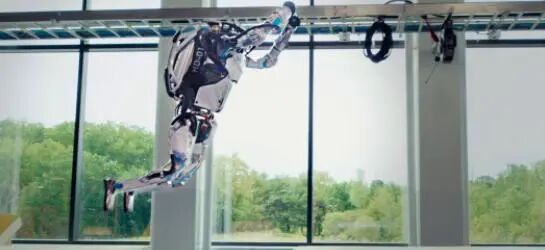
Image of “Atlas” undergoing motion capability testing (Image source Boston Dynamics)
The Russian military is also highly concerned about humanoid robots. In 2015, the head of the Russian “Future Research Foundation” stated that a humanoid robot capable of performing combat tasks would learn to run and overcome obstacles and complete other actions by the end of that year. In 2017, the Russian Android Technology Company developed a humanoid robot named “Fedor” on its official website. “Fedor” can pick up instruments and operate them in specific scenarios, and its precise shooting ability shows great potential in military operations.
Overall, current military humanoid robots worldwide are still in the conceptual or experimental stage, with no large-scale deployment for use, and the battlefield potential of humanoid robots remains to be explored.
The Battlefield Potential of Humanoid Robots:
Bright Prospects and Challenges
On one hand, humanoid robots have many possible applications on future battlefields. Firstly, battlefield environments increasingly highlight traces of human activity, such as towns, industrial areas, and farms. These environments are designed for human use, and humanoid robots with human-like forms have significant advantages in these environments, being able to simulate real humans utilizing various systems within the environment.
On the other hand, the widespread use of humanoid robots will rapidly advance the unmanned construction of the military. Traditional manned equipment can be adapted for operation by humanoid robots, effectively transforming manned equipment into unmanned operation. Thus, military forces with a large number of traditional manned weapons can quickly break free from the inertia of using manned equipment. Additionally, since there is no need to develop unmanned equipment separately, the cost of military unmanned operations can be greatly reduced, allowing for rapid expansion of unmanned combat scale.
In summary, the relevant technical indicators of humanoid robots have developed to a high level, but it should not be overlooked that the deployment of humanoid robots in battlefield use still needs to overcome a series of issues such as power and energy, control and signals, materials and durability, and combat weight. Therefore, humanoid robots do not yet have widespread military applications. In the increasingly complex future battlefield environment, humanoid robots may gain broader opportunities for deployment. At that time, humanoid robot troops stepping onto the front lines will no longer be a scene from a sci-fi blockbuster.
Planning and Production
Produced by丨Science Popularization China
Supervised by丨Guangming Online Science Popularization Division
Authors丨Guo Bingxin, Zhong Yuhang, Lei Hongyu (National University of Defense Technology)
Reviewed by丨Fu Songyang (National University of Defense Technology)
Edited by丨Ding Kai
Proofread by丨Xu Lai, Zhang Linlin
All images in this article are from copyright libraries
Reproducing this article may lead to copyright disputesFor original text and images, please reply “Reprint” in the background

Light Up the “Recommendation”
Let’s Gain Knowledge Together!