Word Count: Approximately 3031 words
Reading Time: Approximately 6 minutes
When purchasing Bluetooth headphones, we are often surrounded by various technical terms: SBC, AAC, aptX, LDAC, LHDC, Hi-Res… What do these encoding technologies mean? How do they affect our listening experience? This article will delve into these audio encoding technologies to help you make informed choices amidst the complex parameters. You can also enhance the sound quality of your headphones by adjusting your phone’s audio settings.
1. Steps to Adjust Sound Settings on Different Phone Models.
Apple PhoneSteps to Enable Lossless Audio
In the iPhone settings, you can enable the “Lossless Audio” option through the “Music” app to ensure music plays at the highest quality.
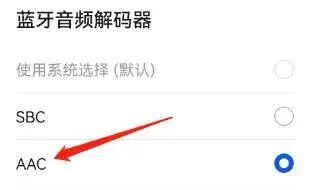
Huawei PhoneSteps to Enable AAC Audio:
1. First, go to [System and Updates], then click on [Developer Options]. 2. Once inside, scroll down and click on [Bluetooth Audio Codec]. 3. In the [Bluetooth Audio Codec], select [AAC].
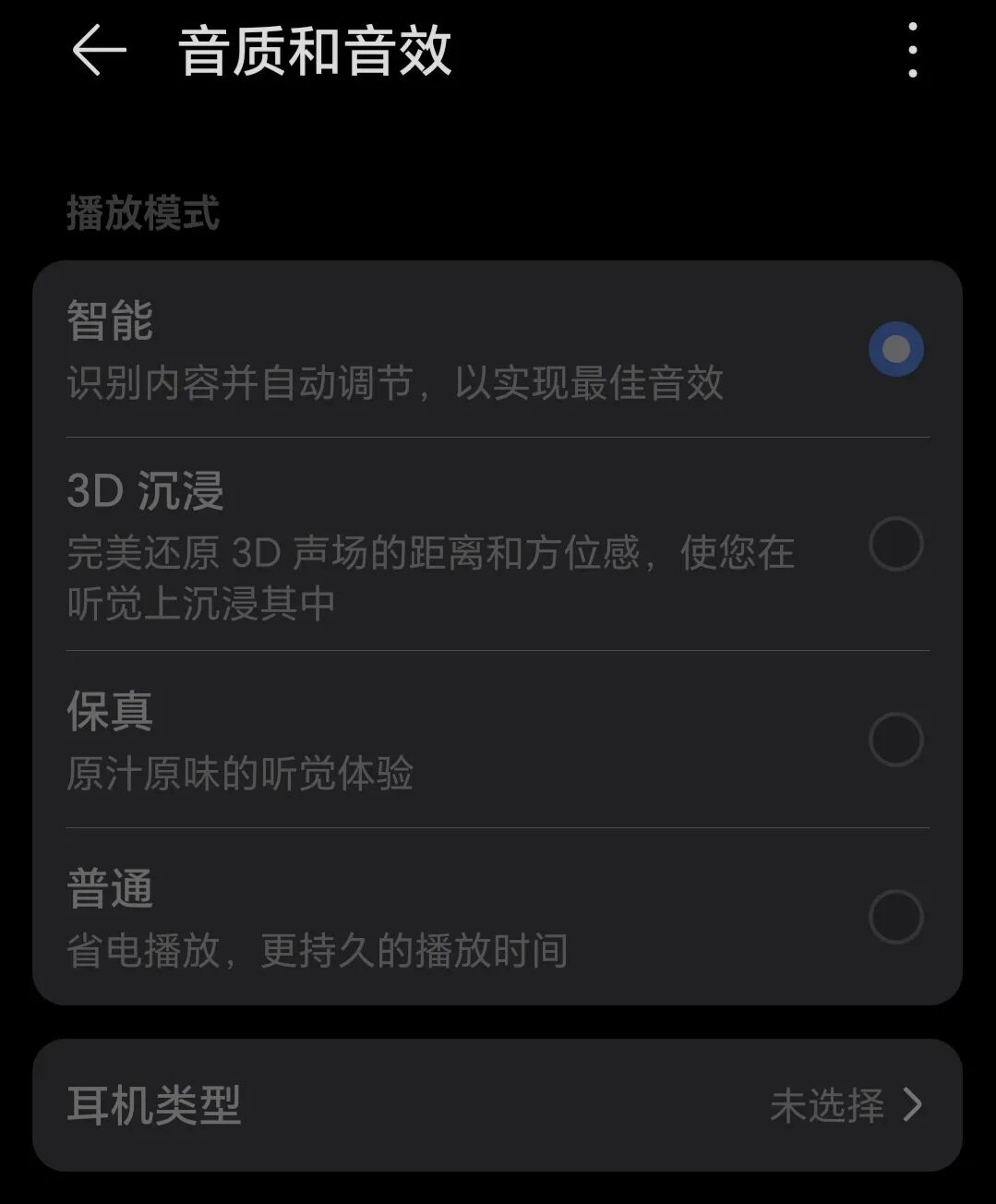
Honor Phone Settings for 3D Immersive Sound:
1. Open phone settings, then Sound and Vibration.
2. Open Sound Quality and Effects.
Xiaomi PhoneSteps to Enable AAC Audio:
1. Open the phone’s “Settings” app. 2. Go to the “Bluetooth” settings. 3. Select the connected Bluetooth device and click the arrow on the right to enter detailed settings. 4. Find the “AAC” option and turn on the switch.
2. Basics of Audio Encoding: Why Compression is Necessary? Before understanding specific encoding formats, we need to grasp a fundamental question: Why does Bluetooth audio require encoding compression? Original audio files (such as CD quality 44.1kHz/16bit stereo) have a large data volume, and direct transmission via Bluetooth faces: – Bandwidth limitations: Bluetooth transmission bandwidth is limited (classic Bluetooth maxes out at about 2-3Mbps) – Latency issues: Large data volume transmission increases latency – Battery consumption: Continuous high data rate transmission quickly drains device battery. Therefore, various audio encoding technologies have emerged, seeking a balance between sound quality, latency, and power consumption through different compression algorithms.
3. Introduction to Audio Codec Parameters
The parameters of audio codecs mainly include: sampling rate (KHz), bit depth (bit), transmission bitrate (kbps), and transmission latency (ms). These parameters collectively determine the performance and sound quality of Bluetooth audio codecs.
Sampling Rate: Refers to the number of times audio signals are sampled per second, usually expressed in kilohertz (KHz). A higher sampling rate can better restore audio details; Bit Depth: Refers to the number of bits per audio sample, typically 16 bits, 24 bits, or 32 bits. A higher bit depth can provide a greater dynamic range and better sound quality; Transmission Bitrate: Refers to the speed at which the codec transmits audio data, usually expressed in kilobits per second (kbps). The higher the bitrate, the better the audio quality; Transmission Latency: Refers to the time required for audio signals to be transmitted from the source device to the receiving device, usually expressed in milliseconds (ms). Lower latency provides a better experience for gaming, video, and video calls.
4. Detailed Explanation of Mainstream Bluetooth Audio Encoding Technologies
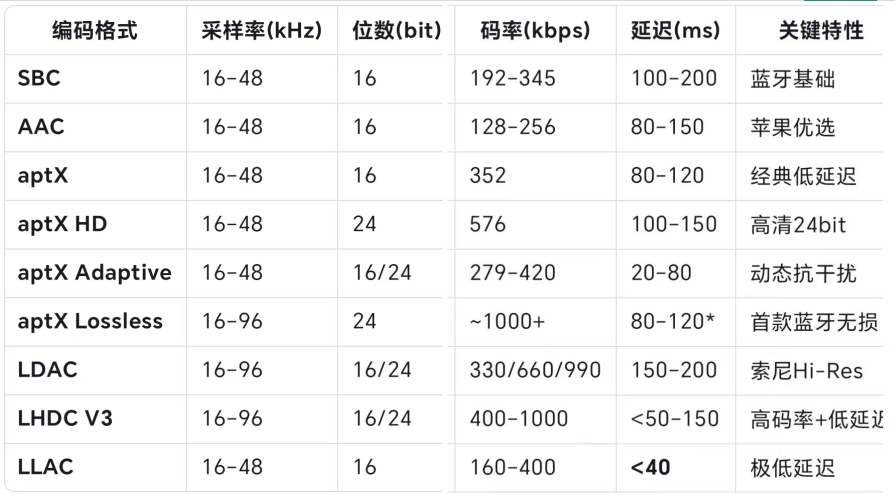
1. SBC (Subband Codec)— The “basic version” of Bluetooth. Background: As the mandatory default codec for A2DP (Advanced Audio Distribution Profile). Technical Principle: Divides audio into multiple subbands and retains important parts based on psychoacoustic models. Parameter Indicators: Sampling Rate: 16–48 kHz Bit Depth: 16 bit Bitrate: 192–345 kbps (typically 328 kbps @ 44.1 kHz under default A2DP protocol) Latency: 100–200 ms (depends on Bluetooth stack optimization)
Advantages: Excellent compatibility; all Bluetooth audio devices support it.Disadvantages: Significant sound quality loss; severe loss of high-frequency details.
Applicable Scenarios: Ordinary voice calls, background music with low sound quality requirements.2. AAC (Advanced Audio Coding)— The preferred technology in the Apple ecosystem. Source: Jointly developed by Dolby, AT&T, and others, and is part of the MPEG standard. Special Optimization: Specifically optimized for bitrates below 128kbps. Parameter Indicators: Sampling Rate: 16–48 kHz Bit Depth: 16 bit Bitrate: 128–256 kbps (typically 250 kbps @ 44.1 kHz) Latency: 100–150 ms (can reach 80 ms on optimized Apple devices) Apple Advantage: iOS devices process during the AAC encoding phase, avoiding secondary encoding loss.
Android Limitation: Android systems typically decode to PCM before re-encoding to AAC, leading to sound quality degradation. Sound Quality Performance: Better than SBC at the same bitrate, especially in mid to high frequencies.3. aptX Series — Qualcomm’s Audio SolutionaptX (Standard Version) Core Technology: Adaptive Differential Pulse Code Modulation (ADPCM). Key Parameters:
Sampling Rate: 16–48 kHz Bit Depth: 16 bit Bitrate: 352 kbps (fixed) Latency: 80–120 ms Sound Quality Characteristics: More natural sound quality than SBC.
aptX HD Upgrade Highlights:
Sampling Rate: 16–48 kHz Bit Depth: 24 bit Bitrate: 576 kbps (fixed) Latency: 100–150 ms
Sound Quality Improvement: Significantly enhances detail performance, approaching CD quality. aptX AdaptiveSampling Rate: 16–48 kHz (dynamically adjustable)
Bit Depth: 16/24 bit Bitrate: 279–420 kbps (dynamically adjustable) Latency: 50–80 ms (as low as 20 ms in gaming mode) Note: Adaptive bitrate and latency, suitable for gaming and video.
aptX Lossless
Sampling Rate: 16–96 kHz Bit Depth: 24 bit Bitrate: ~1 Mbps (requires Bluetooth 5.2+, actual lossless requires >1.2 Mbps) Latency: 80–120 ms (officially unspecified, presumed similar to aptX HD) Note: The first Bluetooth lossless codec (CD-quality FLAC lossless), requires Snapdragon Sound support.
4. LDAC — Sony’s Black Technology– Technical Highlights:Sampling Rate: 16–96 kHz (Hi-Res mode) Bit Depth: 16/24 bit Bitrate: 330/660/990 kbps (three selectable levels) Latency: 150–200 ms (higher at higher bitrates)
Three modes adjustable (Quality Priority/Balance/Connection Priority). Working Mechanism: Separates high-frequency and low-frequency signals for processing, using optimized quantization methods to retain details. Real-world Performance: Achieves nearly 90% of wired connection quality at 990kbps mode, but has weaker anti-interference capability, may automatically downgrade in environments like subways.5. LHDC (including LLAC) — The Rise of Chinese Audio EncodingDeveloper: Savitech (Taiwan). Technical Version:
Sampling Rate: 16–96 kHz Bit Depth: 16/24 bit Bitrate: 400–900 kbps (up to 1 Mbps) Latency: <50–150 ms (low latency mode <50 ms) Note: Supported by flagship models from Huawei/Xiaomi, similar to LDAC but with lower latency.
LLAC (LHDC Low Latency)Sampling Rate: 16–48 kHz Bit Depth: 16 bit Bitrate: 160–400 kbps Latency: <40 ms (officially claimed 30–50 ms) Note: Optimized for gaming/video, sacrificing some sound quality.
Core Technology: Improved based on AAC architecture.
Uses new noise shaping technology. Unique Advantages: Supported by domestic flagship models from Huawei, Xiaomi, etc., optimized for Chinese speech, with better stability in complex environments than LDAC.
5. Technical Comparison and Purchasing Guide 1. Sound Quality Comparison (under the same device conditions) LDAC(990kbps) ≈ aptX Lossless ≈ LHDC > aptX HD > AAC(256kbps) > aptX > SBC 2. Latency Comparison (from low to high) LLAC(80ms) < aptX Adaptive(50-80ms) < aptX(100ms) < AAC(120ms) < LDAC(200ms) < SBC(220ms) 3. Device Compatibility Reference iPhone Users: Prioritize AAC (Apple optimizes AAC best) Android Flagships: LDAC/LHDC (supported by Sony/Huawei/Xiaomi, etc.) Qualcomm Platforms: aptX HD/Adaptive (built-in support for Snapdragon processors) General Compatibility: SBC (basic guarantee) 4. Usage Scenario Recommendations Commuting: LHDC or AAC (balance of anti-interference and sound quality) Home Listening: LDAC in quality priority mode Gaming: aptX Adaptive or LLAC in low latency mode
Sports and Fitness: AAC or basic aptX (stability prioritized)6. Future Trends: Evolution of Bluetooth Audio Technology1. LE Audio New Era: – LC3 encoding based on Bluetooth 5.2 – Supports multi-device synchronized audio – Power consumption reduced by over 50% 2. Popularization of Lossless: – Accelerated commercialization of aptX Lossless – Sony developing follow-up technologies for LDAC – Promotion of China’s HWA standard 3. Wireless Spatial Audio: – Low-latency transmission of head tracking technology – Bluetooth adaptation of Dolby Atmos – Cloud computing for personalized HRTF
Conclusion: Choose According to Needs, Consume Rationally When purchasing Bluetooth headphones, there is no need to blindly pursue the highest specification of encoding support, but rather consider: 1. What codecs does your phone support? 2. What is the audio quality of the music platforms you frequently listen to? 3. What are your main usage scenarios? Sound quality is a system engineering; headphone encoding is just one part of it. Factors such as headphone driver quality, tuning style, ear shape compatibility, whether the playback device supports high-definition audio, and music format are equally important. I hope this article helps you find the most suitable headphones and audio devices amidst the complex parameters.
Headphones and Music
————————————————————————————————
Hello everyone, I am Danran – an 80s music lover who shares headphone usage knowledge and information, working by day and writing by night.
Recent Selected Articles:
> Sony’s flagship WH-1000XM6 noise-canceling headphones officially launched after a 3-year long cycle iteration, featuring 12 microphones for noise cancellation + 360-degree immersive spatial sound quality, truly amazing!
> Correct wearing, selection, and maintenance guide for headphones! [Recommended for collection]
> Must-read for headphone enthusiasts! This inconspicuous symbol can protect your ears and make your music listening safer!
> Open and breathable over-ear headphones! Crowdfunded hit | Innovatively designed open over-ear headphones Movengine AirCore OWH
> Bose QC Ultra over-ear noise-canceling headphones experience and teardown report | A breakthrough in noise cancellation and immersive sound field!
> Xiaomi’s most expensive high-end TWS noise-canceling headphones have been shockingly released!
> Huawei’s newly released headphones are incredibly appealing!
> CES 2025 Global Consumer Electronics Show AI Headphones Review
> The world’s first brain-computer interface AI headphones have been shockingly released, aiding consciousness control in the future!
> I asked DeepSeek “How to choose the right headphones for myself,” and the answer was stunningly comprehensive!
> Faye Wong’s new song “The World Gave Me” brings love and blessings to the reunion moment in the Spring Festival melody.
 If you like the article, feel free to like and share~👇👇👇