Source: Deep Insight (ID: deepchanpin), Author: Deep Insight
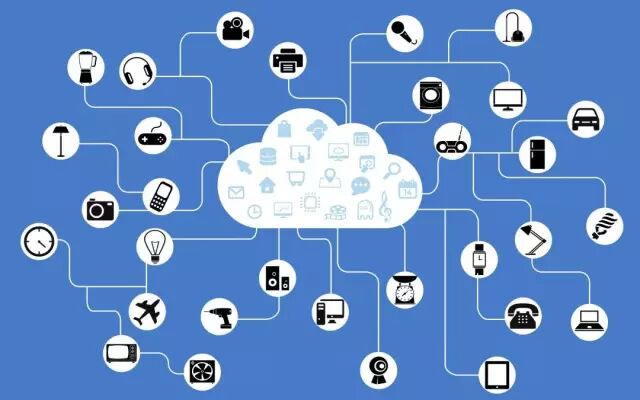
Every generation of the information industry gives birth to a new generation of operating systems. Each generation of the information industry creates different platforms, and each platform is driven by a new generation of operating systems. The PC era had Windows, while the mobile era has Android and iOS.
The PC has become a thing of the past, and the mobile internet has stagnated. For most internet companies, the focus is on the next breakout point—what will the next platform look like? Where is the next goldmine of traffic? From the perspective that “each generation of platforms is driven by a new generation of operating systems,” the next generation of operating systems may also emerge as a result.
Looking at the current industrial development, the next generation of operating systems is likely to be IoT operating systems.
The Smartphone-Based IoT Layout Has Failed
IoT is not a trend; it is a reality. The mobile internet has reached its limits, making it difficult to innovate in business models or create new platforms.
In the early days of mobile internet development, many companies attempted to base their smart home and smart internet layouts on their customized Android ROMs. This was the approach of almost all internet smartphone manufacturers.
These smartphone manufacturers had grand visions—centering around smartphones to control other smart devices in the home, thus driving the advancement of IoT. However, in practice, the smartphone-centered strategy has not been very effective. Almost all smartphone manufacturers can only control their own hardware, which does not allow for much imaginative space. Smartphones largely serve as remote controls.
There are reasons for this situation. Domestic smartphones are primarily based on customized Android ROMs, which can only connect to a very limited number of devices. Additionally, the severe fragmentation of Android means that almost every manufacturer has its own ROM, which only connects to its own services and devices, resulting in a fragmented landscape with little imaginative space.
At the 2015 Sydney Thought Leaders Summit, the father of IoT, Kevin Ashton, remarked: “I’m not saying this, but those smart bottles, smart bikinis, smart cups, and so on, are all rubbish!”
In the eyes of this professor, who proposed the “Internet of Things” for real-time sharing of global object information back in 1999, the true essence of IoT lies in the efficiency of big data, not in these trivial gadgets.
We can understand this issue in this way. People often say that after the mobile internet comes the era of artificial intelligence. However, this phase of artificial intelligence does not exist in isolation, as what we often refer to as artificial intelligence is closely tied to big data and cloud computing. In this environment, almost all hardware, software, and services run in the cloud, constructing a system of interconnected devices.
In this environment, there needs to be a platform or system that can connect software, hardware, and services together. This platform or system is likely to be the IoT operating system.
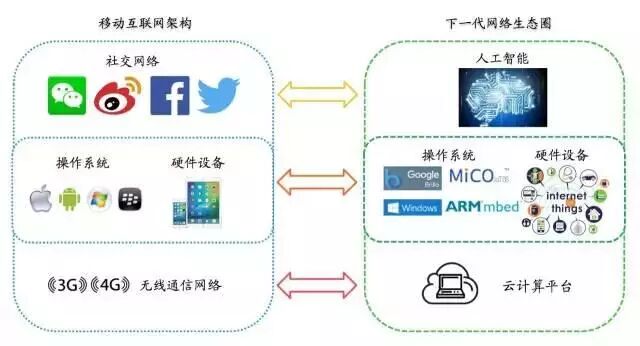
(Mobile Internet Architecture and Next-Generation Network Ecosystem)
(Source: Hongze Research: The IoT Ecosystem Under Artificial Intelligence from Mobile Internet to IoT)
Jack Ma previously hinted at the IoT operating system during a speech in Malaysia—when you install an operating system on a phone, making calls only accounts for 20% of its usage. Today, 80% of the time, phones are not used for making calls. Imagine if we installed an operating system in a car, or if we had an operating system built into a lamp, a refrigerator, or a washing machine; the world would change.
Upon deeper reflection, we realize that the operating system prepared for a lamp, a refrigerator, or a washing machine is precisely the IoT operating system.
IoT Operating Systems Are Not a Trend but a Reality
IoT operating systems are not a trend; they are a reality. According to Gartner’s predictions, by 2020, the economic value added by IoT will reach $1.9 trillion. Therefore, various countries are currently formulating different development strategies for IoT, such as “Made in China 2025,” Germany’s “Industry 4.0,” and the United States’ “Industrial Internet,” etc.
Because IoT is not simply a mobile ROM and hardware connection, it requires a systematic and structured way to collect data and provide services. Therefore, IoT needs not just a ROM, but an OS.
(The Internet of Things is also referred to as Internet 3.0)
(Source: Alibaba Research Institute: Internet 3.0, What Will Happen in the Next 15 Years)
From the definition of OS, we can see this issue—OS stands for Operating System, which is used to manage all hardware and software resources, such as controlling program execution, improving human-computer interfaces, etc.
For IoT systems, it is essential to collect, manage, and process data centrally, and then open it up to partners and industries. Based on this platform, industry partners can develop applications. Additionally, a very important aspect of IoT systems is the need for network access, which includes both wired and wireless access.
On the surface, it seems that existing networks can meet this need, but in reality, the development of IoT is also limited by existing networks. According to Huawei’s estimates, by 2020, the number of IoT devices connected will approach 100 billion (currently only 7 billion), and the speed of newly deployed sensors will reach 2 million per hour. By that time, the current network will not only struggle to bear the load, but the existing network speed and latency will also be far from ensuring the safety and reliability of remote precise control of industrial-grade products—this requires specialized chips, systems, and terminals that connect to 5G networks.
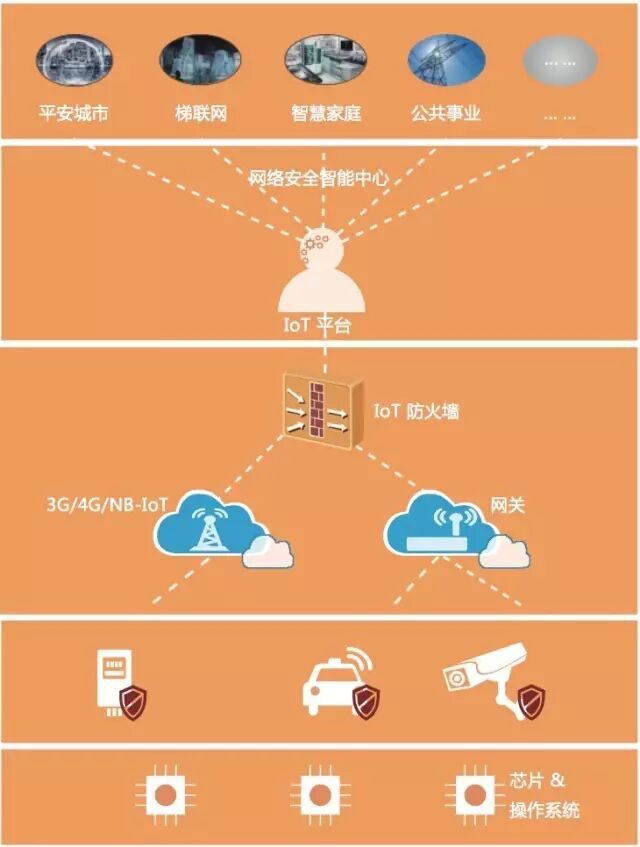
(Huawei’s Proposed IoT Architecture)
(Source: Huawei: Building a Trusted and Manageable IoT World)
Considering all these factors, the task is too heavy for a simple ROM to accomplish. Only an OS can handle the heavy tasks involved. Therefore, you will find that Samsung is gradually sidelining its customized Android system and focusing on its own Tizen and SmartThings.
Companies like Alibaba are also intensifying efforts to promote the implementation of YunOS based on Linux. This OS is equipped with a virtual machine designed, architected, and developed by Alibaba, using HTML5 to build a cloud computing-based runtime environment and mobile cloud application framework, while also providing a local application runtime environment, requiring the completion of all development work at the application layer, architecture layer, and system layer.
This system can not only run on smartphones but also has the core advantage of being able to run on cars, TVs, refrigerators, and other industrial devices. Moreover, the truly frightening aspect is that the ID2 (Internet Device ID) led by Alibaba’s YunOS has successfully been established in the ITU-T (International Telecommunication Union – Telecommunication Standardization Sector). ID2 will be issued by Alibaba’s YunOS, embedded in chips, becoming the identity identifier in IoT devices. Behind it, Alibaba’s cloud computing supports it, capable of penetrating deeply into industrial production and commercial infrastructure. Its scale is incomparable to that of mobile ROMs.
Furthermore, Alibaba’s current layout in the IoT space includes Alibaba Cloud, Alibaba Smart, YunOS, and other business groups, collectively creating a service platform for the IoT era that empowers enterprises and entrepreneurs.
(Alibaba’s Layout in the IoT Field)
(Source: Alibaba Research Institute: Internet 3.0, What Will Happen in the Next 15 Years)
It can be said that almost all internet giants and tech giants are trying to develop their own IoT operating systems.
For instance, communication giant Huawei has its own IoT system, LiteOS. LiteOS has a system size of only 10KB, making it the world’s lightest IoT operating system, and it is open-source. Huawei hopes to have more third-party partners adopt this system to develop industry applications based on Huawei’s data.
In April of this year, foreign media reported that Google is developing an Android IoT system codenamed “Brillo.” Yesterday, at the Google I/O developer conference held at the Moscone Center in San Francisco, Google officially launched this Brillo system based on Android.
Brillo comes from Android, so it will be very convenient for device pairing and setup; any Android device can easily connect and control Brillo smart devices. In addition to Brillo, Google also released the Weave cross-platform protocol. This protocol can connect to the cloud, mobile phones, and devices supported by Brillo, such as products under Nest.
“We want to create a natural and seamless way for smart homes to interconnect,” revealed Google’s Sundar Pichai, stating that the NEST team has updated traditional devices and collaborated with the Android team to provide end-to-end solutions.
Moreover, Microsoft is also preparing for the future IoT operating system. Recently, Russian WZor stated on Twitter that Microsoft is developing a Windows Cloud operating system, which is expected to debut in 2020. This operating system is unique in that it requires an internet connection to use its full features, while offline mode only provides very basic functionalities. Microsoft has also reached cloud cooperation with manufacturing giants like GE and Siemens to better serve IoT users.
In fact, it is not just these companies; we can see from this table how many tech giants are involved in IoT systems:
-
In 2013, Intel established an IoT division and launched the Intel IoT Platform the following year. This platform aims to help enterprise users test, deploy, and protect devices more conveniently.
-
In 2015, Amazon Web Services launched an IoT platform that allows connected devices to interact easily and securely with cloud applications.
-
In 2015, Microsoft released the IoT Suite, which combines years of technology accumulation in cloud computing and storage to help enterprises collect, organize, and process information.
-
In 2016, Cisco acquired the connected communications platform Jasper for $1.4 billion, expanding and completing the existing physical networking ecosystem.
-
In 2014, Tencent launched QQ IoT, focusing on hardware products and opening up to traditional hardware, smart home, wearable devices, automotive, health devices, and other fields.
-
In 2015, IBM launched Bluemix IoT services, providing simple yet powerful functions to connect various types of devices and applications globally.
-
In 2015, Baidu announced Baidu IoT, which will work with strategic partners such as ARM, MTK, Keton, TI, and Broadcom to promote the development of China’s IoT industry.
The Next Generation Operating System Will Unify Artificial Intelligence and IoT Applications
In summary, the unification of artificial intelligence and IoT applications on cloud platforms is the embryonic form of the next generation network ecosystem.
(Application Industry Structure Diagram of the IoT Industry)
(Source: Hongze Research: The IoT Ecosystem Under Artificial Intelligence from Mobile Internet to IoT)
On February 29, 2016, when Alibaba launched its IoT strategy, Alibaba CEO Zhang Yong stated that Alibaba would adhere to the idea of promoting the prosperity of the IoT ecosystem with a big ecological perspective. Alibaba will not make smart hardware but will leverage its strengths in e-commerce, cloud computing, and operating systems to provide basic services that empower merchants, leaving the opportunities for innovation in industrial manufacturing and product design to partners.
From the statement “we will not make smart hardware,” we can see the true thinking that giants should have in IoT—under the framework of interconnected thinking, the unified system of artificial intelligence and IoT deeply excavates the value behind massive data, flexibly responds to ever-changing application scenarios, ensures open and secure communication between sensors, monitoring, and on-site devices, and enables cloud-based remote management and services.
From this perspective, the layout and thinking of giants like Alibaba in the IoT space are relatively advanced. The achievements of YunOS in IoT are also commendable, especially after the release of the internet car last year, the imagination that YunOS can bring to the Internet of Everything has exceeded the original concept.
According to IoTPaaS platform Xively’s analysis, it is estimated that by 2020, there will be 40-80 billion devices connected to IoT globally, with government devices accounting for at least 7.7 billion, with a total value of approximately $21 billion, and an expected return on investment of $47 billion, with an average of 10 IoT devices per person. Gartner’s market research report predicts that the number of devices connecting to IoT globally will reach 63 per second, which is 5.5 million devices per day, and the IoT market size is expected to reach hundreds of billions during the period from 2015 to 2020.
The IoT industry is currently in its early stages of development, and its fragmented characteristics will inevitably lead to a diverse demand for software in the IoT era. One operating system and development tool is unlikely to support all devices in the IoT system. In the short term, it is difficult for IoT operating systems to form a market dominated by two players like Android and iOS in smartphones. The new needs represented by security and integration in IoT will challenge traditional embedded software and provide opportunities for new entrants represented by internet companies.

The War for Next-Generation Operating Systems Has Begun
Source: Caijing Eleven (caijingEleven), Reprinted from: Caijing Magazine, January 23, 2017, Author: Zhou Yuan
When personal computers became commonplace, Microsoft seized the opportunity and became the dominant player in computer operating systems. When smartphones became essential, Google and Apple seized the opportunity and became the dual giants in the mobile operating system market.
The pattern of the operating system industry is that once a monopoly is formed, it is difficult for latecomers to overturn it; they can only wait for the next industrial wave. Now, a brand new operating system market opportunity full of imagination is opening up.
Market research firm Gartner predicts that by 2020, the number of connected devices will reach 25 billion. These massive devices will not only be connected but will likely need to be equipped with operating systems, running applications, and becoming smart terminals in the IoT world.
This critical industrial link is bound to be a battleground for competitors. Companies like ARM, Google, Microsoft, Huawei, and Alibaba are all launching IoT operating systems, creating a spectacular scene of competing forces in the industry.
The characteristic of operating systems is that no matter how diverse they are at the beginning, they will ultimately lead to a life-and-death competition, leaving only a few to become mainstream platforms; this brutal rule will not change because of the IoT.
The special role and position of operating systems in the industrial chain also determine that this is not just a confrontation of technology but a contest of comprehensive strength between enterprises.
International Giants’ Long-Term Layout
Looking back at the development history of IoT OS, 2014 was a key time node.
It was from this year that international giants like ARM, Google, and Microsoft began to emerge, and various IoT operating systems (hereinafter referred to as “IoT OS”) entered people’s view.
Leading chip IP vendor ARM launched the mbed IoT device platform and operating system mbed OS in October 2014.
ARM’s involvement in IoT OS is quite logical. Data shows that in 2015, the shipment of ARM architecture chips was about 15 billion. After SoftBank Group acquired ARM, CEO Masayoshi Son predicted: “In the next 20 years, the annual shipment of global ARM architecture chips will reach 1 trillion.” The prospects for ARM in the IoT era are evident.
Over the past two years, ARM has focused on refining its products. Since its release, ARM mbed OS has iterated rapidly and is now upgraded to version 5.3.
Some believe that lightweight IoT OS represented by ARM mbed OS is small and has low technical content. However, ARM’s Asia-Pacific IoT department market director Pan Shaoqi disagrees with this view.
He told the author: “A good IoT OS needs to have three characteristics: ease of development, low power consumption, and security. Considering that IoT OS needs to cater to so many devices and applications, it is not easy to meet all three characteristics simultaneously, which requires deep technical accumulation.”
“ARM is targeting the global market, and they indeed need to consider comprehensively, paying more attention to the universality and security of the operating system architecture,” said He Xiaoqing, vice chairman of the Embedded Systems Branch of the China Software Industry Association.
Another chip giant, Intel, operates an open-source IoT OS project called Ostro. However, Wind River Systems is clearly the key piece for Intel to “position” itself in the IoT.
Founded in 1981, Wind River is influential in the global embedded software industry, with its products widely used in aerospace, medical, industrial control, and other fields. In 2009, Wind River was acquired by Intel.
In 2014, Wind River launched version 7.0 of VxWorks and announced that VxWorks 7 has been fully upgraded to an IoT real-time operating system.
Wind River publicly claims that currently over 1 billion smart devices run VxWorks. Although it cannot be confirmed how many of these belong to VxWorks 7, Wind River’s years of customer relationships and experience in the embedded industry will undoubtedly be Intel’s strongest “weapon” in the IoT.
Chip Giants Have Already Entered the Game; How Could Google, Apple, and Microsoft Be Absent?
Apple has developed WatchOS for smartwatches, but its overall strategy is to dominate with iOS, integrating hardware manufacturers with the HomeKit smart home platform.
Google has gone a step further, launching the proprietary IoT OS Brillo (now renamed Android Things) and the IoT communication protocol Weave.
Google and Apple’s approach actually represents a technical route for IoT OS, which is to trim the smartphone operating system to fit IoT terminals; its advantage is that it can gain strong support from the original mobile ecosystem.
Notably, in August 2016, Google revealed that it is developing an IoT OS named “Fuchsia” based on the Magenta kernel (a real-time operating system).
Google has said little about Fuchsia, only stating that “this is a completely new open-source project unrelated to Android or Chrome OS.”
Since Google already has Android Things, the rapid launch of a new OS platform has sparked speculation in the industry.
Some speculate that Google’s move is to delve deeper into the industrial IoT market. Others believe that Google aims to build a converged IoT OS that spans multiple terminal platforms. The China Academy of Information and Communications Technology holds this view in its “IoT White Paper (2016).”
However, they all believe that Google, as a technology company with innovation as its mission, is likely to launch a disruptive IoT OS in the future, just as it did with the Android system.
According to Gartner’s Q2 2016 global smartphone sales statistics, Microsoft’s mobile operating system market share has dropped to 0.6%, indicating that Microsoft’s years of planning in the mobile operating system market have ultimately come to nothing.
Switching to the IoT Era, Microsoft Seems to Have a Good Hand.
In July 2015, Microsoft launched Windows 10 while also releasing the IoT-focused operating system Windows 10 IoT Core. Official information indicates that Windows 10 IoT Core is based on Windows 10 and shares a common development environment and API interfaces.
A Microsoft employee in China revealed that Microsoft’s release of an IoT OS is not particularly special; the special aspect lies in the fact that Microsoft’s operating system family today is an integrated system that solves the pain of cross-platform development.
This anonymous source stated that when application developers develop applications, if the underlying operating systems are different, they must provide different versions. Now, with the addition of the IoT operating system, the burden increases. Microsoft provides a family of Windows operating systems from cloud to edge, and supports both Qualcomm and Intel chips.
This means that Microsoft has integrated what previously required solution providers to connect, such as cloud and edge, ARM and non-ARM, allowing developers to focus on application development.
Microsoft Has Formed Cloud Partnerships with GE, Siemens, and Other Manufacturing Giants to Better Serve IoT Users.
For example, after forming an alliance with GE, Microsoft’s Azure IoT Suite will be deeply integrated with GE’s Predix platform, meaning that Microsoft’s customers can use Predix to analyze the data generated by their devices to optimize production. Similarly, GE’s customers can utilize Microsoft’s cloud services.
However, Microsoft currently has some shortcomings. First, Microsoft’s IoT OS is not free; secondly, it currently only supports Intel chips (official support for ARM chips will not begin until the first half of 2017), and Intel chips are relatively expensive.
Cost-sensitive enterprises naturally prefer the combination of “open-source IoT OS + ARM chips.”
In addition to the aforementioned commercial companies, various open-source IoT OS projects are also active in the foreign IoT market, such as FreeRTOS (used by the smart watch pioneer Pebble), TinyOS, and so on.
Although tech giants are pushing their respective IoT OS, He Xiaoqing believes that open-source IoT OS will remain active for a long time in the future.
“The demand for IoT systems is unclear, the business model is immature, and the IoT OS technology is still developing, leading some users to prefer to choose open-source software to customize their operating systems,” He Xiaoqing said.
Opportunity Window for Chinese Companies
In the past seven years, China’s IoT industry has grown rapidly. Statistics from the Ministry of Industry and Information Technology show that by the end of 2015, the scale of China’s IoT industry had surged to 750 billion yuan, with the number of public network machine-to-machine (M2M) connections exceeding 100 million, accounting for 31% of the global total, making it the largest market in the world.
With the collective enhancement of technology and industrial vision, Chinese companies have almost started this round of competition simultaneously with international giants.
The first company to officially “declare war” is a company not well-known outside the industry—Shanghai Qingke Information Technology Co., Ltd. (hereinafter referred to as “Qingke”).
Qingke actually started with embedded wireless modules, with products applied in white goods, remote medical care, smart grids, smart transportation, and other fields, serving over 800 customers globally.
In collaboration with device manufacturers, Qingke keenly sensed the demand for IoT OS and launched the IoT OS MICO in July 2014, three months earlier than ARM’s mbed OS.
With MICO, Qingke has embedded its operating system in every wireless access module it produces, providing it to users for free. Qingke’s CEO Wang Yonghong told the author that as of now, the company has sold over 10 million wireless access modules equipped with MICO, with several million activated online.
The term “activated online” means that device manufacturers have enabled MICO in Qingke’s wireless access modules, and the operating system is genuinely in use.
In addition to the aforementioned promotion model, Qingke has also collaborated with chip companies like MARVELL, REALTEK, and CYPRESS to customize chips preloaded with MICO for major clients.
Wang Yonghong stated that this cooperation is expected to bring actual revenue to Qingke from MICO.
Like Qingke, Huawei is also positioned in the lightweight IoT OS space.
In May 2015, Huawei officially launched the open-source IoT OS LiteOS. The biggest highlight of this system is its ultra-light kernel, which is less than 10KB, making it the world’s lightest IoT OS.
LiteOS is just one part of Huawei’s IoT strategy. Huawei’s IoT strategy is referred to as “1+2+1”: one open-source IoT operating system (referring to Huawei LiteOS); two connection methods, namely wired (home gateways, industrial gateways) and wireless (2G/3G/4G/NB-IoT); and one IoT platform (referring to Huawei’s IoT connection management platform OceanConnect).
A Huawei IoT industry insider told the author that Huawei will leverage its technology accumulation in network devices and chips, especially in NB-IoT (Narrowband IoT), to help operators make a significant leap from 4G to 5G.
At the same time, Huawei is also targeting key areas such as smart homes, smart cities, and industrial IoT. For example, Huawei has announced deep cooperation with Midea in the smart home field.
This insider also revealed that currently, more than half of Huawei’s IoT projects come from overseas, while domestic projects are relatively few.
“Our relationship with operators is no longer as simple as before; operators have their concerns, and they prefer to build their own dominant IoT platform ecosystem,” this insider explained.
Alibaba’s YunOS is another emerging force in the domestic IoT OS battlefield.
Initially, Alibaba YunOS was mainly applied in the smartphone field. Since 2014, YunOS has begun to be applied in IoT fields such as internet TVs, smart homes, internet cars, and robots.
In just two years, Alibaba YunOS achieved breakthroughs in the automotive field: in August 2016, the internet car RX5, produced in cooperation with SAIC Roewe, was successfully launched, and by mid-December, its sales had exceeded 90,000 units.
This number is quite impressive. According to the statistics from the China Passenger Car Association, the RX5, which was launched for less than half a year, ranked 31st among 164 SUV models in China.
Many interviewees believe that the successful mass production of the RX5 represents that Alibaba YunOS has successfully navigated the entire industrial chain of internet cars.
Accenture data shows that China’s connected car market is expected to grow from $7.7 billion in 2016 to $216.2 billion by 2025, with a compound annual growth rate of about 45%. Alibaba YunOS completed key project implementations just before the explosion of the connected car market.
“In the future, Alibaba may capture one-third of the domestic connected car market,” said Geng Zengqiang, CEO of Thunder Software Technology Co., Ltd.
According to Luo Song, chief engineer of the Business Resources and IoT Research Department of the China Academy of Information and Communications Technology, Alibaba YunOS is also actively participating in the formulation of IoT-related standards.
Now, the ID2 (Internet Device ID) led by Alibaba YunOS has successfully been established in the ITU-T (International Telecommunication Union – Telecommunication Standardization Sector). ID2 will be issued by Alibaba YunOS, embedded in chips, becoming the identity identifier in IoT devices.
In addition to Alibaba, Huawei, and Qingke, other notable players in the domestic IoT OS space include Ruff and Thunder Software Technology Co., Ltd. (hereinafter referred to as “Thunder Software”).
Ruff is a startup founded in 2014. Ruff’s CEO and founder Li Ying stated that Ruff sees the pain points of IoT application developers.
Li Ying said that while many people understand internet development, very few understand IoT application development, as it requires knowledge of hardware, drivers, embedded development, and more.
Ruff allows IoT developers to focus only on the application layer without worrying about the underlying implementation, thus attracting many internet developers to the emerging IoT field.
In May 2016, Ruff launched an IoT OS that supports JavaScript application development. By December 2016, the number of developers for Ruff OS had exceeded 7,000. Li Ying estimates that the company’s net revenue in 2017 is expected to exceed 30 million yuan.
Strictly speaking, Thunder Software is not an IoT OS manufacturer, as the company does not develop its own IoT OS but instead takes open-source IoT OS and packages it into a modular IoT platform for IoT application and device developers.
Geng Zengqiang stated that he sees a disconnection in the IoT industry chain. “IoT is too fragmented, making it difficult for upstream chip manufacturers to have the energy to serve thousands of diverse device manufacturers downstream, so we want to be the connector that serves various device manufacturers for chip companies.”
Currently, Thunder Software has established a joint venture with Qualcomm to jointly serve IoT users. “Qualcomm has entrusted us (the joint venture) to serve its second and third largest customers,” Geng Zengqiang told the author.
“In summary, many domestic companies are following the path of ‘from hardware to software,’ leveraging China’s advantages in hardware manufacturing to drive the development of operating system software,” Luo Song commented.
He Xiaoqing, who has focused on embedded operating systems for 20 years, told reporters that there are very few manufacturers in China that excel in embedded operating systems, “but in the field of IoT OS, I can think of five companies, two of which are Huawei and Qingke, and the other three are Google, ARM, and Microsoft.”
Ecological Operation Is a Long Way to Go
“Nokia invested $20 billion in Symbian and ultimately failed. Making an operating system requires not only technology but also operational capabilities,” Li Ying told the author. He has experienced Nokia’s efforts and failures with the Symbian platform as a former technical director responsible for operating the the platform.
He Xiaoqing believes that Chinese IoT OS manufacturers especially need to overcome operational challenges: “Making application products and making operating systems are actually different games; Chinese companies are more familiar with making application products but lack experience in operating an operating system, as no company or organization in China has ever launched a particularly successful operating system.”
Compared to the PC and mobile internet eras, the ecological operation of operating systems in the IoT era has both old barriers and new challenges.
The so-called old barriers include the first being to collaborate with various underlying hardware manufacturers to jointly standardize hardware driver program interfaces and API interfaces.
However, developing IoT OS is evidently more painful, as it must face too many different types of devices.
“IoT seems to be a large market, but it is actually composed of countless small markets, and each company can only ‘fight’ within a few types of devices, making it impossible to cover the entire market immediately. So everyone has opportunities, but it is also difficult to grow rapidly,” Geng Zengqiang lamented.
The second barrier is to gain the support of developers and expand the developer community.
No matter how well the operating system is made, without the support of developers, it is a dead end. Unlike Google and Alibaba, which have support from the mobile operating system ecosystem, ARM, Qingke, and Huawei all need to cultivate their developer communities from scratch.
Currently, the number of global developers for ARM mbed OS has exceeded 200,000. Qingke and Huawei have not disclosed data in this regard, but Wang Yonghong stated that in 2017, the company will vigorously cultivate the MICO developer community, and Huawei has also begun to expand its LiteOS open-source community, which will bring significant changes.
The new challenge is that the ecological competition between operating systems in the IoT era has expanded from the “edge” to the “cloud.”
Many interviewees stated that unlike computer or mobile operating systems that need to support many applications, most IoT terminals only need to complete data collection and transmission, while data analysis and processing mainly occur in the cloud, making cloud capabilities very important.
Companies like Google, Microsoft, and Alibaba, which have a complete “cloud + edge” combination of IoT OS, clearly have inherent advantages in forging comprehensive capabilities.
“Alibaba has excellent cloud computing and big data capabilities; we hope YunOS will become a cloud-integrated collaborative intelligent platform centered on users, integrating people, things, and services into one network,” said Zhang Chunhui, head of Alibaba YunOS.
The lack of capabilities in either cloud or edge will inevitably lead to various alliances among enterprises. For example, IBM has allied with ARM, and Qingke has cooperated with Alibaba Cloud and AWS; Huawei insiders revealed that Huawei may collaborate with international cloud service providers in the future, as Huawei aims for the global market.
In short, the ecological operation of operating systems in the IoT era will further test manufacturers’ strategic vision and industrial integration capabilities.
Who will become the future giant of IoT operating systems? Currently, no one can predict; everything is just beginning.