At the forefront of the artificial intelligence wave, following the stunning debut of large language models (LLMs) like GPT-4, a more disruptive concept is rapidly moving from the background to the forefront—AI Agents. As highlighted in several forward-looking reports by various tech media, AI Agents are widely regarded as the “next battlefield after large models.” They signify the next critical phase in AI development, heralding the arrival of a new era.
But what exactly is an AI Agent? How does it differ fundamentally from chatbots like ChatGPT that we are familiar with? To put it in the simplest terms:
An AI Agent does not just converse with you; it acts on your behalf.
1. Clarifying the Basics: What is an AI Agent?
1.1 One-Sentence Definition
An AI Agent is an intelligent system capable of autonomously perceiving its environment, making independent decisions and plans, and executing a series of tasks to achieve predefined goals.
1.2 An Excellent Analogy: Your All-Purpose Digital Employee
To understand this more intuitively, imagine you have a tireless, highly capable “digital employee.” You can set a rather complex goal for it, such as: “Help me plan a three-day trip to Kyoto next weekend to see the autumn leaves, including round-trip transportation, hotel accommodations, and a daily itinerary, along with a detailed budget estimate.”
A chatbot might provide you with some suggestions and information. However, an AI Agent would start acting like a real assistant:
1. Perception/Search: It will independently search the internet for the latest Shinkansen schedules and prices, check for highly rated hotels in Kyoto with available rooms, and browse recommended itineraries on various travel websites.
2. Decision/Planning: Based on your vague requirements, it will autonomously decide and design what it considers the optimal route, select the most cost-effective hotel, and plan detailed daily activities.
3. Execution/Presentation: Finally, it will integrate all the information and generate a complete report containing transportation options, hotel links, daily itineraries, and precise budgets to present to you. In more advanced forms, it can even directly call APIs to complete bookings.
This is the core appeal of an Agent—it is an actor, not just a responder..
1.3 AI Agent vs Chatbot: A Thorough Clarification
| Feature | Standard Chatbot (e.g., Basic ChatGPT) | AI Agent |
|---|---|---|
| Core Positioning | Information provider, content generator | Task executor, problem solver |
| Autonomy | Passive response, Q&A | Proactive planning, autonomous decision-making to achieve goals |
| Task Complexity | Typically handles single, immediate tasks | Can handle long-term, multi-step complex tasks |
| Environmental Interaction | Limited to dialogue interface | Can call external tools (APIs) and interact with the real world |
| Goal Orientation | Complete current dialogue | Achieve the final set macro goal |
2. Core Exploration: How Does an AI Agent “Think” and “Act” Like a Human?
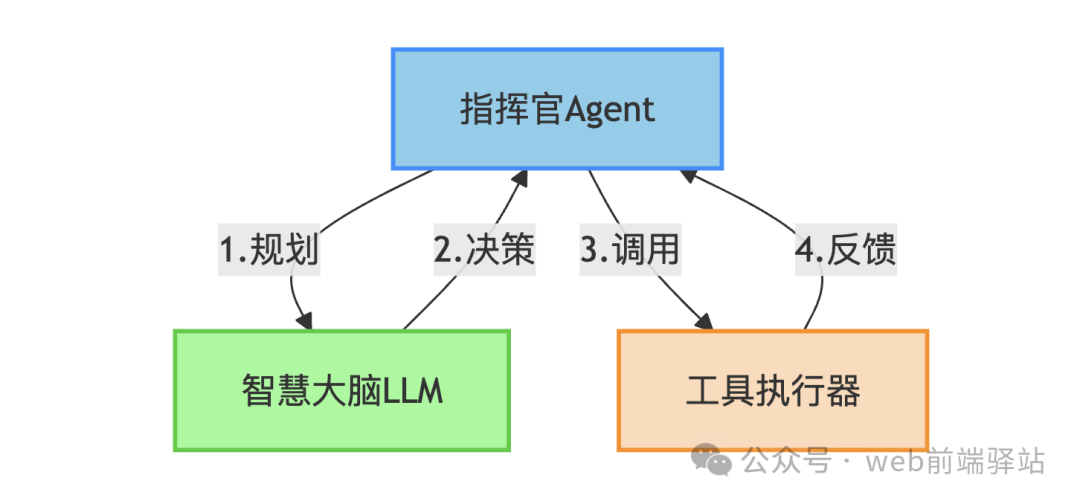
2.1 The Iron Triangle: Agent, Large Model, and Tools
- To understand the magic of an Agent, one must first clarify its core “iron triangle” relationship. Large Language Model (LLM): Acts as the “intelligent brain” of the Agent. It provides world knowledge, powerful logical reasoning, language understanding, and decision-making capabilities. All complex thinking and planning occur here.
- Tools: Act as the “hands and senses” of the Agent. They extend the Agent’s capabilities beyond pure text. These tools can be search engines, calculators, code interpreters, or any application API interfaces.
- Agent: Acts as the “commander.” It is a sophisticated scheduling system responsible for understanding the ultimate goal, tirelessly driving the “brain” (LLM) to think and plan, and accurately calling the “hands” (Tools) to execute tasks based on the planning results.
Without the Agent as the scheduling system, LLM and Tools are separate and passive.
2.2 Breakdown of the Core Architecture of AI Agents
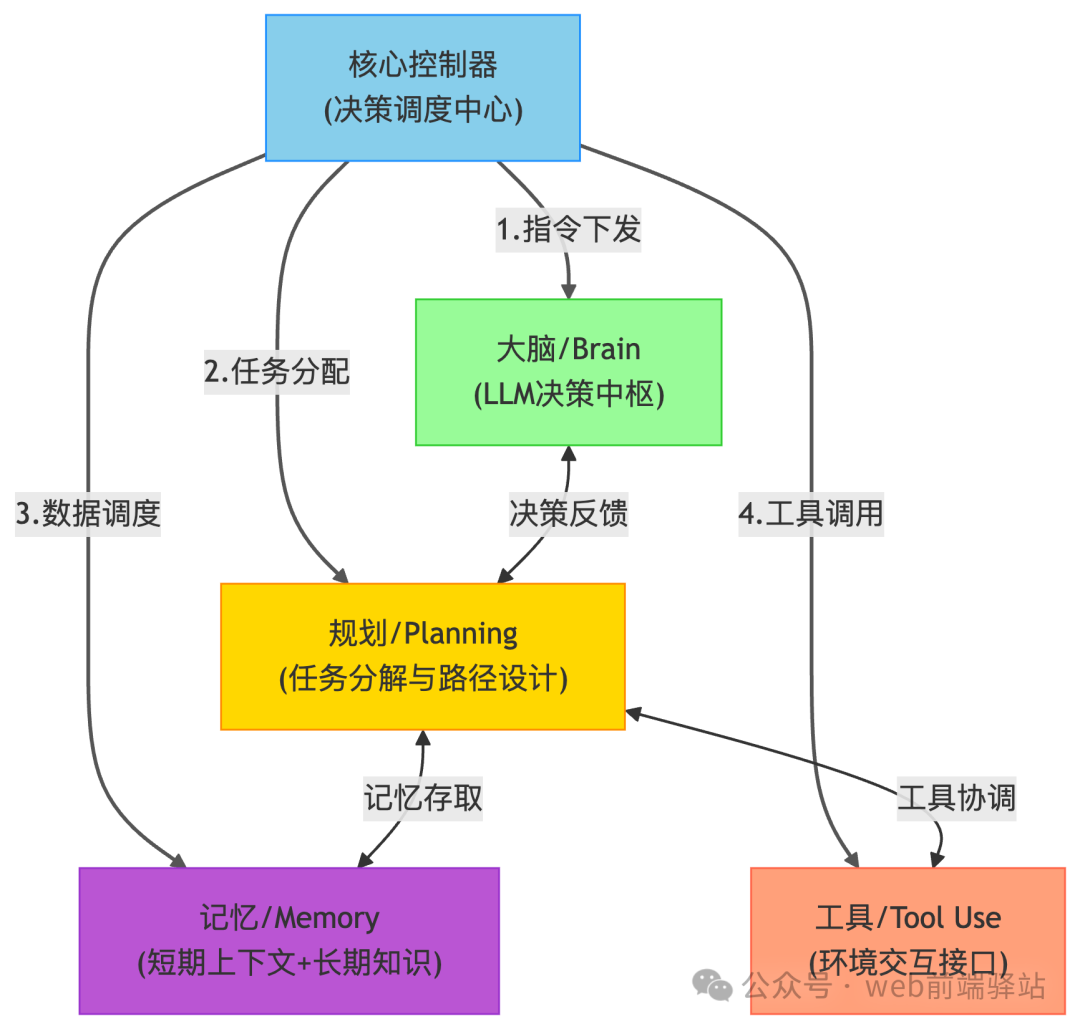
A typical AI Agent usually consists of the following four core modules, which work together to mimic human thinking and action processes.
2.2.1 Brain: The LLM as the Decision-Making Center
This is the engine of the Agent, responsible for handling all high-level cognitive tasks. When the Agent receives a goal, it is first understood, interpreted, and initially thought out by the LLM brain.
2.2.2 Planning: The Art of Moving from Goals to Steps
This reflects the wisdom of the Agent. It breaks down a grand, vague goal into a series of clear, executable small steps. For example, breaking down “planning a trip” into “searching for flights,” “comparing hotels,” and “designing an itinerary.” The currently popular ReAct (Reason + Act) framework, initially proposed by researchers at Google Brain, allows the Agent to perform “thinking reasoning” before taking action, marking a significant milestone in the field.
2.2.3 Memory: Enabling the Agent to Learn from Experience
To handle long-term and complex tasks, the Agent must possess memory capabilities.
Short-term memory: Refers to remembering dialogue history and intermediate steps in the current task to ensure task coherence.*Long-term memory:Through external vector databases and other technologies, the Agent can “store” past successful experiences and knowledge, retrieving and referencing them when encountering similar problems in the future, thus achieving continuous learning.
2.2.4 Tool Use: Breaking the Boundaries Between Digital and Physical
This is the most fundamental difference between an Agent and a Chatbot. By calling tools, the Agent can:
Access real-time information: Call search engine APIs to get current news or weather. Perform precise calculations: Call calculators or code interpreters. Operate other software: Call internal APIs of enterprises to check order statuses; or call third-party application APIs to send emails, book meeting rooms.
2.3 Key Protocol One: Model-Context Protocol (MCP)
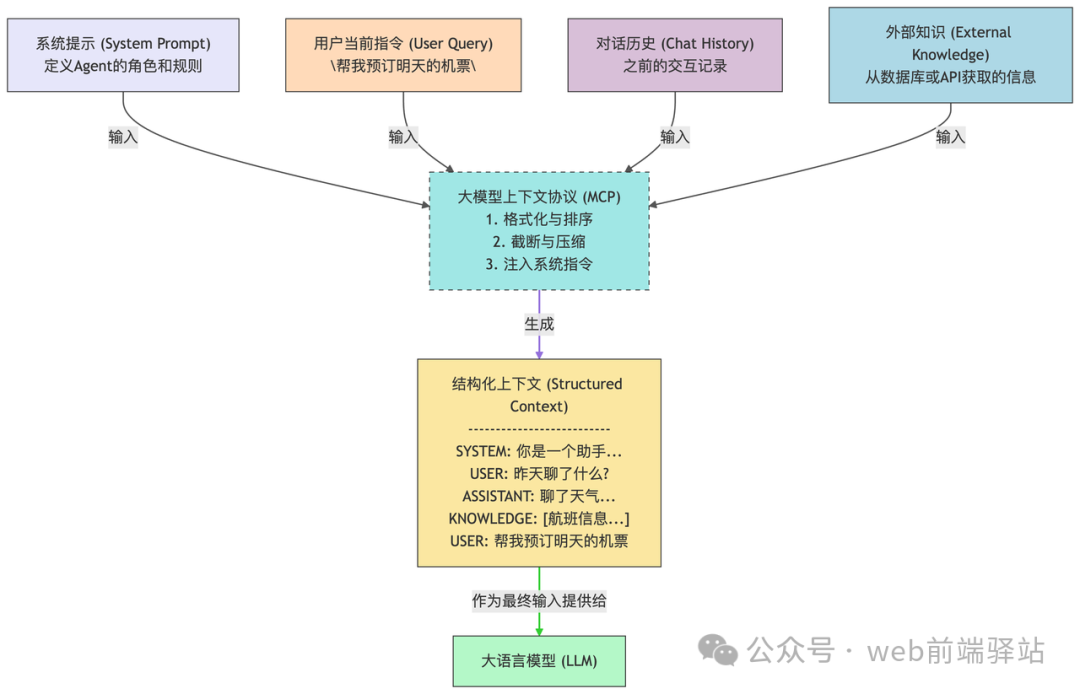
Before each interaction between the Agent and the large model, a crucial “behind-the-scenes work” is being conducted, managed by the Model-Context Protocol (MCP).
The essence of MCP is an efficient context manager.Its core task is to gather information from multiple sources, including system instructions, user history, and external knowledge, and assemble, sort, and compress them into a structured, optimal context before submitting it to the large model for processing. This ensures that the LLM does not become “overloaded” or “confused” when receiving information, leading to more accurate decision-making.
2.4 The Path to Advancement: From Single Intelligence to Multi-Agent Collaboration
When the capabilities of a single Agent reach their limits, AI development moves towards a more complex form—Multi-Agent Systems.
2.4.1 Why is “Teamwork” Necessary?
No matter how powerful a single Agent is, its knowledge and capabilities are limited. Complex real-world problems, such as managing a complete software project, often require a team with different roles, including product managers, programmers, and test engineers. Multi-Agent Systems are designed to simulate this efficient team collaboration.
2.4.2 Multi-Agent Collaborative Planning (MCP)
The core idea of Multi-Agent Collaborative Planning is that multiple Agents with different roles and capabilities dynamically and collaboratively plan for a common grand goal. They will discuss who does what, when to do it, how to cooperate, and even adjust each other’s tasks when encountering difficulties.
Applicable Scenarios:
- Supply Chain Management: Procurement Agents, Warehouse Agents, and Logistics Agents work together to dynamically adjust the entire supply chain based on real-time sales data.
- Game AI: A squad of AI enemies devises complex encirclement and feint tactics to surround players, as illustrated.
2.4.3 Key Protocol Two: Agent-to-Agent Communication (A2A)
To achieve efficient team collaboration, members must have a common communication language. The Agent-to-Agent Communication (A2A) protocol plays this role. It is not a simple natural language chat but a rigorous layered encapsulation process similar to a network protocol. A high-level intention is packaged into structured data that machines can accurately parse and execute, ensuring precise collaboration between Agents.
3. Cutting-Edge Practice: Which AI Agents are Defining the Future?
3.1 Open Source Frameworks: A Powerful Toolkit for Developers
LangChain: The most popular Agent development framework today, akin to a “Swiss Army Knife,” providing various standardized components and toolchains needed to build Agents, significantly lowering the development threshold. LlamaIndex: Focused on connecting “data” with LLMs, particularly adept at building Q&A or analytical Agents based on vast private knowledge bases. AutoGen: A multi-agent dialogue framework launched by Microsoft, its core highlight is the ability to easily build “collaborative groups” composed of multiple conversational Agents to solve complex problems.
3.2 Commercial Applications: Star Products Reshaping Industries
Devin: The first “AI Software Engineer” launched by Cognition AI, (widely reported by several leading tech media) can autonomously complete the entire process from requirement analysis to coding and deployment, causing a stir in the industry. MultiOn: As a “browser Agent,” it can perform clicks, fill out forms, and other operations on any website like a human, achieving cross-application complex task automation. Adept: Also focused on converting natural language instructions into software operations, aiming to create a universal AI teammate capable of operating all software.
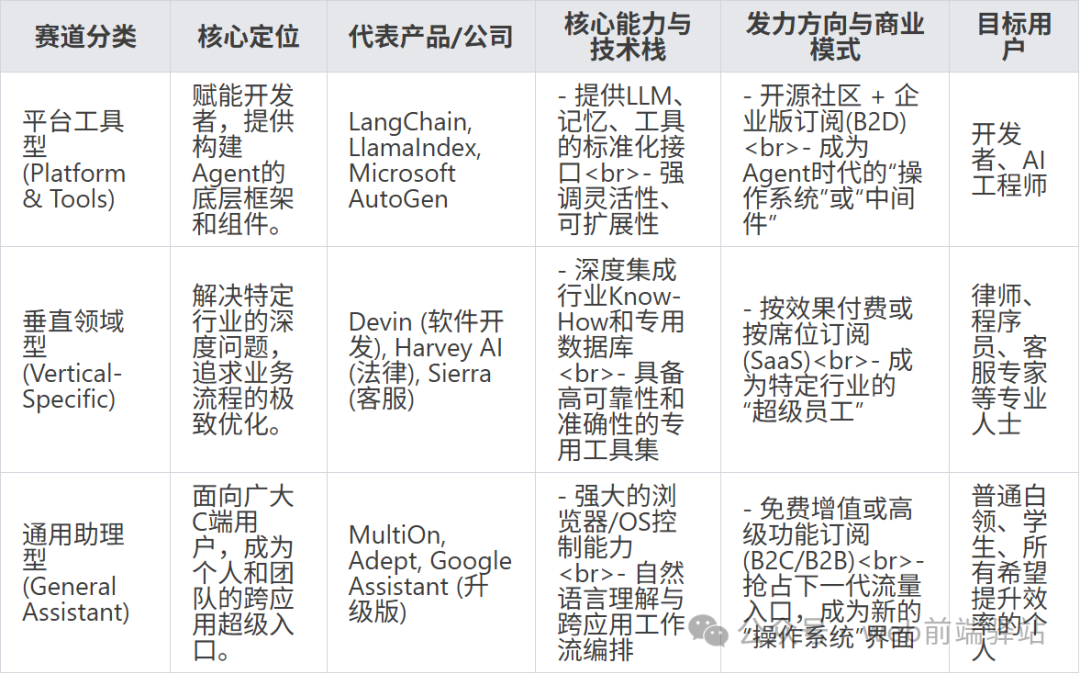
3.3 Market Landscape: Comparison of Mainstream Agent Products and Capabilities
4. Value Realization—Application Scenarios and Business Landscape of AI Agents
4.1 Empowering Individuals: Your Super Productivity Partner
Imagine you only need to tell your AI assistant: “Help me research the trends in the global semiconductor market for 2025, focusing on the latest financial reports from TSMC, Samsung, and Intel, and compile it into a 10-page draft PPT.” The Agent will start working autonomously, saving you dozens of hours.
4.2 Transforming Enterprises: Driving Business Process Automation (BPA)
In enterprises, Agents are transitioning from “auxiliary tools” to “digital employees.” According to Gartner’s predictions, by 2026, over 30% of new applications will use AI to drive personalized adaptive user interfaces, with AI Agents being the core technology to achieve this. For example, a smart customer service Agent can not only answer customer questions but also autonomously access the order system, verify refund conditions, execute refund operations, and automatically send email notifications, achieving end-to-end process automation.
4.3 Scientific Exploration: Accelerating Research and Discovery Processes
In the field of scientific research, AI Agents can conduct data analysis, simulate experiments, and literature searches 24/7. Researchers can instruct the Agent: “Analyze this batch of gene sequencing data to find potential mutation sites related to specific diseases,” greatly accelerating the research process.
5. Looking Ahead—Opportunities, Challenges, and the Future of AI Agents
5.1 Huge Opportunities: From “Human-Computer Interaction” to “Human-Computer Collaboration”
The ultimate value of AI Agents lies in their potential to fundamentally change our relationship with the digital world. Future work models will no longer require humans to adapt to tools; instead, tools (Agents) will actively understand human intentions and collaborate to complete tasks. OpenAI has repeatedly emphasized in its official blog that one of its long-term goals is to develop AI Agents that can serve as powerful collaborators for humans. This will give rise to numerous new business models based on Agents and the rise of “one-person companies.”5.2 Severe Challenges: The Path to Trustworthiness The road to a bright future is not smooth; Agent technology still faces many challenges:
- Reliability: The “hallucination” problem of LLMs may lead to Agents executing incorrect or unpredictable operations.
- Security: How to prevent Agents from being exploited by malicious instructions to perform harmful tasks?
- Cost: As pointed out by deep analysis media like “Gizmodo”, the high reasoning cost of Agents executing complex tasks, requiring extensive calls to LLMs, is a significant barrier to commercialization. However, when assessing their value, one must consider the “opportunity cost”—if an Agent can save an expensive software engineer 2 hours of work each day, the value it brings may far exceed the cost of API calls. Therefore, for enterprises, the core issue is to find application scenarios that can achieve a “positive value cycle.”
- Ethics: How to ensure that the decision-making processes of Agents align with human morals and values?
5.3 Final Thoughts: Will AI Agents Become the New “Operating System”?
A thought-provoking perspective is that future AI Agents may evolve into a new type of “operating system.” This idea aligns with the views of Microsoft founder Bill Gates, who has repeatedly stated that future “personal agents” will disrupt the software industry, eliminating the need to use different applications for different tasks; we will only need to tell the intelligent agent what we want in natural language.
6. Start Your Journey of Exploring Agents
Whether you are a developer, entrepreneur, or a curious student about AI, you can start your journey of exploring Agents right away.
- For Developers: We recommend starting with the official documentation of LangChain to try building your first “Hello, Agent!” application. At the same time, you can follow the AutoGen GitHub project to understand the charm of multi-agent collaboration.
- For Product Managers/Entrepreneurs: Delve into the three tracks in “Part Three: Market Landscape” and think about which aspects of your business can be reshaped by Agent technology. Trying out general assistant products like MultiOn may inspire new ideas.
- For Ordinary Users/Students: Start by using AI products with Agent capabilities to experience how they can enhance your learning and work efficiency. You can visit our BetterYeah AI official website to experience our Agent products for free, and we will continue to bring you cutting-edge interpretations and application cases of AI Agents.
7. Frequently Asked Questions about Agent Applications (FAQ)
-
Q1: Do I need to learn programming to use AI Agents?
-
A: Not necessarily. For general assistant-type Agents (like MultiOn), users only need to issue commands in natural language. However, for platform tool-type Agents (like LangChain), developers need programming skills to build and customize Agents.
-
Q2: Will AI Agents completely replace my job?
-
A: They will replace repetitive, process-driven tasks, not humans. AI Agents are more like powerful partners that can free humans from tedious work, allowing us to focus on creative, strategic, and interpersonal tasks that AI finds difficult to handle.
-
Q3: What basic tools are needed to build my own AI Agent?
-
A: Basic construction usually requires: a powerful LLM API (like OpenAI API), a development framework (like LangChain), a vector database (for long-term memory), and the tool APIs you want it to use (like search APIs), or you can directly register and log in to our BetterYeah AI Agent development platform for a free experience.
-
Q4: Is the cost of using AI Agents high currently?
-
A: Yes, the current costs are relatively high. The main expenses come from the API call fees of LLMs. A complex task may require the Agent to engage in dozens or even hundreds of “thoughts” with the LLM, which can incur significant costs. Reducing reasoning costs is one of the core challenges in the industry.
Conclusion
We are standing at the dawn of an era of “autonomous intelligence” ushered in by AI Agents. It is no longer a distant fantasy from science fiction but a profound industrial transformation that is happening in reality. As analyzed in reports from various consulting agencies, AI Agents are becoming the key bridge connecting the digital world with the physical world, with immeasurable commercial potential.
From the workings of the “iron triangle” to the flourishing market landscape, and the profound impact on our future work and life, the core value of AI Agents remains consistent:
They are “actors” capable of autonomously understanding goals, planning paths, and ultimately completing tasks.
Understanding AI Agents is to understand the future. We hope this ultimate guide can clear the fog for you and provide a clear cognitive map. Now, consider how to leverage this powerful “digital employee” for your own use and embark on your intelligent new chapter.