 Recently, Wang Xingxing, founder, CEO, and CTO of Yushu Technology, shared his latest views on the current development status of the global robotics industry at the 2025 World Robot Conference. Wang believes that the humanoid robot industry is on the eve of the “ChatGPT moment,” which could arrive in as little as 1-2 years.I would like to share my personal views on the global humanoid robot market. The biggest characteristic in the first half of this year is that due to the booming robotics industry and relevant policy support, both complete machine manufacturers and component manufacturers have achieved an average growth of 50% to 100%. This growth rate is quite remarkable and is very rare for the entire industry, driven by demand.In the overseas market, Tesla, as an industry representative, plans to mass-produce thousands of humanoid robots this year and will release the third-generation Optimus humanoid robot, which is worth paying close attention to. Additionally, global companies are highly enthusiastic about the robotics industry, with companies like NVIDIA, Apple, Meta, and OpenAI continuously promoting development in this field.I would like to share a few personal opinions, which may not be accurate.The first point is that many people may have a misconception regarding the robots themselves: the reason why robots are not widely applied and their functions are not perfect is due to poor hardware or high costs.In fact, the current hardware, whether it is the complete machine or dexterous hands, is sufficient in many respects. Of course, it can be improved, and there are many engineering issues to address regarding mass production.However, from a technical perspective or from the standpoint of AI, the current hardware is completely adequate. The biggest challenge remains embodied intelligence, or the development of AI technology, which is still insufficient. This is also the biggest limitation for the current robots, especially humanoid robots, in terms of large-scale application.The current position of the robotics industry is similar to the 1-3 years before the birth of ChatGPT; the industry has already identified similar directions and technical routes, but no one has managed to realize them.
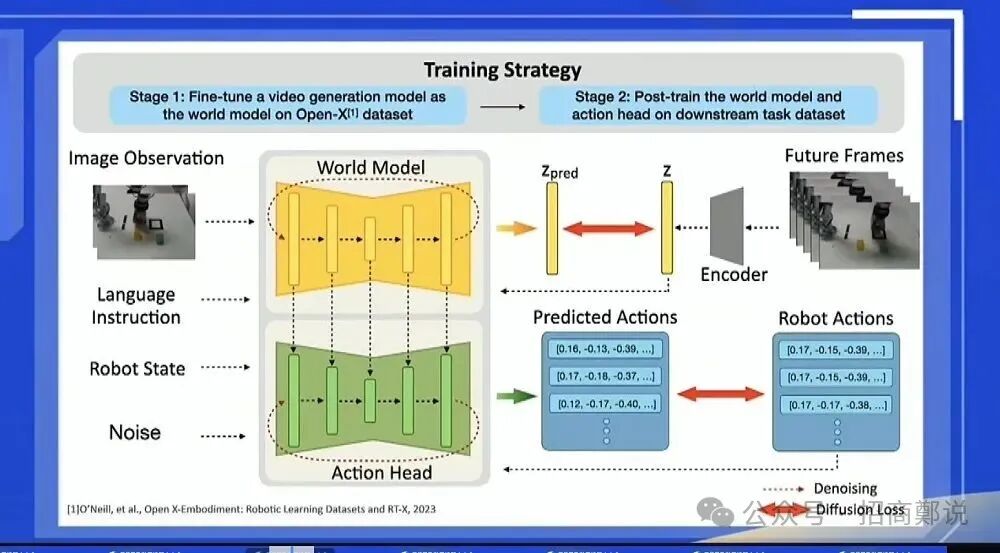
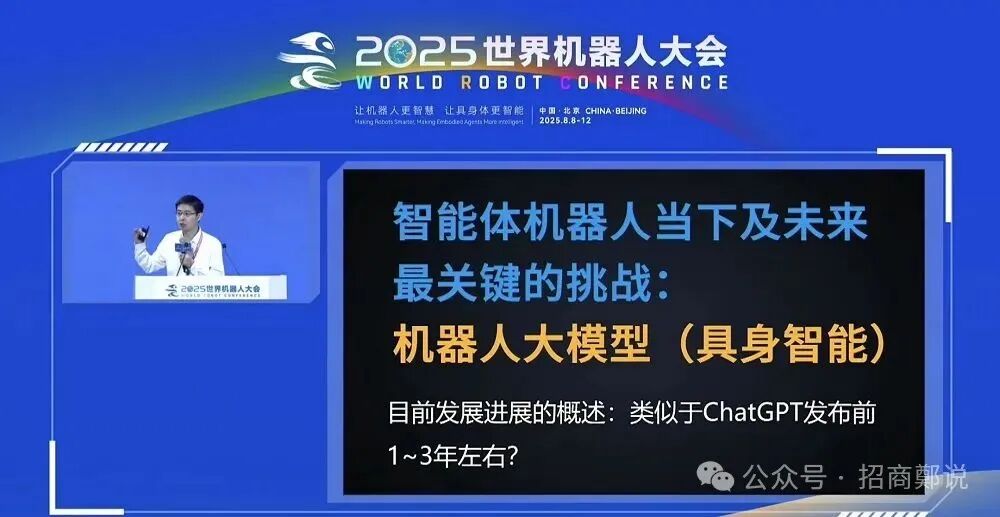 In the years leading up to ChatGPT’s release, those working on voice AI had been doing so for nearly ten to twenty years, but everyone still thought it was very primitive and useless. After ChatGPT was released, it demonstrated capabilities stronger than those of an average person. Robots have not yet reached this critical point.Regarding AI technology for robots, I believe the critical point may be when a humanoid robot can enter a completely unfamiliar environment (for example, a venue it has never seen before), and I can tell it, “Take this bottle of water to a certain audience member,” or “Organize this room,” and it can smoothly and autonomously complete the task. This would be the ChatGPT moment for humanoid robots.If progress is swift, we may achieve this goal in the next 1-2 years or 2-3 years at the latest, with a high probability of realization within 3-5 years.Currently, the issue of insufficient embodied intelligence is due to either the model or the data. I feel that globally, there is too much focus on the data aspect of robotics. The biggest problem is actually with the models, not the data.For embodied intelligence and robotics, the model architecture is still not good enough or standardized. While there is a high focus on model issues, there is comparatively less attention on data issues. In the field of large language models, people believe that having enough data, especially good data, will lead to better model training.However, in embodied intelligence and robotics, it can be observed that in many cases, having data does not mean it can be effectively utilized.One relatively popular model is the VLA model. The VLA is a relatively simplistic architecture, and I personally remain somewhat skeptical about it. The VLA model lacks sufficient data quality and the ability to collect data when interacting with the real world.A simple idea is to add RL training on top of the VLA model, which is a very natural thought. However, I feel that even with our company’s attempts at combining the VLA model with RL training, it is still insufficient; the model architecture needs further upgrades and optimizations.Here, I would like to briefly share some of the things we have done in the past. You may have noticed that Google has released their new generation of video generation models, or in some sense, a video-driven world model. Last year, when OpenAI released their video generation model, a natural thought arose: I could control a video generation model and tell it, “Help me generate a robot to organize the room.”If the robot in the generated video can complete the task, can I make this video generation model directly drive a robot to complete the task? This idea is very straightforward, and we pursued it last year.You can see that the video in the upper right corner is actually generated, not captured by a camera. We used a pre-trained video generation model, retrained it to first generate a video of a robot’s actions, and then controlled a robot to perform the task. This technology is feasible. Google’s video generation world model also aims to achieve this effect.
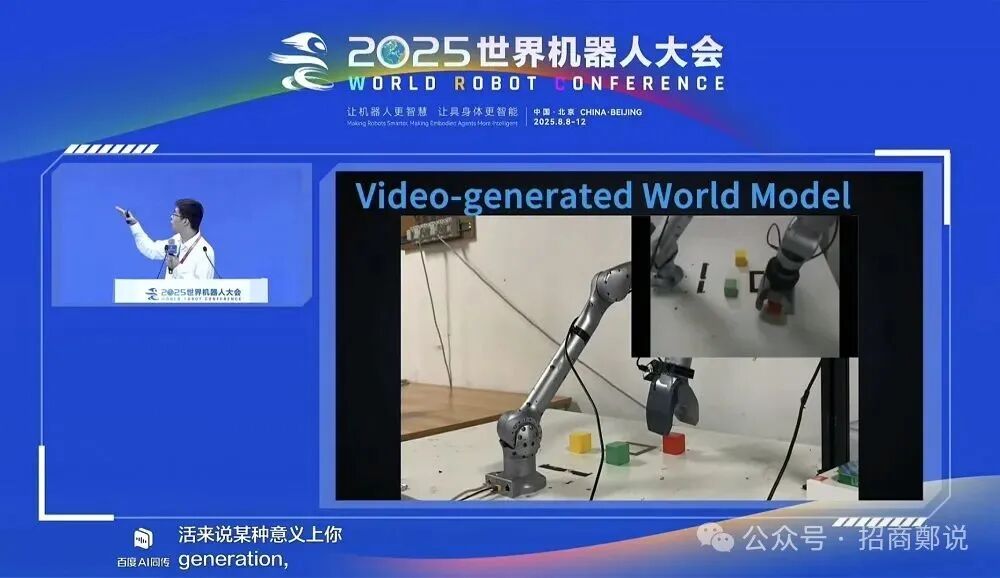 I believe this direction may develop faster than the VLA model and has a higher convergence probability. However, I cannot guarantee it, as there are still many issues. One major problem is that video generation models focus too much on the quality of video generation, leading to high GPU consumption.For robots to perform tasks, in some sense, you do not need very high precision in video generation quality; you just need to drive the robot to work. You should pay attention to Google’s video generation model, which is still very interesting. The entire model architecture is quite simple and straightforward, directly aligning the robot’s action sequences with the model architecture.
 Another point is that, as you know, robots can already dance and perform combat effects quite well, but they face a significant problem. If we want to further enhance robot capabilities, specifically the RL Scaling Law for robots, it is still poorly executed.For example, when I train a robot to perform new actions or dance new dances, I have to retrain it from scratch, which is very inefficient. We hope that every time a robot undergoes new training, it can build upon past training.Theoretically, when I conduct RL training, the speed of each training session should become faster, and the effectiveness of learning new skills should improve. However, across the industry, no one has successfully implemented the RL Scaling Law for robotics. I believe this is a very worthwhile direction to pursue.Because the RL Scaling Law has already been fully validated in the language model field, but in the motion control of robots, we are just beginning.I personally feel that in the next 2 to 5 years, the focus of intelligent robot technology will be on end-to-end embodied intelligent AI models. I believe the model itself is the most important aspect.Then, there is the need for lower-cost, longer-lasting hardware, which is indisputable. As you know, even in the automotive industry, after more than a hundred years, even today, it still requires a significant engineering effort for a company to produce a good car.For the robotics industry, if we aim to produce several million, tens of millions, or even hundreds of millions of humanoid robots each year, the engineering challenges are still quite astonishing.At the same time, low-cost, large-scale computing power is also crucial. In humanoid robots or mobile robot bodies, it is not feasible to directly deploy large-scale computing power. Their size is limited, their batteries are limited, and the power consumption for deploying computing power is restricted.I personally feel that in humanoid robots, the maximum deployable computing power can only be around 100 watts peak power, and during normal operation, the computing power is only a few dozen watts, which is roughly equivalent to the computing power of several smartphones.However, in the future, robots will still require large-scale computing power, and I believe it may be distributed computing power. When robots are working, we hope their communication latency is relatively low. If a robot working in Beijing has its data center in Shanghai or Inner Mongolia, the latency would be too high.I believe that in the future, when humanoid robots are widely used in industrial fields, factories can have distributed server systems, allowing all robots to connect directly to local servers within the factory. The security and communication latency of the servers would be acceptable.Alternatively, if every household in a community has a robot, there could be a distributed cluster computing center in that community to ensure low latency and security. Moreover, if a new customer wants to purchase a humanoid robot, they would not need to invest in the construction of this computing power, significantly reducing costs.I believe that distributed computing power will be a very important area for the robotics industry in the future, potentially broader than the current distribution of computing power.Furthermore, the development of AI and robotics is always a global co-creation process. Whether it is Chinese tech companies, American industry giants, or multinational companies like NVIDIA, all have made significant contributions to this process.In the AI field, no large company can guarantee that with enough talent and resources, they can always stay ahead. OpenAI and DeepMind have proven that AI innovation is always accompanied by some randomness, along with the wisdom and creativity of many smart young people. Therefore, many significant breakthroughs often stem from the contributions of numerous companies and universities, ultimately requiring global collaboration to achieve.
Shanghai Lin Hong Asset Management Limited
Shanghai Lin Hong Asset Management Limited
Shanghai Lin Hong Asset Management Limited was established in2015and is a professional service organization engaged in industrial real estate research, planning, analysis, investment promotion, and operation. Its main focus is on enhancing the industrial capabilities of various industrial parks, incubators, and accelerators, with a business core centered on planning, consulting, investment promotion, operation, and service system construction. The company’s strategic positioning is to “cultivate industries and focus on services,” aiming to become a strategic partner for industrial parks, building a complete industrial operation ecosystem, and striving to promote innovation-driven industrial development. The company currently operates and manages4industrial parks (3 in Shanghai and 1 in the Yangtze River Delta), and4technology incubators (3 in Shanghai and 1 in Tianjin). The total area is800,000square meters, with the main industries being biomedicine, medical devices, industrial automation, and artificial intelligence. The number of enterprises settled in the parks exceeds1,800, with a total output value exceeding37billion.