In this article, we introduce another language in computing: C Language; what are its differences from Go Language? What are its applications? Let’s take a look!
Introduction
The C language was born in 1972-1973 and is a general-purpose programming language that is “close to hardware, highly efficient, and deeply influential”; its role is not only to write the lowest-level, most critical, and fastest code but also to be widely used in system software, application software, embedded systems, game development, and many other fields.
The Different Roles of C Language in Various Scenarios
1. Operating Systems and Runtime
1. Most of the UNIX, Linux, and Windows kernels are written in C (with a small amount of assembly).
2. The currently used glibc, musl, win32 API, and POSIX thread libraries are all C interfaces.
2. Embedded Systems and the Internet of Things (MCU/SoC/RTOS)
1. From 8-bit microcontrollers to 64-bit ARM, startup code, drivers, and protocol stacks are almost all written in C.
2. Code size is controllable and can be precise to the byte, with no runtime overhead.
* Automotive ECUs, drone flight control, and smart bracelet firmware all rely on it to “run”.
3. The “Mother Tongue” of Languages and Virtual Machines 1. The core interpreters of CPython, Ruby MRI, Lua, and PHP; 2. The runtimes and garbage collectors of Go, Rust, and Swift are first started using C/C++ and then self-bootstrapped. * C is a “good choice for writing compilers/interpreters”.
4. High-Performance Computing and Middleware 1. BLAS/LAPACK (scientific computing), FFmpeg (audio and video), and OpenSSL (encryption) are all written in C. 2. The upper-level Python is just “glue”; the real computational power still resides in these C libraries.
5. Networking and Databases
The core engines of Nginx, Redis, and PostgreSQL are pure C.
6. Cross-Language “ABI Common Language”
Any language that provides an extern “C” interface can be called by other languages according to the C ABI standard, therefore Rust, Swift, and Fortran can painlessly reuse C libraries.
* C has become the “lingua franca of the binary world”.
Characteristics of C Language
1. Close to the machine: can directly manipulate memory addresses, bits, and registers.
2. Extremely simple syntax: only 32 keywords, yet sufficient to express everything.
3. Highly efficient: compiled code is almost assembly, with zero additional overhead at runtime.
4. Portable: almost any hardware platform has a C compiler (gcc/clang/msvc…).
Why Learn It in Computer Science?
1. Truly understand computers: C allows you to deeply understand memory, CPU, and registers.
2. Understand the open-source world: Linux source code, Git, FFmpeg, and Redis are all in C.
3. Write extensions for other languages: Python’s Numpy, Go’s CGO, and Rust’s FFI all rely on C interfaces.
What are the Differences Between C Language and Go Language?
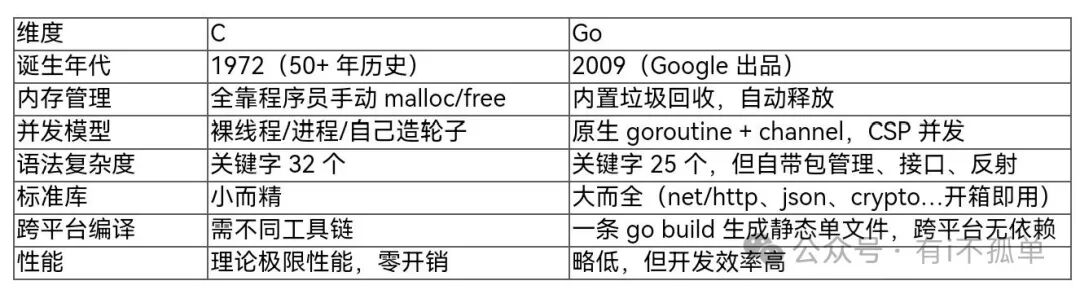
C Language: “A minimal, hardware-close system-level assembly substitute”; Go Language: “A modern system language for the cloud era with garbage collection and native concurrency”.
Below is a quick comparison from 8 dimensions to help you understand the differences between C Language and Go Language at a glance:
Examples of Application Scenarios:
1. Writing operating system kernels, microcontroller firmware → choose C
2. Writing high-concurrency RESTful APIs, microservices, cloud-native containers → choose Go
3. Writing performance-critical encoding/decoding libraries (FFmpeg) → C/C++
4. Writing DevOps tools, Kubernetes ecosystem components → Go is the recommended language
Conclusion
If we compare a computer system to a city, then C Language is the “reinforced concrete”—you can’t see it, but all the skyscrapers rely on it for support.
C Language is like the “Latin of computers”: ancient, simple; once you learn it, you possess the “universal key to unlock all underlying black boxes”.
Finally, I leave you with a saying:
C allows you to “deeply mine every drop of performance from hardware” while Go lets you “easily handle high concurrency”.
 -END-
-END-
Contributed by: Programming Team
Typeset by: Media Promotion Center
First Review: Zeng Xilin
Second Review: Zhang Quanyuan
Final Review: Li Ji’an