TinyML Market Status
TinyML (Tiny Machine Learning) is a technology that runs machine learning models on resource-constrained microcontrollers and edge devices. The goal is to implement efficient machine learning algorithms on devices with low power, low memory, and low computational resources to support real-time data processing and decision-making. Remi El-Ouazzane, President of STMicroelectronics’ Microcontroller and Digital IC Division, once stated: “TinyML will become the biggest driving force in the MCU market over the next decade. In the next five years, 500 million MCUs from the company will run some form of TinyML or AI workload.”
Acquisition Status, Compatible MCU Series, Market Share, and Focus Areas of Various Manufacturers in the TinyML Field
|
Manufacturer |
TinyML Related Acquisitions |
Compatible MCU Series |
2024 MCU Market Share |
Focus Areas in TinyML/Edge AI |
Advantages |
Disadvantages |
|
Infineon |
Acquired Swedish TinyML and AutoML startup Imagimob in May 2023 |
– AURIX™ – TRAVEO™ – PSOC™ – XMC™ |
21.3% (Global leader in 2024) |
– Betting on RISC-V architecture – Positioning for automotive over the next decade – PSOC Edge empowering edge AI |
– Leading MCU market share – Leader in automotive MCUs – Strong technical accumulation |
– Relatively late in positioning for emerging AI technologies |
|
Renesas Electronics |
Acquired embedded AI and TinyML solution provider Reality AI in July 2022 |
– RZ/V series MPU – RA series MCU – RX series MCU |
~18% (Top three) |
– RZ/V2N MPU integrates DRP-AI accelerator – Provides 15 TOPS of AI inference performance – Targeting the visual AI market |
– Up to 30% market share in automotive MCUs – Strong AI inference performance – Leading visual AI technology |
– Overall performance decline – Weak demand in industrial IoT |
|
NXP |
eIQ ML (self-developed) |
– S32K5 series – i.MX RT700 – LPC series |
~18% (Top three) |
– S32K5’s eIQ Neutron NPU focuses on automotive edge sensors – i.MX RT700 optimized for AI edge computing – AI/ML accelerators built into the entire product line |
– Strong in automotive MCUs – Leading in software-defined vehicles (SDV) – Comprehensive AI accelerator coverage |
– High inventory levels – Noticeable weak demand |
|
STMicroelectronics |
Acquired Canadian AutoML startup Deeplite (known for edge AI as DeepSeek) in April 2024 |
– STM32 series – STM32N6 (with NPU) – STM32WBA6 – STM32U3 |
~17% |
– STM32Cube.AI tools – Collaboration with Edge Impulse – STM32N6 integrates NPU – Dual-line approach: wireless IoT + ultra-low power |
– Strong STM32 brand influence – Comprehensive ecosystem – Deeplite technology enhancement |
– Slowing market share growth |
|
Qualcomm |
Announced acquisition of edge AI development platform Edge Impulse in March 2024 |
– Mainly focused on mobile chips – IoT product line |
Non-traditional MCU manufacturer |
– Edge Impulse platform includes data collection, model training, deployment, and monitoring tools – Expanding AI capabilities of IoT products |
– Important position of Edge Impulse in the TinyML field – Strong AI technology accumulation |
– Non-traditional MCU manufacturer – Relatively small MCU market share |
|
Texas Instruments (TI) |
No relevant acquisition information |
– TMS320F28P55x (with NPU) – C2000 series – MSPM0 series |
~10% |
– Industry’s first real-time MCU with integrated NPU – C2000 devices integrate NPU – Cost optimization for consumer electronics |
– First 64-bit MCU – NPU fault detection accuracy of 99% – CNN processing efficiency improved by 5-10 times |
– Continuous performance decline – Low market share |
|
Microchip |
No relevant acquisition information |
– PIC32A series |
~10% |
– PIC32A supports TinyML deployment – Supports low-cost AI through 64-bit FPU – Strengthening smart sensor field |
– Rich peripherals – Low-cost AI strategy – Targeting consumer electronics |
– Late in AI technology positioning – Lack of dedicated NPU |
|
Nordic |
Acquired Neuton.ai |
– nRF series |
Smaller |
– Focused on low-power wireless MCUs – TinyML in IoT applications |
– Leading low-power technology – Expertise in wireless technology |
– Small market share – Relatively narrow product line |
Comparison of TinyML Technical Features
A set of data can also illustrate the importance of TinyML: the cost of each TinyML device (including sensors) is $260, with an average power consumption of ≤1100 milliwatts; while the average cost of each AI chip for LLM is $20K70K, requiring tens of thousands of chips, with an average power consumption of 7001200 watts.
Main TinyML Development Frameworks and Tools
Currently, well-known TinyML or AutoML frameworks include SensiML, Stream Analyze, Qeexo AutoML, NanoEdge AI Studio, Imagimob (acquired by Infineon), Reality AI (acquired by Renesas), Neuton.ai (acquired by Nordic), Edge Impulse (acquired by Qualcomm), and eIQ ML (NXP).
Market Outlook
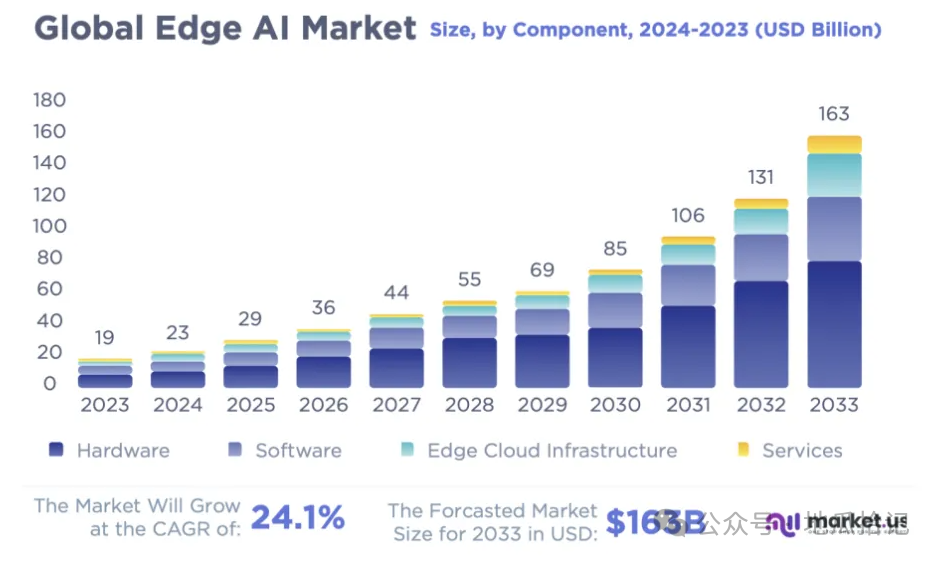
TinyML, as a revolutionary technology, is turning our imagination of smart devices into reality. By running lightweight machine learning models on microcontrollers, we can empower various devices to understand and adapt to their surroundings. With the further development of AI technology and the growing demand for edge computing, the TinyML market is entering a period of explosive growth, with major MCU manufacturers accelerating their layout through acquisitions and self-development, leading to increasingly fierce competition.