We have created a custom expansion board compatible with Arduino Mega 2560 and Arduino DUE, capable of driving DC encoder motors, servos, and stepper motors, with various external communication interfaces and multiple sensor interfaces. The solution is provided for free, and the board cost is low.At the end of the article, there is a technical communication group for everyone to happily connect to the future of intelligence. We welcome everyone to follow and communicate.Arduino MEGA 2560 is a widely used open-source electronic prototyping platform, featuring rich I/O interfaces, open-source and community support, cost-effectiveness, cross-platform support, stability, and reliability, making it very popular among users. However, when developing robots based on the bare board Arduino MEGA 2560, the following issues may arise (see the table below), and we will find solutions for typical problems one by one.
| Serial Number | Traditional Learning Pain Points | Solutions |
| 1 |  Developing robot hardware circuits is complex: it requires motor drivers, sensor interfaces, communication interfaces, and power supply, all circuits need to operate compatibly; Motor drivers need external breadboards, wiring is slow and prone to disconnection. Developing robot hardware circuits is complex: it requires motor drivers, sensor interfaces, communication interfaces, and power supply, all circuits need to operate compatibly; Motor drivers need external breadboards, wiring is slow and prone to disconnection. |
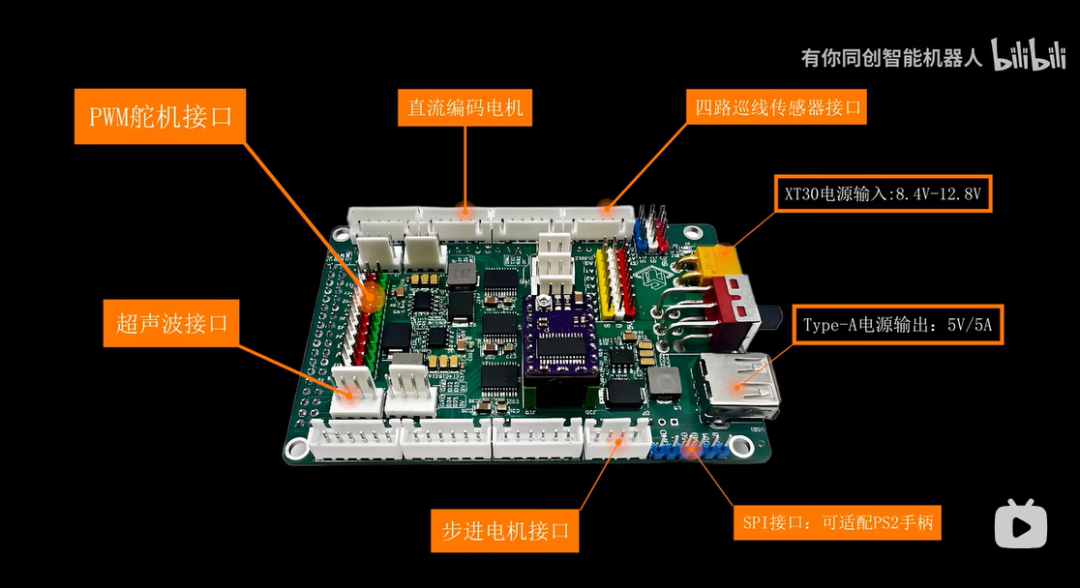
 Overall design interface, highly integrated, achievingintegrated motor driving and plug-and-play sensors. It can drive 6 DC encoder motors, 11 PWM servos, 1 stepper motor, communication interfaces include 1 IIC communication interface, 2 UART serial interfaces, 1 SPI communication interface, sensor interfaces include 1 set of 4-line line-following sensor module interfaces, and 4 ultrasonic sensor interfaces. Overall design interface, highly integrated, achievingintegrated motor driving and plug-and-play sensors. It can drive 6 DC encoder motors, 11 PWM servos, 1 stepper motor, communication interfaces include 1 IIC communication interface, 2 UART serial interfaces, 1 SPI communication interface, sensor interfaces include 1 set of 4-line line-following sensor module interfaces, and 4 ultrasonic sensor interfaces. |
| 2 |  Power management is complex: The robot motor interfaces are numerous, and there are many types of motors, requiring careful consideration of interface reuse and current load. Power management is complex: The robot motor interfaces are numerous, and there are many types of motors, requiring careful consideration of interface reuse and current load. |
 Power management optimization: integrated 5V buck module + reverse connection protection.Power input uses XT30PW interface, supporting up to 30A instantaneous current; includes 1 Type-A 5V/5A output interface, which can power controllers like Raspberry Pi, RDK, Jetson Nano, etc. Power management optimization: integrated 5V buck module + reverse connection protection.Power input uses XT30PW interface, supporting up to 30A instantaneous current; includes 1 Type-A 5V/5A output interface, which can power controllers like Raspberry Pi, RDK, Jetson Nano, etc. |
| 3 | Difficulty in developing low-level driver libraries: Embedded development involves a large amount of work, including drivers for various hardware, sensor data processing, robot body algorithms, etc., lacking a complete program library. |
Providing low-level driver libraries and source code: Self-developed low-level driver libraries for DC encoder motors and servos, providing API interfaces and usage examples; |
| 4 | Limited and few supporting resources: Robot application scenarios are single: supporting experimental tutorials are not open-source, lacking algorithm principle explanations, tutorials are not operable, and execution is weak; |
Modular design, focusing on typical application scenarios: Self-research and design of typical robot chassis, robotic arms, perception control cases, etc., explaining principles, algorithms, and specific operations in detail, allowing even beginners to quickly practice and replicate; |
UNI-ARU expansion board has emerged
To solve the typical problems mentioned above and optimize the solutions, we have independently developed and designed the UNI-ARU expansion board, and it is open-source, open-source, open-source!!!1. Provides multiple interfacesIt can drive 6 DC encoder motors, 11 PWM servos, 1 stepper motor, IIC communication interface, 2 UART serial interfaces, 1 SPI communication interface, 1 set of 4-line line-following sensor interfaces, 4 ultrasonic sensor interfaces, and 12 additional GPIOs. It provides various interfaces, along with related source code and tutorials based on this board.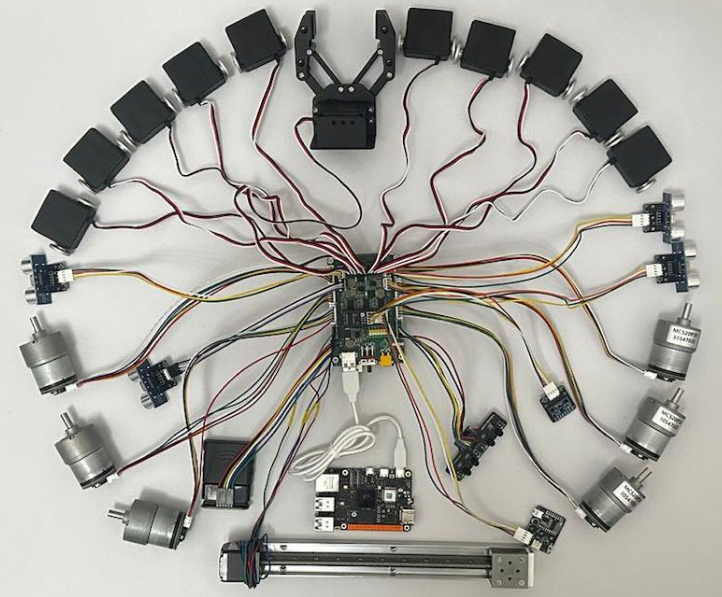 Physical image of various interfaces
 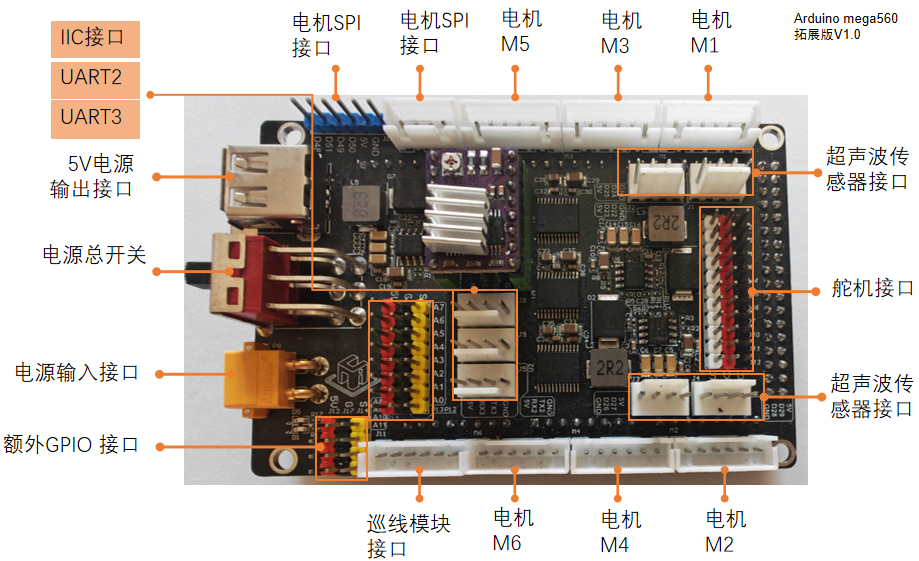 3D functional diagram
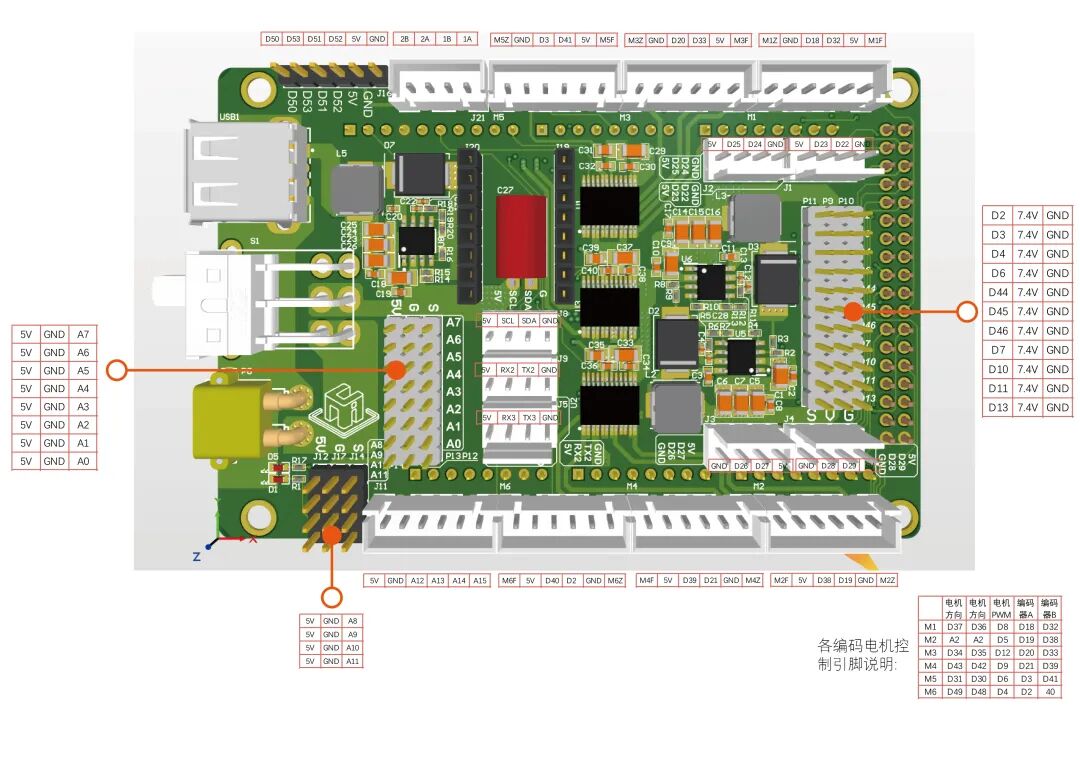 Pin description diagram2. Supports multiple power circuitsUNI-ARU expansion boardhandles all power circuits: supports a wide voltage input of 8.4V-12.8V, providing a 5V/5A Type-A external output power supply, which can power RDK, Raspberry Pi, Jetson Nano, K210, etc. This driver expansion board is designed based on the Arduino Mega 2560 main board and is also compatible with the Arduino DUE main control board.3. Accompanyinglow-level program source files
We have created a code example for each interface of theUNI-ARU expansion board to help users use it faster.
Gitee download link:https://gitee.com/little-wooden-man/mega2560_-extended_-bord
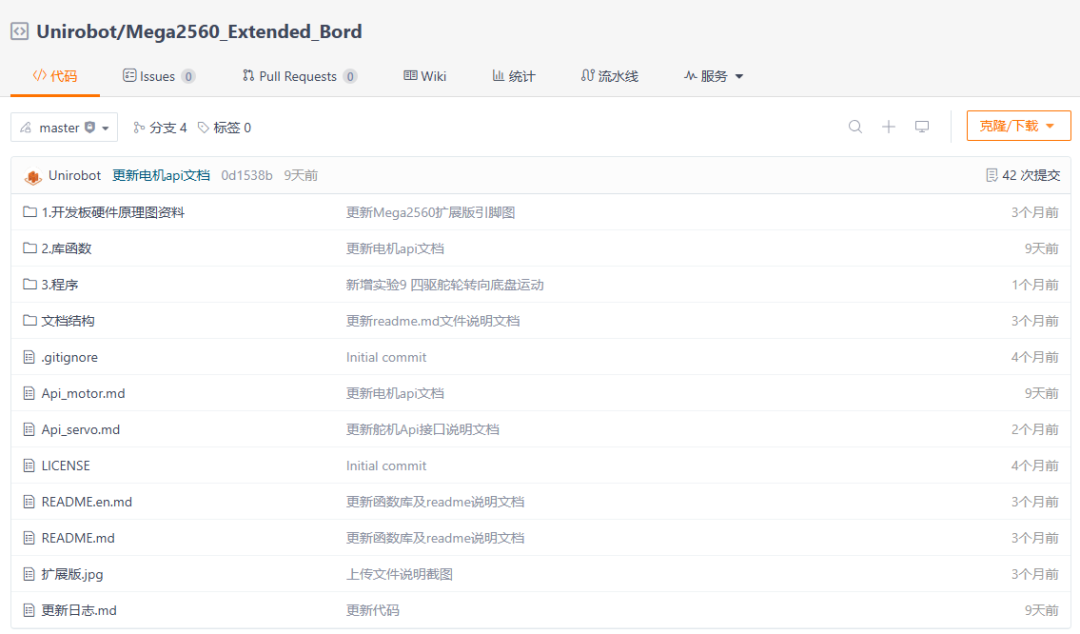
4. Provides detailed experimental tutorials
Based onUNI-ARU expansion board, various application projects can be created, from the most basic motor PWM driving, PID control, 9 types of chassis prototype control, 6 types of robotic arm kinematics control, 6 (specific number depending on experiments) types of typical sensor usage, AI vision applications, to comprehensive project designs covering classic competitions, with detailed operable tutorials and necessary effect demonstration videos. (Copy the link below into your browser to view)https://unirobot.yuque.com/org-wiki-unirobot-gr9ewx/hg616l?# “GX-MAT-09 Design Development Manual V2.0 (Illustrated Version)”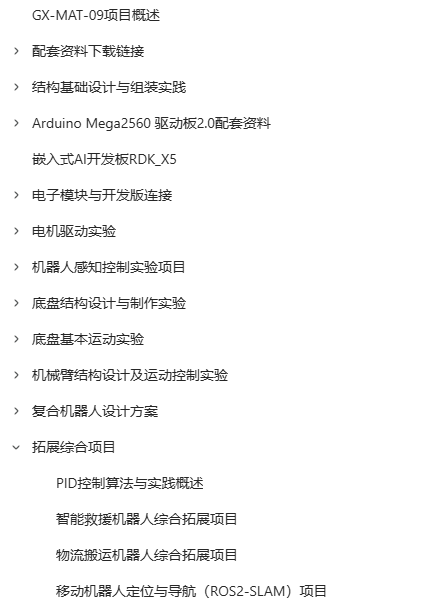
We have open-sourced the entire hardware solution, and JLCPCB can provide free board fabrication!
Copy the project link below to start your replication now!
https://x.jlc.com/platform/detail/278a899ed5834980b6136bf73e044076?type=1&share=jlc1742868845686
UNI-ARU expansion board project demonstration video (copy the link below into your browser to view)
https://www.bilibili.com/video/BV1tUosYiERx/?spm_id_from=333.337.search-card.all.click&vd_source=96b0fd8fa0825eb9ea3516a93146410f
Some images referenced in this article are sourced from the internet. If there are any copyright issues, please contact this public account for deletion.
How to obtain the project:Click the “Read the original text” button at the bottom left of the article, or log in to the hardware innovation community website x.jlc.com, and search for “Arduino MEGA 2560 Driver Board“ to find it..