Click the blue text to follow us
Reprinted from Semiconductor Industry Observation
With the IPO of Weijie Chuangxin falling below expectations, the final battle of domestic RF chips has arrived ahead of schedule.What was bound to happen has finally come; all parties in the industry have calmed down to think about the way out and the future, reducing chaos and returning to the essence of the industry, viewing this final battle of domestic RF chips with a rational and objective perspective.The two most important battlefields in the final battle of domestic RF chips are technology and market. The capital market has little time left for domestic RF chip startups, with a short window of 3 years and a long one of 5 years. If they cannot go public or be acquired, they will ultimately face elimination.
Technological Competition
In the chip industry, products are a manifestation of technology, and technology reflects talent. However, technology is not only a reflection of talent but also of time and funding. To produce technologically advanced chip products, investment in talent, time, and funding is essential. Only when these three elements are in place can one gain technological competitiveness.Technological advantages and competitiveness must ultimately be reflected in products; it is only valuable and meaningful to let products speak for themselves. For companies, technology that cannot be realized or converted into product competitiveness is not truly meaningful technology.The technology of RF chips in China has developed over nearly 20 years, from stumbling beginnings to rapid advancements, thanks to the persistence and efforts of Chinese RF professionals and the favor and support of capital. Today, the technology and products of Chinese RF front-end chips have been fully deployed, learning from and catching up with foreign manufacturers. Below is a summary of the technology and products of domestic RF chips:2G PA/3G PA:Domestic production of 2G PA began in 2006, and it has been 16 years since then. From initially using GaAs technology, it has now fully transitioned to CMOS technology. Domestic RF chip companies produce products that are both cheap and good.3G PA has been domestically produced since 2012, with both GaAs and CMOS technologies coexisting. The pure 3G mobile phone market has essentially disappeared, leaving no market space for PA.Phase 2/Phase 5N:With the innovation of Phase 2 architecture under the leadership of MTK, 4G PA has emerged, known as Phase 2 PA. This was also the earliest prototype of modular PA, using substrate technology to integrate several different dies into one package, employing different processes, integrating PA and switches. Domestic RF chip companies spent three years focusing on research and development to achieve success, followed by two years of technical iteration to catch up with foreign manufacturers.Subsequently, based on Phase 2 PA, it was upgraded to Phase 5N, entering the 5G PA ranks, with no significant technical barriers.L-PAMiF:Sub-6GHz UHB L-PAMiF significantly increases the design difficulty for PA, with n77/78/79 PA operating at higher frequencies and wider bandwidths, thus increasing design complexity. It also requires higher power and greater integration, adding integrated LNA and filters, which leads to higher thermal management requirements. Leading domestic RF chip companies began mass production in 2020, and today, four domestic RF chip companies have achieved mass production, widening the technological gap between domestic RF chip companies.PAMiD:The sub-3GHz PA module solution for 5G mobile phones has evolved from Phase 7 to Phase 7L, integrating LNA into PAMiD, resulting in a highly integrated L-PAMiD, which is currently the most widely used module solution; next, it will evolve from Phase 7L to Phase 7LE, adding EN-DC based on MH L-PAMiD.Domestically, there is a blank space for this product, with a large number of filters integrated. Compared to L-PAMiF, the integration level is higher, and the research and development difficulty is greater. PAMiD will further widen the technological gap between domestic RF chip manufacturers.WiFi FEM:Producing WiFi4 FEM is easy, and making WiFi5 FEM is not difficult, but achieving normal mass production of WiFi6 FEM is clearly not so easy.WiFi FEM has entered the WiFi6 era, covering frequency bands of 2.4GHz, 5GHz, and 6GHz. Without full-band coverage, it cannot be called WiFi FEM; without real WiFi6 FEM technology, it cannot be called WiFi FEM. With WiFi7 already on the horizon, the next step is to begin research and development of WiFi7 FEM.Cat.1 PA:Cat.1 PA is a scaled-down version of Phase 2 PA, utilizing the same technology. The challenge lies in who can minimize size and reduce costs.BT FEM:The technical threshold for Bluetooth FEM is low, using CMOS technology, making research and development relatively simple. The market is small, yet there are nearly 10 domestic BT FEM manufacturers.UWB FEM:UWB FEM is similar to BT FEM, using CMOS technology, with no linear technical specifications required, and low power requirements. However, the frequency ranges from 6G-9GHz, belonging to high-frequency broadband. Overall, the technical difficulty is not high, and there has been no evolution in technology; once completed, it is done, with several domestic companies also engaged in this field.Base Station PA:There is little introduction to base station PA in the market, and well-known PA companies have not formally entered this field. Is it due to high technical difficulty or a small market?Base station PA is divided into macro base station PA and micro base station PA, which have been monopolized by foreign companies for the past five years. Early on, macro base station PA used LDMOS technology, and now 70% of products have transitioned to GaN technology. There are indeed technical challenges, especially regarding high reliability requirements. Micro base station PA generally operates at 10W, using GaAs technology, which is relatively easier. Domestic companies have now entered this base station market.DiFEM/LFEM:This product already has leading players in the domestic market, with no technical issues, and domestic chips are also very competitive in terms of cost.Batch consistency is currently a challenge; without SAW filter resources, it is nearly impossible to survive in this field.Switch/LNA:Switches and LNAs have become the most basic conventional products in RF front-end chips, appearing in various chip modules. Companies producing FEM have this technology, with over 50 domestic companies possessing this technology and products.Filters:Filters are the area where domestic RF chips need to make breakthroughs, as filter R&D technology involves EDA, design, process, and packaging technology. To produce filters, establishing one’s own production line has become an industry consensus.BAW/FBAR filters will also encounter patent issues, and circumventing foreign patents will cost domestic RF chip companies significant R&D time and expenses.
Market Competition
Market competition is also a technological and product competition. The top three markets for RF front-end chips are the mobile phone market, WiFi router market, and base station market.The competition in the mobile phone market is essentially a battle for major clients, specifically Huawei/Glory, Xiaomi, OPPO, vivo, along with the three major ODM manufacturers: Wingtech, Huaqin, and Longqi, all competing for these few clients. According to supply chain management principles, each client typically only introduces 2-3 domestic RF chip companies (retaining 2 foreign companies). This leads to one outcome: having a core product but no major clients results in elimination; having major clients but no core product also leads to elimination. Only domestic RF chip companies that possess both a core product and major clients can win the final battle.What constitutes a core product? It refers to those products with high technical content and significant sales proportions. In the RF chip industry, the higher-end the chip product, the larger the market scale tends to be. Therefore, domestic RF chip companies must climb the technological peak while also capturing major clients, facing significant challenges. The following product market sizes in 2021 illustrate this:2G PA/3G PA Market Size:Within 600 million yuanThe market is shrinking, products have reached their peak, with low margins, leaving only 2-3 domestic suppliers.Phase 2/Phase 5N PA Market Size:Approximately 5.5 billion yuanMost Phase 2 PA and Phase 5N PA have been domestically produced, with Skyworks and Qorvo holding a combined market of 1 billion yuan. As 4G mobile phones transition to 5G, Phase 2 PA will decline while Phase 5N PA will grow, but the overall market size will remain stable over the next two years. Weijie Chuangxin holds about 60% market share.L-PAMiF+LFEM Market Size:Approximately 5 billion yuanGenerally, clients will procure L-PAMiF+LFEM together; apart from Huizhiwei starting to supply clients in 2020, other domestic manufacturers only began mass supply in the second half of 2021. This product is primarily dominated by foreign manufacturers, and its market size is expected to grow with the increase in 5G mobile phones. It is anticipated that by 2022, most market share will be replaced by domestic RF chips.PAMiD Market Size:Approximately 6 billion yuanThis market is occupied by Skyworks, Qorvo, and Qualcomm RF360. The market size will continue to grow, but domestic RF chip companies will not be able to capture this market share within two years.Discrete Switch/LNA Market Size:Approximately 3.6 billion yuan (RF switch: 2.8 billion, LNA: 800 million)So far, the market has been monopolized by Zhaoshengwei, with an estimated 1.5 billion yuan coming from the South Korean market. According to Weijie Chuangxin’s financial report, RF switch sales in 2021 were approximately 50 million yuan.This market size is declining; as long as Zhaoshengwei does not abandon this market, other companies have no opportunity. Even mobile PA companies with RF switch technology, good supply chain pricing, and major client bases have no chance. Otherwise, these mobile PA companies could directly go public with RF switches.DiFEM Market Size:Approximately 2 billion yuan (estimated)Currently, the only domestic manufacturer producing DiFEM is Zhaoshengwei, while foreign manufacturers include Skyworks, Murata, Qorvo, and Qualcomm RF360. Specific market data has not yet been collected and will be updated later.As Zhaoshengwei’s SAW filter factory begins mass production, it will continue to dominate, if not monopolize, the DiFEM market.WiFi FEM Market Size:Approximately 3 billion yuanThe market size for WiFi6 FEM is larger than that for WiFi5 FEM, and WiFi5 FEM is larger than that for WiFi4. It is believed that in the future, the market size for WiFi7 FEM will certainly exceed that of WiFi6 FEM.Over 20 domestic companies are engaged in WiFi FEM, while currently, over 80% of the market share belongs to Skyworks, Qorvo, and Richwave, with Qualcomm RF360 also developing WiFi FEM and set to enter this market.Cat.1 PA Market Size:Approximately 300 million yuanThe market capacity is limited, with limited growth potential. There are as many as 7 domestic competitors, with no technological evolution, leading to a final outcome of homogeneous products competing on price, resulting in no profits.BT FEM Market Size:Approximately 100 million yuanIn such a small market space, why are there as many as 10 domestic manufacturers? The answer is simple: the technical threshold is too low.UWB FEM Market Size:Approximately 2 million yuanUWB, like Bluetooth, is short-range communication, requiring no additional FEM, while also pursuing low power consumption; adding FEM would negate low power consumption.UWB base stations require FEM to increase transmission power. However, the promotion of UWB base stations falls under the realm of commercialization, unrelated to operators. UWB is an old technology from over a decade ago, and the future market’s potential and timing remain uncertain. Even if the UWB market does emerge, the market size for adding FEM to UWB base stations would only be around 100 million yuan.Base Station RF Front-End Chip Market Size:3-6 billion yuanThe base station market is significantly influenced by technological upgrades and policies, making it a cyclical market. Therefore, the market size in 2021 has little reference value.Base station RF front-end chips include PA, Switch, LNA, and Filter (SAW, LTCC, BAW/FBAR).Base stations are further divided into macro base stations and micro base stations. According to market information, the market size for micro base station PA in 2021 was 500 million yuan, while the procurement of filters for macro and micro base stations was around 600 million yuan.The domestic landscape for macro and micro base station PA has been initially established, with three clients and four domestic base station PA manufacturers. The clients are Huawei, ZTE, and New H3C, with three of the four domestic base station PA manufacturers either preparing to go public or undergoing guidance for listing, while one will not go public. According to industry insiders, domestic base station PA achieved nearly 2 billion yuan in shipments in 2021.Discrete Filter Market Size:Approximately 11 billion yuan (SAW filter: 10 billion, BAW/FBAR: 1 billion)This 11 billion yuan filter market includes Murata’s 700 million USD, Qualcomm’s 300 million USD (SAW+BAW), Wisol’s 200 million USD, Taiyou’s 200 million USD, Broadcom’s 100 million USD (FBAR), and domestic filters at 200 million USD. Only the n40 and n41 frequency bands in mobile phones will use BAW/FBAR filters, and in the future, most filters will be integrated into modules.80% of domestic filter sales come from four companies: Haoda, Deqing Huaying, Maijie Technology, and Sanan Integrated.
PA and Filter Competition
The arrival of RF front-end modules could have allowed PA and filters to form a cooperative relationship, but as more and more domestic filter companies publicly announce their development of RF front-end modules, this relationship has shifted from cooperation to competition.There is a saying: “If everyone is poor, why should you be the first to get rich and break this balance?” In any industry, a person who breaks the balance has infinite possibilities. They may maintain their original circle or abandon it…The domestic RF chip industry has fallen into a prisoner’s dilemma, with domestic filter companies developing PAMiD, LPAMiF, LFEM, and DiFEM, while mobile PA companies ponder whether to enter the filter market.Zhaoshengwei started with RF switches, moved into filters, and ultimately achieved PA modularization, making it the most complete company in the domestic RF front-end chip layout.What about Weijie Chuangxin? What about other domestic PA companies? Undoubtedly, they must develop their own filters, just like Skyworks, Qorvo, and Qualcomm, as having their own filters is essential for producing competitive RF front-end modules.The competition between domestic PAs and domestic filters has officially begun. Who will emerge as the victor in this final battle?The competition between domestic PA and domestic filters is essentially a competition between PAMiD and LPAMiF products, especially PAMiD, where filters account for 60% of the total cost in the module. Who has the advantage? Let’s first analyze the products.The filters required for PAMiD are all small-sized, such as Low Profile CSP (thickness less than 0.35mm) or WLP. Since PAMiD is applied in high-end mobile phones, there are high requirements for filter performance and reliability. Additionally, PAMiD needs to support complex CA functions, requiring the use of four-way or six-way filters, significantly increasing the design difficulty for filters.The filters required for PAMiD include Low band: n5, n8, n12, n20; Mid band: n1, n3, B34/39; High band: n7, n40, n41, where SAW filters account for 70% and BAW filters account for 30%. Apart from n40 and n41 BAW/FBAR filters, which can be provided by domestic manufacturers, the other filters are only available from foreign manufacturers. As for LPAMiF, the n77/79 frequency bands use LTCC or IPD filters, which are unrelated to SAW and BAW/FBAR filters. Future millimeter-wave AiP and SAW, BAW/FBAR filters will also be unrelated.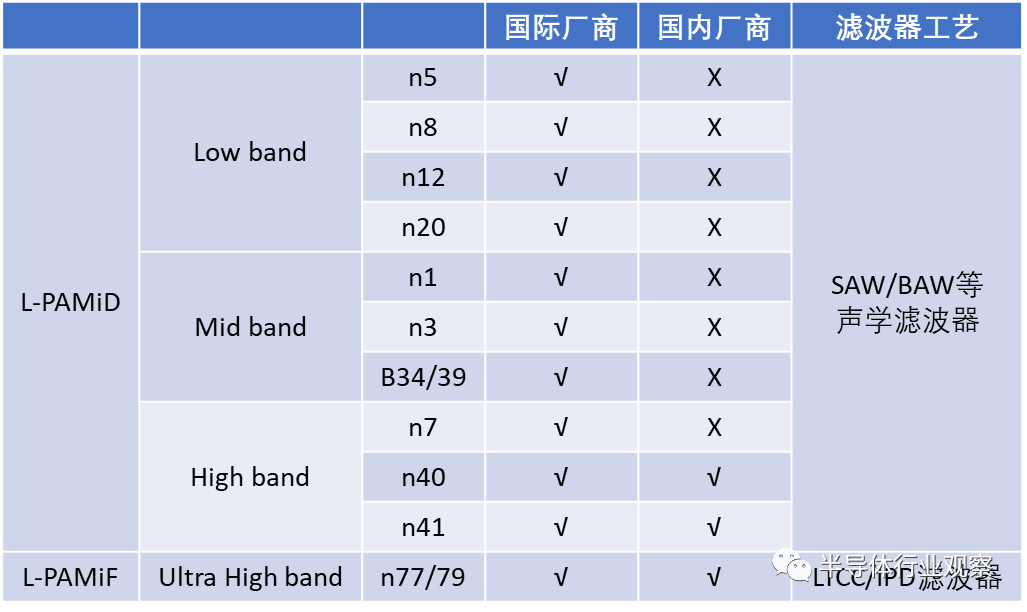 Domestic filter companies developing PAMiD and LPAMiF must first develop PA, as no company in the market sells 5G PA bare DIE; secondly, they must develop the filters required for the modules. Of course, they can also purchase foreign filters, but that would mean having no advantages in both PA and filters. Therefore, to win in competition, domestic filter companies must advance in both PA and filter development, requiring significant investment in both manpower and funding.Looking back at the current state of domestic filters, discrete Rx SAW filters are already okay, but discrete large-size Normal SAW filters can only be applied to frequency bands like B1/5, and discrete large-size TC-SAW filters (expandable to B3/8/28/7, etc.) are still not available. The ability to integrate small sizes and use IHP/TC-SAW/BAW processes to achieve full-band filters like B1/3 is still lacking.However, for mobile PA companies, PA technology has already been mastered, and they only need to purchase foreign filters to create PAMiD, solving the integration issue, and later replace with domestic filters (whether by purchase or self-manufacturing). Relatively speaking, they can launch PAMiD products more quickly.The future is uncertain; who will ultimately win the competition between domestic PAs and domestic filters remains to be seen.
Conclusion
The final battle of domestic RF chips will be divided into two phases: the first phase is the IPO race, and the second phase is the elimination race after going public. Some will fall in the first phase, while others will fall in the second phase; regardless of which phase, this journey will not be long.Do not fear the results and the future; focus on being your best self, looking towards brighter lights and deeper dreams. Even if one day you bid farewell to chip entrepreneurship, remind yourself that you have lived through it all.