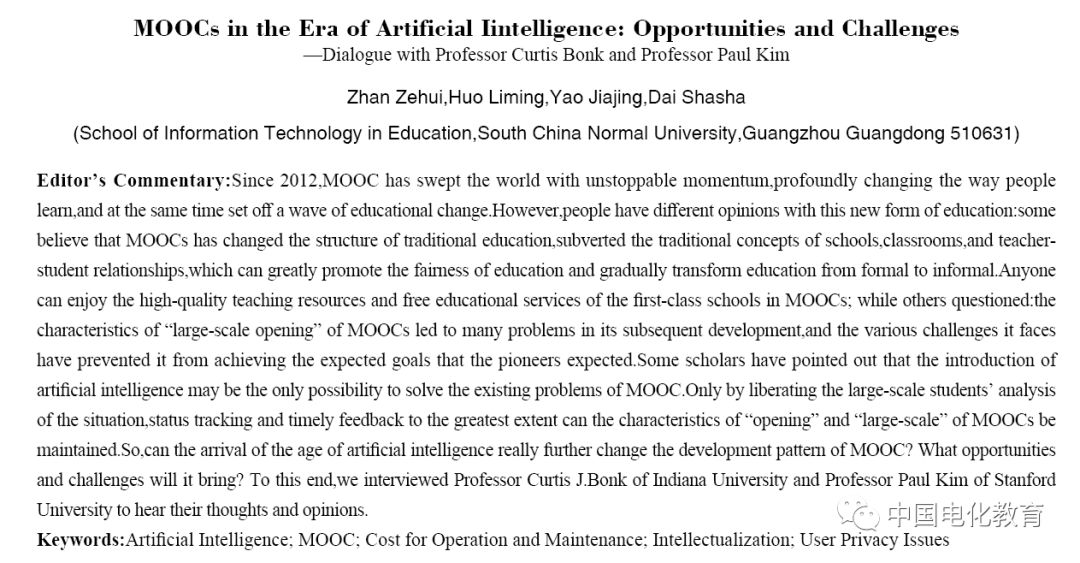
Zhan Zehui, Huo Liming, Yao Jiajing, Dai Shasha
* This article is a research result of the Youth Pearl River Scholar Program of Guangdong Province (Yue Teacher Letter [2017] No. 79), the Major Project of Basic Research of the Guangdong Provincial Department of Education, and the Major Project of Applied Research “Design and Application of an Information Platform for Cultivating Innovative Abilities Based on Subject Models” (Project No.: #2017WZDXM004), and the Research Project on the Cultivation Path of Innovative Thinking in Adolescents (Project No.: #2017WT016).
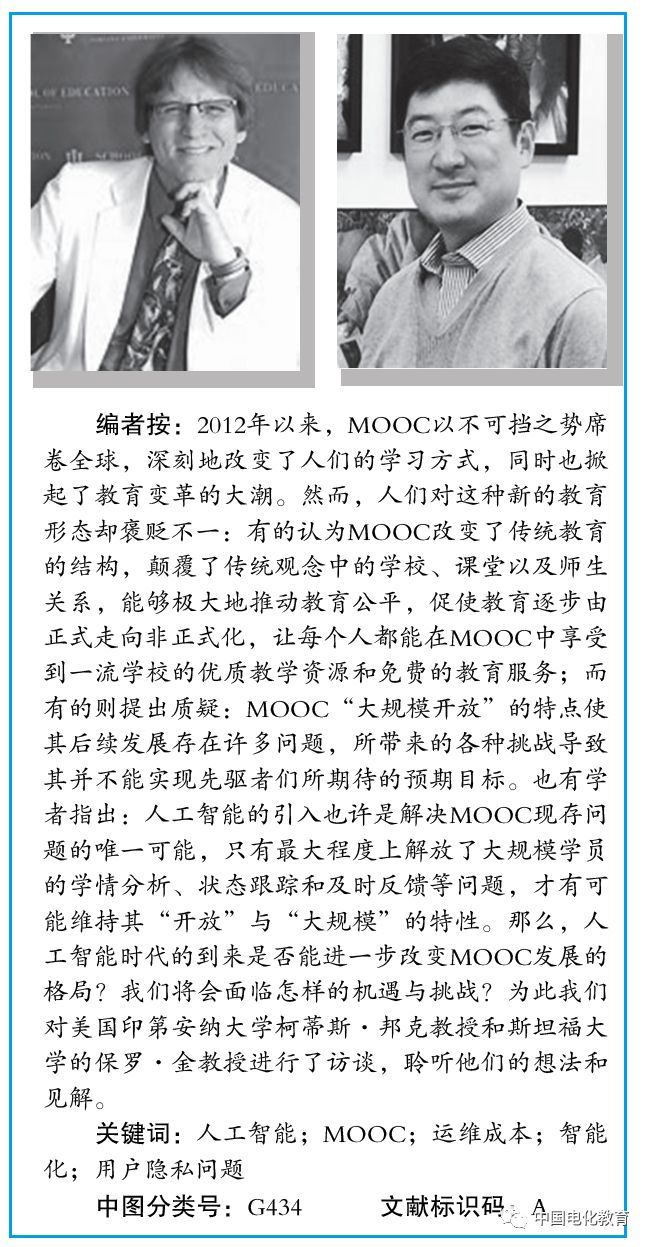
Curtis J. Bonk: A dual professor at the School of Education and the School of Information at Indiana University, he has received the Digital Star Award from the Indiana University Information Technology Association, the Best Achievement Award from the United States Distance Learning Association, the Indiana State Distance Education Teaching Innovation Award, and the Mildred B. and Charles A. Wedemeyer Award for Outstanding Achievement in Distance Education. He has been recognized as an outstanding contributor in the field of education by Education Next and Education Week magazines for three consecutive years. Professor Bonk has delivered over 1,800 presentations on online learning worldwide and has published and edited over 300 articles and book chapters covering topics such as online education, blended learning, massive open online courses (MOOCs), massively multiplayer online games, Wiki books, blogs, open-source software, collaborative learning technologies, and synchronous and asynchronous computer conferencing. His works, including “The Handbook of Blended Learning: Global Perspectives, Local Designs,” “Empowered Online Learning: 100+ Activities for Reading, Reflecting, Displaying, and Practicing,” “The World is Open: How Web Technology is Revolutionizing Education,” “Increasing Technology Variety (TEC-VARIETY): 100 Activities to Motivate and Retain Online Learners,” and “MOOCs and Global Open Education,” have had a significant impact in the field of educational technology.
Paul Kim: Chief Technology Officer and Associate Dean at the Stanford University Graduate School of Education. He has led projects in learning technology design, educational research, and community development at Stanford University. He has served as the Executive Director of Information Technology at the University of Phoenix, Vice President and Chief Information Officer at Waterloo College, and Chairman of the Board of the California Institute for Cross-Cultural Studies. Professor Kim is a member of the Advisory Committee of the National Science Foundation’s Education and Human Resources Directorate and one of the senior researchers of the NSF POMI project, which aims to develop and assess wireless mobile computing and interactive systems for K-20 formal and informal learning. As an authority in the field of artificial intelligence, Professor Kim is active in international forums, focusing on educational contextual innovation, mobile empowerment design, and advocating for educational equity and sustainability in educational ecosystems.
Interviewer: Hello, professors! Ten years ago, we had an in-depth discussion with Professor Bonk about blended learning, at a time when MOOCs had not yet “emerged,” but you had already anticipated the important trend of combining blended learning with open educational resources. Now, many years later, this trend has been confirmed, and with the emergence and development of MOOCs, the application and integration of open educational resources and courses in blended learning models have become more urgent. However, in recent years, scholars have begun to discuss the future fate of MOOCs, with two mainstream viewpoints emerging: rapid development or extinction. This also means that the development of MOOCs actually faces many challenges. Do you think these challenges will impact the future commercial market of MOOCs? Can the “free” and “open” nature of MOOCs be sustained in the long term?
Bonk: I have a deep impression of that interview. Time flies; the field of blended learning has developed significantly over the past ten years. The emergence of MOOCs has undoubtedly provided a strong boost to blended learning. Currently, billions of people worldwide need education, and MOOCs are addressing the educational needs of about 100 million people. Last year, the number of MOOC participants increased by 23 million, and based on the annual population growth trend of about 225 million, MOOCs still have opportunities for continued growth. More and more teachers are using MOOC resources to enrich their traditional face-to-face courses, and some teachers assign related MOOC tasks in their face-to-face classes, encouraging students to exchange MOOC certificates for real credits. Some MOOCs are also beginning to develop into blended formats, combining offline classroom instruction and discussions with online large-scale MOOC learning. These examples are no longer accidental but are becoming normalized.
Indeed, the development of MOOCs faces enormous challenges in various aspects, which is understandable. We also see that MOOC learners have the opportunity to browse courses and access content, but they also have the chance to obtain assessments or certificates. However, currently, as the recognition of MOOC certificates increases, many platforms no longer offer free assessments and certificates. From another perspective, not everyone needs free education; in fact, more people hope to receive quality education. Therefore, the ultimate goal of MOOCs may not be “free” but rather “quality” and “efficiency.” Thus, I believe that the commercial market for MOOCs remains robust; while free content may not change, free services and assessments will become increasingly scarce. The fees charged by MOOCs are necessary for developers to ensure the long-term normal operation of MOOCs. In fact, the development, operation, and maintenance of each MOOC require significant financial investment and consume a large amount of human and material resources. For example, once free content is available, who will be responsible for the continuous updates? When will updates occur, and can they be timely? How can we ensure the accuracy and high quality of the content during updates? Solving these issues requires financial investment. Therefore, in the future, the degree of free assessments and certificates provided by MOOCs will certainly decrease, but this is a realistic need for the long-term operation and maintenance of MOOCs. We cannot simply categorize fees as a business model; we need to consider various factors.
Interviewer: Indeed, behind every successful MOOC is a significant investment of effort. The operation and maintenance of MOOCs require substantial human, material, and financial resources; if these investment issues are not addressed, the long-term development of MOOCs will also be limited. On the other hand, the “free” and “open” characteristics of MOOCs have attracted many learners. It should be said that the most exciting aspect of MOOCs stems from their large-scale nature. However, it is precisely because of the vast number of learners that it is challenging for MOOCs to meet the needs of every learner, leading to many issues, such as the widely discussed high dropout rate.
Bonk: Strictly speaking, the current MOOCs resemble a large library filled with a dazzling array of books; perhaps they can only be referred to as Massive Open Online Content (MOOC) or Massive Open Books. Among those involved in building MOOCs, about 80% or 90% have only established large-scale open online content, with only about 10% truly creating a complete and coherent large-scale open online course. The current MOOCs still have a long way to go to achieve the goal of transitioning from “content” to “courses.”
Kim: I agree with Professor Bonk’s viewpoint. The essence of MOOCs, beyond providing content, is the communication and interaction among course stakeholders (teachers, teaching assistants, course participants), which is currently the area that needs improvement.
Interviewer: Professor Bonk mentioned earlier that charging for MOOCs will become a trend, largely due to the operational needs of MOOCs, which is indeed a realistic demand that cannot be avoided. Today, the rapid development of technology has ushered in the era of artificial intelligence. With the support of intelligent technology, perhaps new solutions can be generated for the previously mentioned issues of dropout rates, free content provision, and effective assessment? Can you share your thoughts on this?
Kim: To some extent, artificial intelligence can indeed help us address these investment issues. For example, we can consider using intelligent technology to manage the transactional operations of course management, freeing MOOC educators and administrators from repetitive tasks, reducing the costs of course creation and operation, and facilitating the sustainable development of MOOCs. Specifically, the application of artificial intelligence technology in MOOC teaching can achieve various functions: for instance, tracking the teaching process of MOOCs, helping teachers identify difficulties and blind spots in the classroom, automatically communicating with students, providing error correction feedback after class, conducting automatic assessments, and offering personalized tutoring, thereby achieving precise teaching. Additionally, intelligent tutors, automatic assessment of outcomes, predictive analysis and consultation, immediate formative and summative evaluations, generative reports, and backend decision support systems can all help reshape the teaching methods of teachers and the learning approaches of students.
Currently, in a simple API service model, management personnel, teachers, or students typically submit requests to the server, which are then processed by front-end services (including DLaaS Stack, business intelligence services, account management, and form submissions) before the server returns the results. With the introduction of intelligent methods, this “request-response” service transforms into a system that automatically learns and stores learner behavior, proactively analyzing behavior paths and identifying user needs. By embedding machine learning models, the larger the data volume on the platform, the higher the accuracy of identification. In this way, learners can receive a self-portrait generated by the system; administrators can analyze integrated data to predict key performance indicators; teachers can understand students’ learning situations and emotional states based on the platform, assess their teaching effectiveness, and intelligently group online learners, manage groups, collect assignments, and evaluate work, providing intelligent content recommendations to learners and teachers. As a result, teachers will have more time, energy, and channels to focus on learners and engage in more creative teaching activities. Therefore, the introduction of artificial intelligence technology has significantly improved the speed and accuracy of obtaining effective information for teachers, students, and administrators, which is also very meaningful for freeing teachers from labor and reducing MOOC management costs.
Interviewer: As a special form of course, MOOCs have varying learning cycles and difficulty levels, with significant differences among participants, making it often challenging to conduct comprehensive and precise assessments. This can hinder MOOC teachers from providing the precise and timely guidance typical of traditional teaching, which can affect and diminish the learning motivation and self-efficacy of MOOC learners. When MOOC learners encounter obstacles during their studies, what role do you think artificial intelligence technology can play?
Bonk: First of all, online MOOC learners are often quite sensitive; when they encounter difficulties, they can easily feel frustrated due to a lack of guidance and support. Additionally, MOOC learners typically lack supervision and feedback throughout most of their learning process, requiring them to invest more time and effort in self-monitoring and self-guidance, which often leads to decreased motivation and increased likelihood of dropping out of the course. Furthermore, many factors influence MOOC learners’ learning, including gender, age, region, frequency of internet connection, learning background, degree level, religious beliefs, and prior MOOC experience, and sometimes even cross-cultural factors should be considered. We usually recommend that MOOC teachers take the following measures to help learners overcome difficulties: guide students to form study groups based on interests or ability levels, encourage communication and collaboration through synchronous or asynchronous tools, and promote mutual support among learners to minimize their sensitivity to obstacles. However, due to the large number of MOOC learners and their diverse academic backgrounds and varying starting levels, it is challenging for teachers to supervise every learner throughout the course and provide immediate feedback. However, artificial intelligence can collect and analyze learners’ learning behavior logs, which can provide feedback and guidance through supervision to help all learners overcome difficulties, reduce feelings of helplessness, and maintain learning motivation.
Kim: Yes, in addition to reducing learners’ feelings of helplessness as mentioned by Professor Bonk, I believe artificial intelligence can also play a significant role in assisting MOOC educators in objectively and effectively evaluating student work. For MOOC teachers, objectively evaluating all students’ assignments and providing corresponding feedback is a significant challenge; imagine the situation of evaluating assignments and tests for 20,000 students simultaneously. However, with the help of intelligent assessment and analysis reports from artificial intelligence, it is possible to automatically grade objective questions and even use text recognition and machine learning to automatically grade subjective questions, thereby improving the efficiency of teachers’ grading work and alleviating the psychological pressure on teachers offering MOOCs.
Bonk: I agree with Professor Kim’s viewpoint; MOOC teachers face many problems and difficulties. First, there are challenges in assessment: how to accurately evaluate a large number of learners; second, there are issues in organizing learner collaboration: how to promote participation, interaction, and the formation of learning teams among MOOC learners; third, there are concerns about ensuring the timeliness, accuracy, and scientific nature of course content; fourth, there are promotional issues: most teachers have not received training in marketing, so after completing course production, they face challenges in how to market and promote the course to the public; fifth, there are skill-related issues: many teachers do not know how to record and edit course videos and are unfamiliar with multimedia components and mobile applications on MOOC management platforms. Therefore, offering MOOCs presents significant challenges for teachers’ teaching skills, management levels, and information literacy. Without certain technical and financial support, teachers are generally unwilling to offer MOOCs. However, by introducing artificial intelligence technology, we can better assist teachers in addressing these challenges. For example, various user-friendly intelligent tools can help teachers better prepare lessons and design resources. Consequently, how to build MOOCs in an intelligent environment will also be a topic for future professional development of teachers.
Interviewer: Indeed, the era of artificial intelligence has quietly arrived. Many of the issues and challenges faced by MOOCs mentioned earlier may generate new solutions with the support of artificial intelligence technology. For instance, through learning behavior logs, we can model learners to track their learning situations and provide corresponding real-time guidance and intelligent recommendations. We can also model courses to assess their teaching effectiveness. What are your thoughts on the intelligent development of MOOCs?
Kim: In fact, humans have long envisioned scenarios for the application of artificial intelligence in education. In the early days, people imagined a robot teaching students in a classroom. In recent years, people have gradually realized that artificial intelligence has been integrated into various physical or virtual learning environments, interacting with learners in various ways and having a significant impact. It is expected that by 2028, the application scope of artificial intelligence in education will greatly expand and deepen, enabling one-on-one companionship and guidance, allowing learners to ask questions and receive solutions at any time. Many studies have shown that although artificial intelligence is still in its early stages of development, many visionary companies and institutions are making significant investments in the development of artificial intelligence in education. It is expected that by 2023, the global education market related to artificial intelligence will grow to $3.6 billion, indicating a significant development prospect for artificial intelligence in education. Moreover, many countries are placing great importance on the application and development of artificial intelligence in education; for example, the Chinese government has issued a series of documents to vigorously introduce various new artificial intelligence technologies into education and teaching, promoting educational reform.
Therefore, applying artificial intelligence technology to MOOCs is of great significance. I believe that in the future, MOOC teaching will become increasingly intelligent, precise, and personalized, significantly reducing teachers’ teaching burdens, assisting them in solving various teaching problems, providing course content recommendations, automatic evaluation and feedback for tests, analyzing learners’ learning paths, and assessing learners’ emotional attitudes, among other functions, thereby helping MOOC teachers and administrators conduct better teaching, management, and decision-making.
Bonk: From Professor Kim’s description, we can foresee the necessity and significance of applying artificial intelligence in MOOCs. From the learners’ perspective, MOOCs urgently need to address the issue of increasing learner engagement, as engagement is a crucial guarantee for course completion rates. We need to focus not only on designing more attractive resources but also on enhancing feedback on course resources to improve learner engagement. Therefore, one possible development direction for the application of artificial intelligence technology in MOOCs is to enhance feedback, such as understanding learners’ learning situations through analyzing their behavior trajectories or formative assessments and providing reasonable feedback. For example, based on learners’ assignment completion status, targeted content recommendations can be made; utilizing a data reservoir to maintain long-term contact with learners can increase their attention to the course; and identifying learners who have not logged into the course platform for an extended period or have not completed assignments for a long time can trigger reminder emails or text messages. Additionally, tracking learners’ learning behaviors can help analyze their feedback needs, such as how learners wish to receive feedback, how often they expect feedback, and where the feedback comes from. Imagine that relying solely on human effort to complete these complex analyses is nearly impossible. However, as a course, these tasks are essential, and only in an intelligent environment can they be efficiently and conveniently accomplished.
Furthermore, after integrating MOOCs with intelligent tutor systems, the system will become a conversational partner for MOOC learners anytime and anywhere, providing personalized resources and support services based on learners’ needs, helping them adapt to the online learning environment and find solutions to difficulties. For instance, in terms of learning content, the system can analyze learners’ personal learning situations and interest goals, customizing personalized services through big data to recommend optimal learning content; in terms of learning feedback, it can provide personalized problem-solving intelligent tutors to answer and guide students’ individual questions in a natural interactive manner, and provide comprehensive and objective comprehensive quality evaluation reports based on scientific data; in terms of learning motivation, it can help learners control their learning paths based on their situations and set their own learning goals, establishing a sense of self-efficacy, and so on.
Interviewer: The integration of MOOCs with artificial intelligence technology can indeed bring new developments to MOOCs, namely intelligent, precise, and personalized. Could you introduce the intelligent technologies that you believe are suitable for application in MOOCs?
Bonk: I believe the specific technologies may include the following categories: first, scaffolding technologies, such as job aids, learning support services, course descriptions, outlines, procedure charts, and embedded tutorials on the platform. These scaffolding technologies are characterized by their accompanying nature and on-demand accessibility, providing appropriate help and guidance to MOOC learners to meet their self-directed learning needs; second, evaluative technologies, including electronic portfolios, knowledge mapping, resumes, and digital badges. Evaluative technologies can facilitate learners’ rapid and accurate understanding of their learning status, enabling them to communicate effectively with teachers or other learners based on their existing knowledge and experience. Currently, most MOOC learners struggle to accurately recognize and articulate their learning experiences and achievements in the course, making it particularly critical to improve this situation through evaluative technologies. Additionally, visualization technologies are also worth noting, such as collecting and analyzing learners’ process data to help them visualize the content they have learned, and even using mind maps to visualize their thought processes, presenting understandable charts or textual content to learners, thereby promoting knowledge connection, reproduction, and internalization.
Kim: I completely agree with Professor Bonk. In MOOCs, scaffolding technologies, evaluative technologies, and visualization technologies can help teachers, learners, and administrators make more accurate assessments. The integration of multimodal technologies is also an excellent attempt. In addition, I believe that using intelligent technologies to help students answer questions and provide learning support and emotional care is also an important direction that should not be overlooked. Some remote learning platforms have already begun to adopt automated evaluation, virtual coaching, intelligent learning companions, and teaching agents to collect and analyze accompanying data, creating a “humanized” support environment in the technological context, allowing learners to feel that they are not alone in their learning journey. This can help reduce feelings of isolation while providing timely guidance, making it more likely for learners to persist in completing their MOOC studies. This may also be one of the future intelligent development directions for MOOCs.
There are many ways to apply artificial intelligence technology in education; some can assist teachers in teaching diagnosis, evaluation, and decision-making, while others aim to support student collaboration and communication. In fact, we have also found that the application directions of artificial intelligence technology vary in focus and are suitable for different contexts. We should apply different technologies to improve or solve different problems. However, I always believe that we should view the use of technology positively and leverage it to serve the development of MOOCs. From deep learning model algorithms to natural language processing, from chatbots to classification technologies, all can contribute to the further development of MOOCs to address various issues and challenges in the development process. In recent years, many internet giants have been striving to seize the high ground of artificial intelligence development, embedding artificial intelligence technology into the services they provide. New educational models will become a key focus of future investments, especially in the AI + education sector.
Interviewer: Earlier, we discussed the integration of artificial intelligence technology with MOOCs and the potential development directions and challenges it brings. This actually reflects the concept of the integration of smart education and open education. From this perspective, the characteristics of smart learning environments, such as recording processes, recognizing contexts, connecting communities, and perceiving environments, provide many insights for optimizing the MOOC learning environment. Currently, we understand that there are two types of assistance provided by artificial intelligence systems: the first is reactive assistance: when learners encounter questions during the MOOC process, they request help from the intelligent system, which then provides corresponding assistance and support based on the request; the second is proactive assistance: the system automatically monitors and analyzes learners’ data to provide intelligent feedback. Both are relatively common forms of assistance and have been applied to varying degrees in MOOCs. What are your views on these two forms of assistance?
Bonk: To be honest, I am not very supportive of the second form of assistance. I feel that automatically monitoring, collecting, and analyzing various data related to individuals without their consent, and then pushing relevant content to them without considering their subjective willingness, is inappropriate. From a personal perspective, learners may feel that their freedom to choose learning content is being deprived during the process of data collection and analysis by the system. It is akin to having someone constantly supervising your learning, similar to being in an area filled with high-definition surveillance cameras, where everyone walking through is recorded and identified, leading to a sense of lack of freedom and invasion. Therefore, I prefer the first form of assistance, where the system provides support and feedback only when I have a need and request help. Of course, there is no absolute superiority or inferiority between these two forms; whether they can be accepted and adopted depends on the learners’ preferences and their subjective willingness regarding learning autonomy.
Interviewer: Yes, the choice of which form of assistance the intelligent system adopts should ultimately be determined by the learners. As artificial intelligence technology continues to develop, when users participate in a MOOC, the artificial intelligence technology based on the learning platform can completely collect, obtain, analyze, and even expose various information about users without seeking their authorization or even without their knowledge. Thus, while improving the intelligent monitoring and feedback capabilities, artificial intelligence can also easily lead to privacy infringement issues. Therefore, regarding the integration of analysis and feedback technologies in MOOCs to achieve system-directed content delivery to learners, what are your thoughts?
Bonk: Indeed, artificial intelligence may lead to privacy infringement issues, which need to be taken seriously and addressed. However, compared to that, I am more concerned about the deprivation of learners’ autonomy in learning. As I mentioned earlier, I am not very fond of learning under surveillance, so I believe that the necessity of incorporating automated analysis and feedback technologies is not as significant. Most people believe that analyzing learners’ data through intelligent analysis technologies can better understand their learning situations and provide support and feedback. However, I think this may lead us back to the era of behavioral psychology analysis and hinder our forward development. Society has evolved into a learner-centered era, but with the integration of numerous technologies that control and regulate learners, we seem to have returned to the era of Skinner’s learning theory, which focuses more on behavior regulation. Undeniably, automated analysis technologies are useful; they reduce teachers’ workloads to some extent, but ultimately, they are just technologies, and various software systems are merely robots. The interaction between humans and robots feels entirely different from that between humans. Moreover, while we may learn the necessary basic skills and knowledge from these interactions, true knowledge extends far beyond that, as it is constantly evolving. If computers can analyze our habits and provide us with basic knowledge to help us solve certain problems, that is entirely acceptable. However, the real world encompasses not only existing basic knowledge but also a vast amount of generative knowledge that requires us to analyze, synthesize, apply, and evaluate in real and complex contexts. Therefore, we can utilize the analysis and feedback technologies within artificial intelligence, but we should not overly trust and rely on them.
Interviewer: Thank you very much to both professors for the insights and reflections you have shared with us. Technology is a double-edged sword, and artificial intelligence is no exception. While we enjoy the conveniences it brings, we must also be prepared to address the various potential negative impacts. Only by actively responding can we find a balanced path for future development. We must clearly recognize the advantages and issues of integrating artificial intelligence technology into MOOCs, among which user privacy is a concern for many experts. Therefore, while calling for platforms and technical personnel to protect user privacy, we should also actively consider whether it is truly necessary to analyze various data from users, which data should be encrypted and protected, how to address the negative impacts arising from artificial intelligence technology infringing on user privacy, how to define the degree, scope, and bottom line of artificial intelligence usage, and how to strengthen the protection of user privacy, etc. In summary, only by actively responding can we ensure better integration and development of both.
Kim: I completely agree with Professor Bonk’s views and your reflections. The effectiveness of technology and the impacts it brings depend on the user’s purpose and methods of use. In fact, privacy infringement and the potential deprivation of learners’ autonomy are just a small part of the issues that may arise during the application of artificial intelligence. However, since we have chosen to apply it, we must actively respond and seek solutions. It is clear that the future development of artificial intelligence is very promising, and its application in education should be given high priority. Especially in the context of MOOCs, we should strive to enhance the iteration of artificial intelligence technology in education, improve the accuracy and quality of educational teaching, and make the overall service in the education field more intelligent, providing more possibilities and opportunities for intelligent teaching. However, it is important to note that introducing artificial intelligence does not mean that intelligent teaching can be achieved. To realize truly precise teaching and learning services and provide personalized services for students, it is essential to integrate teachers’ wisdom. Only by fully combining technology with teachers’ teaching wisdom can we achieve intelligent teaching and maximize the application of technology in teaching. Overall, the integration of artificial intelligence with MOOCs can bring infinite possibilities for MOOC development. Despite the various problems and challenges that may arise during the development process, we should maintain a positive attitude towards it and respond accordingly.
Bonk: We also need to recognize that while MOOCs incorporating intelligent technologies can develop in an intelligent direction, they may not necessarily progress towards a wise direction. The significant impact of artificial intelligence education on MOOCs includes providing precise and personalized educational services from emotional, intellectual, personality, and capability perspectives, truly achieving personalized education; offering comprehensive learning support across all educational levels, including community education, adult education, and pre-service training, thereby realizing a lifelong education system for society; and providing every online learner with all learning records and certificates, allowing learners to have their unique “learning resumes,” and ensuring their authenticity and reliability with the support of technologies like blockchain. Such MOOCs will be more open, shared, interactive, and collaborative, better meeting human developmental needs. From this perspective, the significance of artificial intelligence technology for large-scale online education is extraordinary, and we should view it positively and strive for its development.
Author Information:
Zhan Zehui: Professor, PhD, research direction in learning science and intelligent education ([email protected]).
Huo Liming: Master’s student, research direction in learning science and intelligent education.
Yao Jiajing: Master’s student, research direction in learning science and intelligent education.
Dai Shasha: Master’s student, research direction in learning science and intelligent education.