One of the important features of Tesla is its intelligent driving, which is executed through its Autopilot domain controller (AP). The research team of CITIC Securities in TMT and automotive sectors collaborated with several companies and institutions to perform a complete teardown of the Tesla Model 3, and recently released a report analyzing the E/E architecture, three electric systems, thermal management, body, etc., with a deep dive into the Autopilot controller (AP).
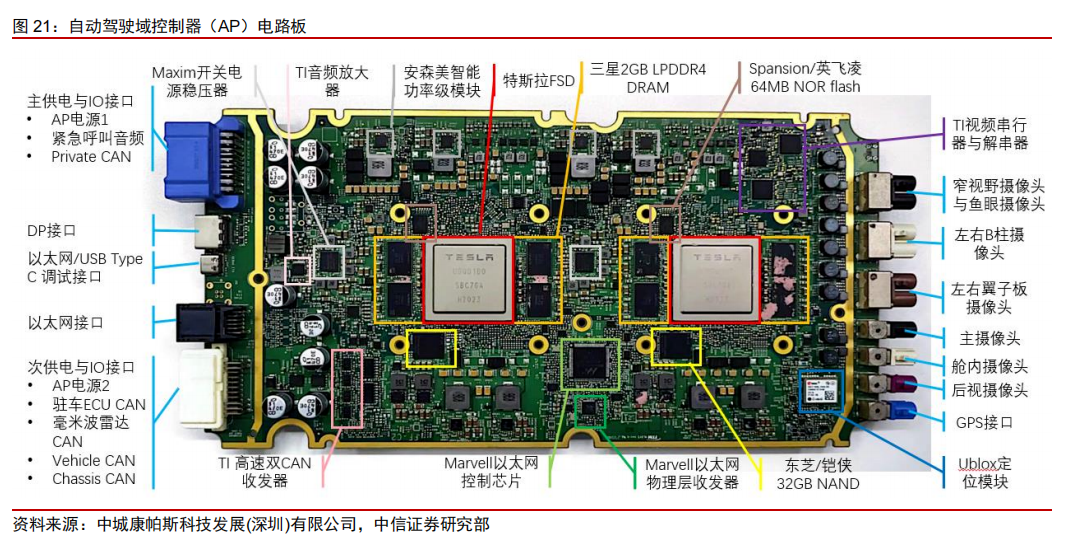
The core of the Tesla Model 3 Autopilot domain controller (AP) lies in the FSD chip developed independently by Tesla, while the other configurations are not fundamentally different from current other autonomous driving controller solutions.
The HW3.0 version of the AP used in Model 3 is equipped with two FSD chips, each configured with four Samsung 2GB memory chips, totaling 8GB for a single FSD. Additionally, each FSD is equipped with a Toshiba 32GB flash memory and a Spansion 64MB NOR flash for booting. In terms of networking, the AP controller includes a Marvell Ethernet switch and physical layer transceiver, as well as a TI high-speed CAN transceiver. For autonomous driving, positioning is also very important, so it is equipped with a Ublox GPS positioning module.
Regarding external interfaces, all cameras of the Model 3 are directly connected to the AP controller, along with TI’s video serializer and deserializer for these cameras. There are also power interfaces, Ethernet interfaces, and CAN interfaces to ensure the normal operation of the AP controller. As an onboard controller, Tesla’s Autopilot domain controller also considers emergency situations, hence it is equipped with an emergency call audio interface, paired with a TI audio amplifier and a fault CAN transceiver.
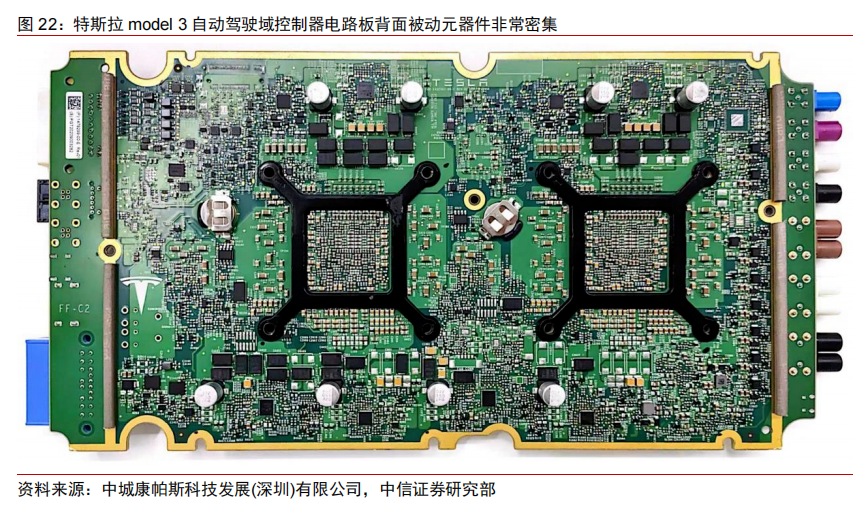
Another noteworthy point is that to ensure driving safety, the AP controller must operate stably at all times. Therefore, Tesla has incorporated a considerable number of passive components into the AP controller. The front side has eight On Semiconductor intelligent power modules, along with a large number of inductors and capacitors. The back side is even more evident, as the entire circuit board is densely populated with passive components with almost no control chips, far exceeding other controllers and significantly higher than various common smart terminals in everyday life. From this perspective, as smart vehicles develop, domestic passive component companies are also expected to benefit.
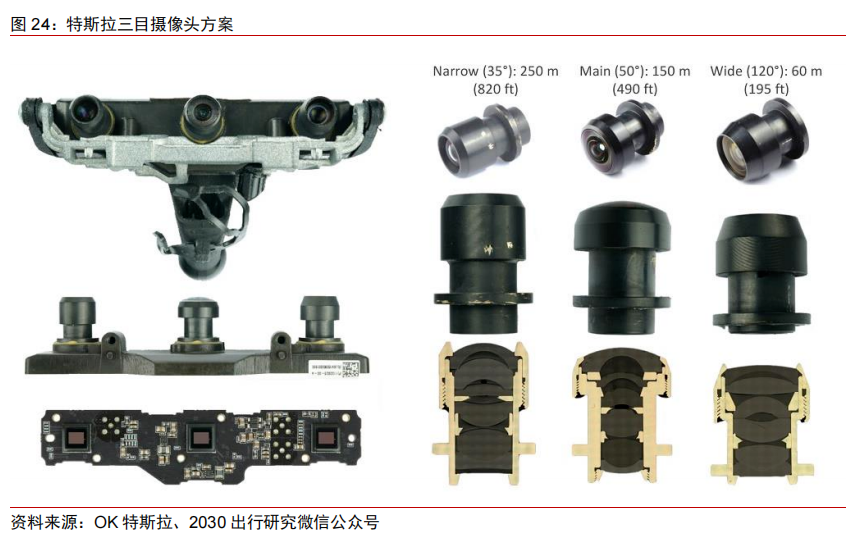
To achieve autonomous driving, Tesla has proposed a complete solution based on vision, centered around the FSD chip, with its peripheral sensors mainly consisting of 12 ultrasonic sensors (Valeo), 8 cameras (3 front-facing on the windshield, 2 side-facing on the B-pillar, 2 rear-facing on the front fenders, 1 rear-facing camera at the back, and 1 DMS camera), and 1 millimeter-wave radar (Continental).
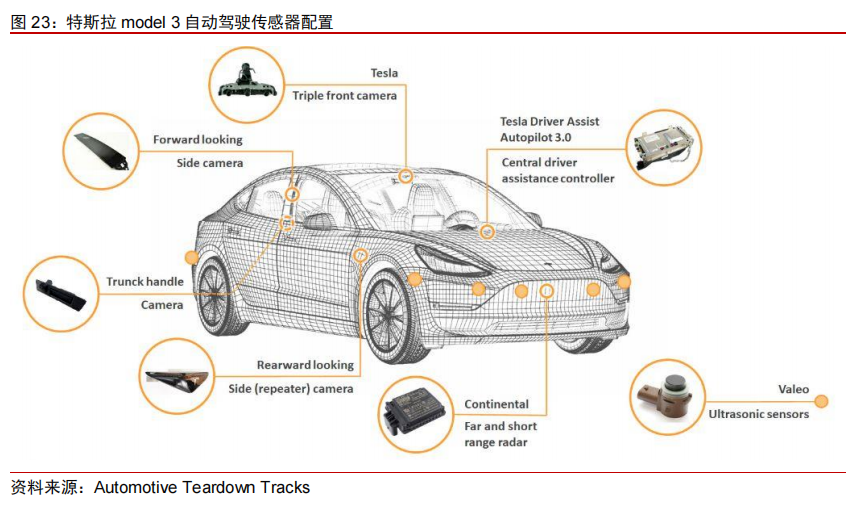
The core of the front-facing tri-camera includes the main camera in the middle and two side cameras with long-focus and wide-angle lenses, forming a combination of different fields of view. All three cameras use the same On Semiconductor image sensor.
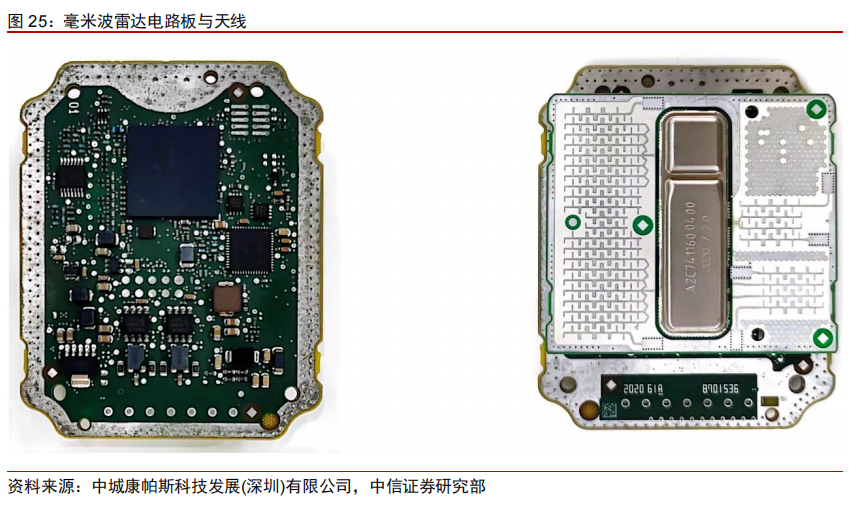
The millimeter-wave radar is located near the vehicle emblem at the front and consists of a circuit board and an antenna board. The internal components of this millimeter-wave radar include a Freescale control chip and a TI voltage regulator management chip.
However, the true core of the entire AP controller is actually the FSD chip, which is a key focus for Tesla to achieve higher AI performance and lower costs. Unlike the current mainstream Nvidia solutions, the largest area occupied by the Tesla FSD chip is not the CPU or GPU, but the NPU. Although this design is entirely optimized for neural network algorithms, its generality and flexibility are not as good as Nvidia’s GPU solutions, but under the current circumstances where there has been no fundamental change in AI algorithms, the applicability of the NPU will not be threatened.
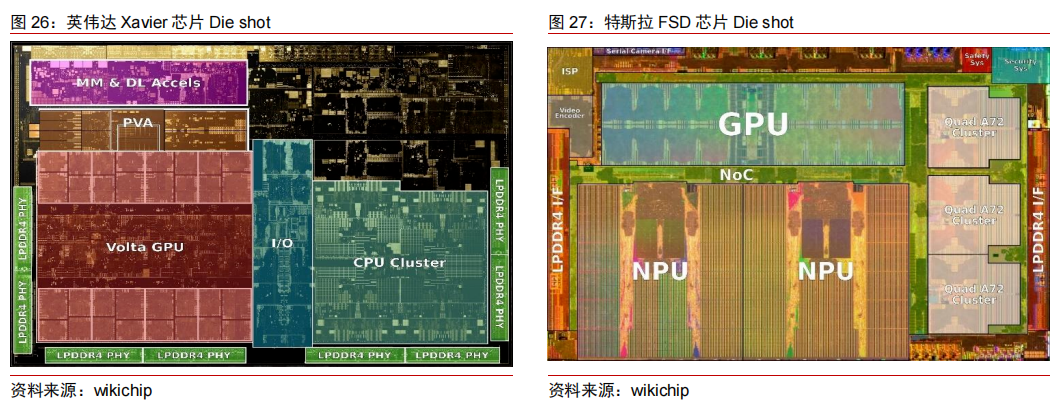
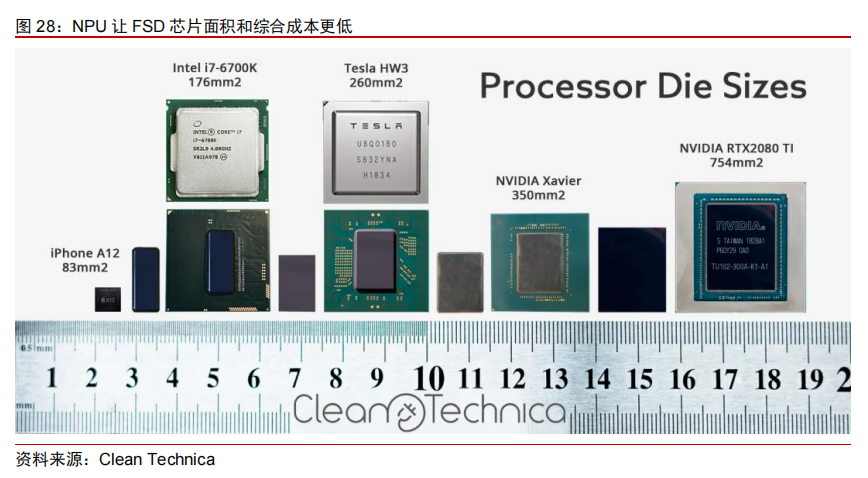
The NPU unit can effectively accelerate convolution operations and matrix multiplication in common visual algorithms, allowing the Tesla FSD chip to use a Samsung 14nm process, achieving 144 TOPS of AI computing power, with an area of only about 260 square millimeters. In comparison, Nvidia’s Xavier uses TSMC’s 12nm process, with a chip area of 350 square millimeters, yet only achieves 30 TOPS of AI computing power. This gap is also the reason Tesla switched from the HW2.5 version of Nvidia’s Parker SoC to the HW3.0 self-developed FSD chip. Therefore, without fundamental changes in algorithms, Tesla FSD can achieve both cost and performance advantages, which constitutes the competitiveness of Tesla’s autonomous driving solutions.
In terms of AI algorithms, according to the description on Tesla’s official website regarding artificial intelligence and autonomous driving, the complete construction of the AutoPilot neural network involves 48 networks, which are trained daily based on data generated from millions of vehicles, requiring 70,000 GPU hours of training. At the basic code level, Tesla has an OTA-capable bootloader, a custom Linux kernel (with real-time patches), and a large amount of memory-efficient low-level code.
Future innovations in the autonomous driving domain will still focus on the chip side, and innovations in sensors such as LiDAR and 4D millimeter-wave radar will also significantly promote intelligent driving. In the foreseeable future, dedicated AI chips will become an important force competing with Nvidia, and domestic AI chip companies are expected to achieve better development by riding the wave of smart vehicles.