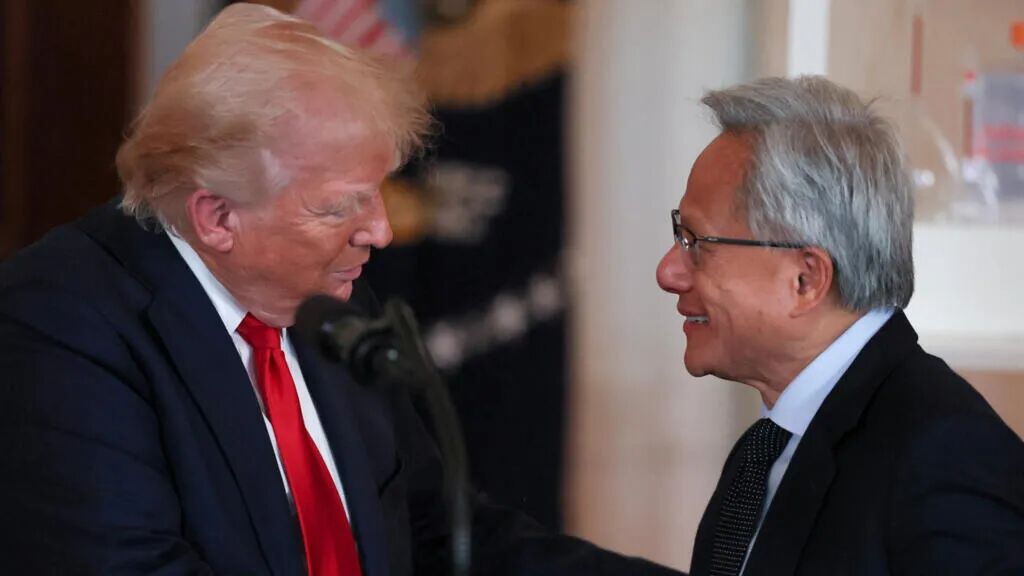
Direct News:The U.S. government has issued an export license for NVIDIA chips, and there are reports that NVIDIA will pay 15% of its chip sales revenue to the U.S. government. What are your thoughts on this?
Special Commentator Sun Xingjie:NVIDIA’s CEO Jensen Huang has put in considerable effort to facilitate chip exports to China. Ultimately, after Huang’s visit to the White House, the U.S. Department of Commerce began issuing licenses, marking a significant development in the U.S.-China economic and trade game. In the context of the strategic competition in artificial intelligence, the U.S. uses chips as a strategic tool to contain China. However, NVIDIA is a business, and even though its products have strategic attributes, it still needs a larger market to achieve its commercial interests. Huang has repeatedly stated that Chinese chip companies are making significant progress. If NVIDIA cannot export to China, it will lose the Chinese market and force Chinese companies to become self-reliant, rapidly growing in the domestic market.
The issuance of chip export licenses by the U.S. is not only due to lobbying by Huang and other American business leaders but also the efforts of U.S.-China economic and trade negotiations. The U.S. has chips, and China has rare earths; rare earths and chips are now linked, and both are important elements for the industrial development of the two countries. As for the U.S. government’s requirement for NVIDIA to hand over 15% of its revenue, whether this can be realized is still uncertain, but this approach is indeed very much in line with Trump’s style. Experts studying export controls also believe that there has been no precedent for U.S. companies to give a portion of their revenue to the government to obtain export licenses. The U.S. government has not clearly thought about how to use this money; it is neither a tax nor a fine, but more like extortion from NVIDIA. NVIDIA has stated that it will comply with the rules set by the U.S. government.
The U.S. demanding 15% of the profits will first make chip trade not just an economic activity but one in which the U.S. government participates and profits. If NVIDIA passes on 15% of the cost to importers, it means that the U.S. government is extorting Chinese companies through NVIDIA. Secondly, it will disrupt the market pricing process. If a portion of revenue can be obtained through ‘tribute’ for export licenses, then the prices of exported goods will inevitably include this cost, which does not conform to market rules.
Direct News:NVIDIA’s chips exported to China are specially supplied, and their safety is also a major concern. What are your thoughts on this?
Special Commentator Sun Xingjie:Chinese authorities have already held discussions with NVIDIA regarding chip safety issues. Some media analyses suggest that NVIDIA’s chips are unsafe, not advanced, and not environmentally friendly, so Chinese consumers can choose not to buy them. NVIDIA has not yet started exporting specially supplied chips to China, and it is normal for the Chinese government and media to express concerns about the safety risks of these chips. If NVIDIA wants to develop in the Chinese market, it must pay attention to the demands of Chinese consumers and avoid tampering with the chips. As a business, it should prioritize users and the market.Export controls on chips are an important part of the U.S.-China economic and trade negotiations. The U.S. has been containing China in the chip field for years, not only through export controls but also by mobilizing allies to form a coalition against China. However, China’s artificial intelligence is also developing rapidly. Trump has launched an indiscriminate tariff war against the world, restructuring the U.S. economic and industrial alliance system. Additionally, China’s strategic will and capability during the U.S. tariff war have made the U.S. reassess China.
The U.S. views artificial intelligence as a crucial industry related to its hegemony, and industrial development has been securitized. Export controls are mostly based on ‘national security’ reasons. Allowing NVIDIA to provide chips to China that do not affect ‘American security’ achieves the U.S. goal, but it inevitably raises safety concerns among Chinese consumers. Of course, for Chinese consumers, until better alternative products are available, NVIDIA’s specially supplied chips are also an option, but there is a need to prevent chips with safety defects from ‘working sick.’ As technology continues to develop, chips will gradually become ‘de-securitized.’ Over-securitization will lead to enormous costs, making both buyers and sellers losers.
Author丨Sun Xingjie
Layout丨Chen Pianpian
Editor丨Guo Yongji
Proofreader丨Song Jingjing
Supervisor丨Kang Xiaoming
 This article is copyrighted by ‘Direct News’ and may not be reproduced without authorization.If you need to reprint, please reply ‘Authorization’
Direct News is the all-media news brand of Shenzhen Satellite TV
Produced by the 'Live Broadcasting of Hong Kong, Macao and Taiwan' team

For more analysis, please download the Direct News APP

To participate in comments, please @Direct News on Sina Weibo
For more exciting content, search Weibo for ‘Direct News‘