
Abstract: On July 26, 2025, the World Artificial Intelligence Conference (WAIC 2025) opened at the Shanghai Expo Exhibition Center under the theme “Intelligent Era, Together for a Common Future.” Among the highlights were humanoid robots, with over 150 humanoid robots showcasing their latest advancements at the conference.
01 Advancements in Humanoid Robot Technology
The scale and impact of this year’s AI conference have significantly increased, with the number of participating companies, exhibition area, and the number of new products launched all reaching record highs. The exhibition area exceeded 70,000 square meters for the first time, attracting over 800 companies and showcasing more than 3,000 cutting-edge exhibits, including over 40 large models, more than 50 AI terminal products, 60 intelligent robots, and over 100 new products making their global or Chinese debut. Compared to last year, the number of robot exhibitors has grown exponentially, with only 18 robot-related companies participating last year, while this year has seen over 80. Humanoid robots have garnered significant attention, with over 150 humanoid robots displayed, marking the largest concentrated showcase of domestic humanoid robots in history.
Technological advancements related to humanoid robots continue to progress. In terms of large model capabilities, continuously iterating large models have made humanoid robots more autonomous. For example, the Lingxi X2 from Zhiyuan Robotics is equipped with a multimodal large model, enabling deep semantic understanding and emotional interaction. At the AI conference, it not only answered technical questions but also proactively requested charging based on its power status, demonstrating a preliminary semblance of human-like autonomous decision-making. Galaxy General Robotics has combined visual-language models to accurately identify product locations and types in retail shelf scenarios, avoiding misoperations even when faced with densely arranged or similarly appearing automotive parts, further enhancing its generalization capabilities. The AlphaBot from Zhiyuan Square, equipped with a self-developed global full-body VLA large model, showcased skills such as making ice cream, coffee, and drinks, as well as 2X2 palletizing and drumming, demonstrating strong cross-device execution generalization capabilities.
In addition to robot companies developing their own large models, technology companies are also entering the robot business by providing large models for robots. For instance, Tencent unveiled three embodied large models at the World Artificial Intelligence Conference: a multimodal perception model, a planning large model, and a perception-action joint large model. The multimodal perception model aims to help robots understand their environment, the planning large model enables robots to comprehend complex tasks and think, while the perception-action joint large model translates the robot’s thoughts into precise and safe physical actions. The introduction of these models will enhance the intelligence level of humanoid robots, facilitating their transition from laboratory settings to real-world applications at scale.
In terms of mobility, humanoid robots have improved degrees of freedom and stability. For example, the G1 combat robot from Yushu Technology, with 29 joints and an intelligent balance algorithm, performed complex boxing combinations and spinning kicks at the conference, engaging in combat demonstrations with humans and autonomously getting back up within seconds after falling, thanks to its dynamic balance system. The Star Motion Era robot executed 360° explosive jumps and related street dance moves, achieving millisecond-level joint control through its motion algorithms.
In terms of perception and operational capabilities, humanoid robots have made further breakthroughs in cross-modal sensing and fine manipulation. For instance, Feixi Robotics integrated 3D vision and force feedback to engrave patterns on the surface of eggs, switching engraving designs at will. The XMAN-F1 bipedal humanoid robot from Qinglang Intelligent smoothly prepared popcorn at the conference, adjusting the amount of ice and sugar based on customer preferences and collaborating with other specialized robots (such as delivery robots).
Moreover, the technological advancements of humanoid robots rely heavily on substantial training data support. The training datasets required for humanoid robots exhibit significant multimodal characteristics, necessitating not only basic textual information but also the integration of action commands, environmental lighting changes, and other physical world parameters. The industry currently faces a widespread challenge of insufficient data. At this conference, the National Local Joint Innovation Center for Humanoid Robots and the Pujiang Laboratory team announced plans to complete the accumulation of 25 million complete machine data by the end of the year, reaching ten times the scale of similar datasets from Google. Concurrently, Zhiyuan Robotics officially launched the open-source plan for “Zhiyuan Lingqu OS,” the industry’s first reference framework for embodied intelligent operating systems. This system adopts a “layered open-source, co-construction and sharing” strategy, divided into three layers: upper, middle, and lower, with the upper layer providing a full-scenario toolchain for simulation testing, data annotation, etc. These initiatives are expected to provide more data resources for the humanoid robot industry, reduce R&D costs for companies, and enhance the generalization and emergence capabilities of robots, enabling them to meet the operational requirements of more complex scenarios.
02 Commercialization Progress of Humanoid Robots
The continuous progress of related technologies for humanoid robots has broadened their application scenarios. In industrial settings, Shanghai Electric unveiled a humanoid robot developed with the concept of “industrial genes and scene customization,” capable of autonomously identifying, locating, and transporting boxes of various specifications in multiple industrial environments, demonstrating good dynamic obstacle avoidance response times and positioning accuracy, significantly enhancing logistics efficiency. Kepler’s humanoid robot showcased its focus on manufacturing and warehousing logistics in automotive factories, planning to continue deepening its efforts in intelligent manufacturing and warehousing logistics.
In the medical and wellness sector, Fourier Intelligence is set to launch the GR-3 humanoid robot, its first medical wellness robot focused on interactive companionship, featuring a Morandi warm color scheme, animal-like head, gentle facial curves, lively eyes, and a soft touch, bringing humanoid robots closer to humans. Fourier’s booth also established an “Embodied Intelligent Rehabilitation Port,” centered around the GRx series humanoid robots, constructing modules for guiding consultations, cognitive rehabilitation training, and upper limb rehabilitation training, aiming to create a more intelligent and humanized rehabilitation service experience.
In commercial service scenarios, the XMAN-F1 from Qinglang Intelligent prepares popcorn and mixes drinks for users, while Galaxy General’s Galbot accurately identifies products on densely packed shelves, and Zhiyuan’s Expedition A2 performs drumming and guiding tasks, indicating that humanoid robots are gradually achieving diversified applications.
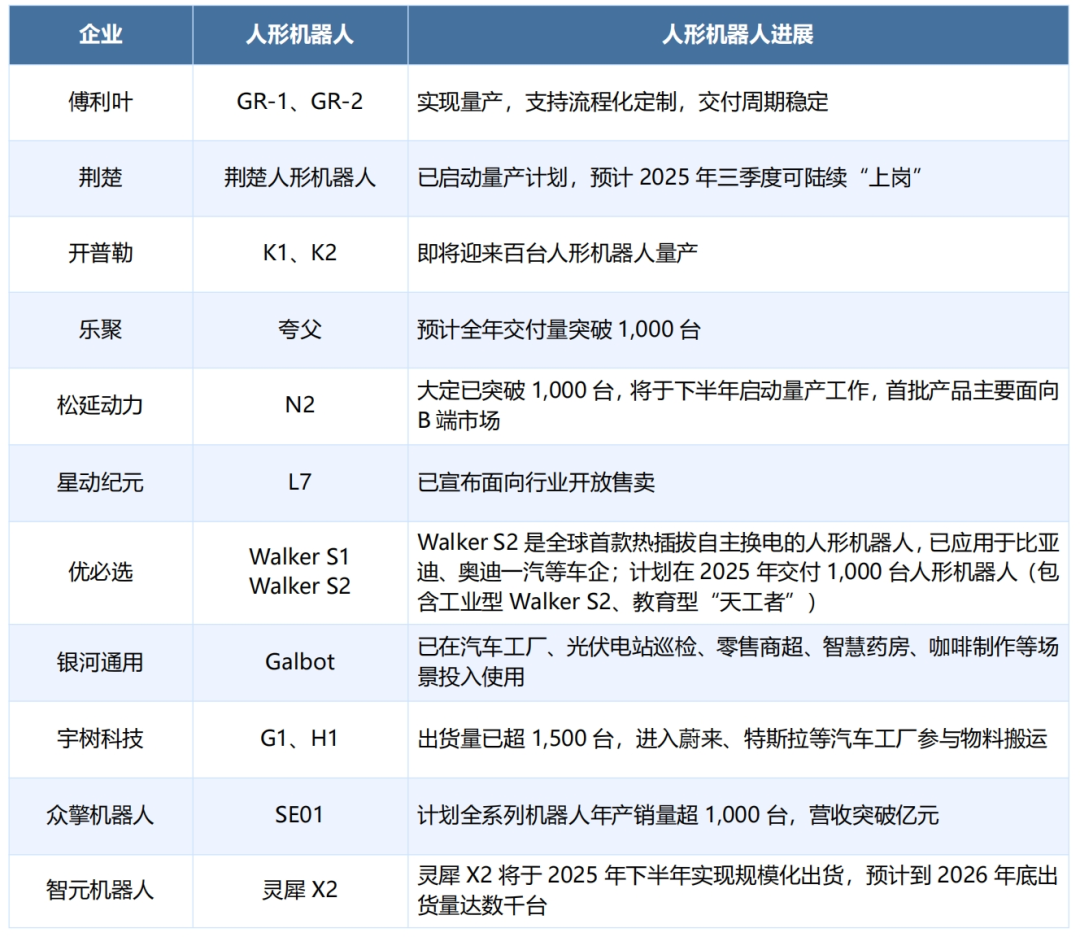
As the application scenarios for humanoid robots continue to expand, their commercialization process is also accelerating. In terms of mass production, several companies have announced plans for the mass production of humanoid robots. For instance, Kepler’s humanoid robot is set to enter mass production with a hundred units, marking a new phase of commercialization; Zhiyuan Robotics’ Lingxi X2 is expected to reach thousands of units shipped by the end of 2026. The advancement of these mass production plans signifies the humanoid robot industry officially transitioning from the technology validation stage to large-scale production.
Figure 1: Overview of Major Participants and Product Progress in China’s Humanoid Robot Field (Incomplete Statistics)
 Data Source: Public Information, Lai Mi Data Compilation
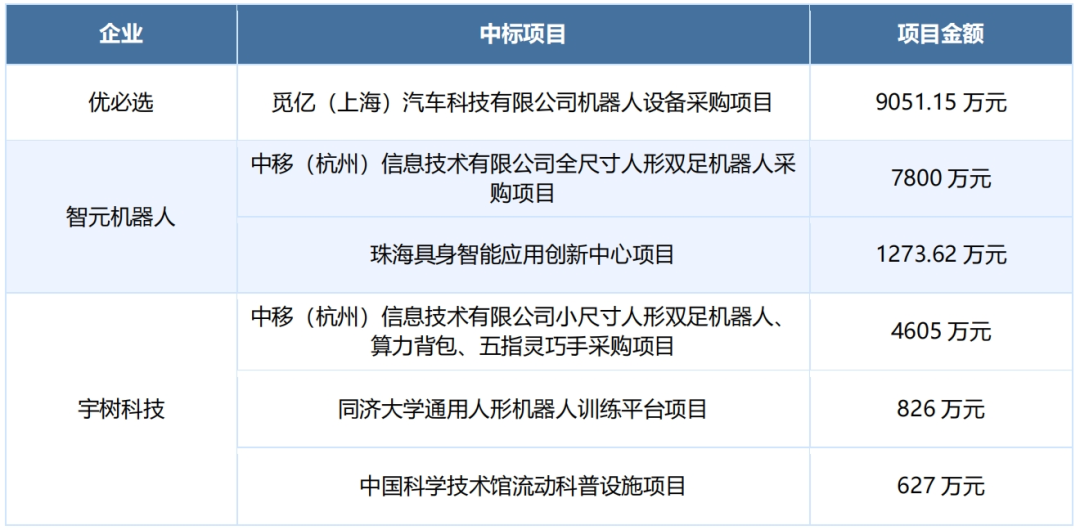
Orders are a significant manifestation of the commercialization of humanoid robots. Since 2025, several companies have secured milestone large commercial orders, marking a new phase in the commercialization of humanoid robots. For example, in July, Zhiyuan Robotics and Yushu Technology jointly won the bid for the humanoid biped robot OEM service procurement project from China Mobile (Hangzhou) Information Technology Co., Ltd., with a total amount of approximately 120 million yuan (including tax), which is the largest publicly disclosed single bid order in the domestic humanoid robot industry to date; UBTECH won the robot equipment procurement project from Mi Yi Automotive, amounting to 90.5115 million yuan, setting a new record for the largest single order amount for global humanoid robot companies. The realization of these large orders has brought substantial revenue to humanoid robot companies, validating the feasibility of their business models and injecting strong momentum into the rapid development of the entire industry.
Figure 2: Order Situation in the Humanoid Robot Field Since 2025 (Incomplete Statistics)
 Data Source: Public Information, Lai Mi Data Compilation03 Investment and Financing Dynamics
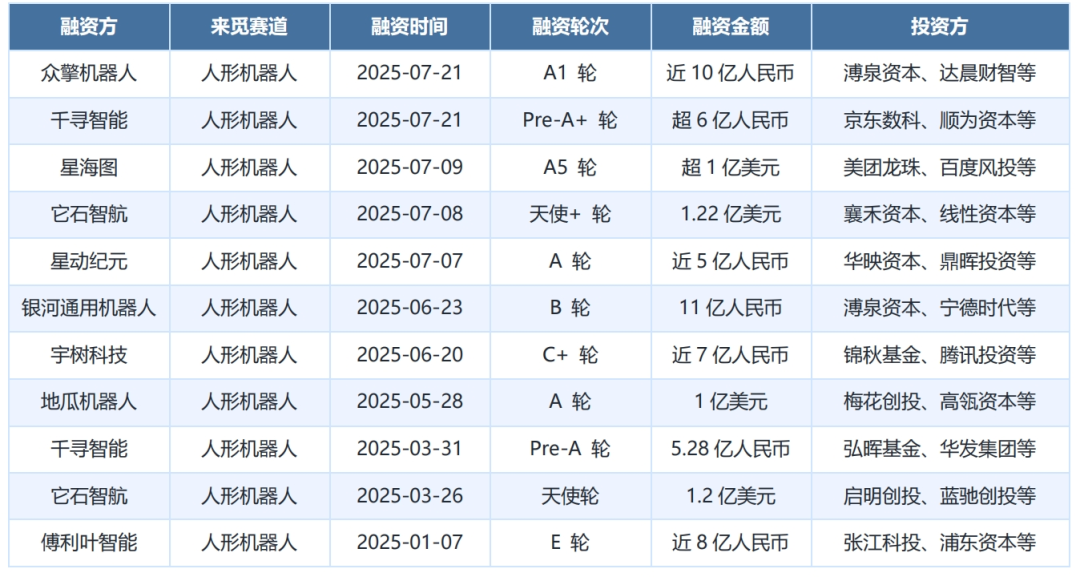
In the past two years, driven by policy support, continuous technological breakthroughs in the industry, and increasing market demand, the financing heat in the humanoid robot sector has continued to rise. According to Lai Mi PEVC data, since 2025, there have been over 80 financing cases related to domestic humanoid robots, with a total financing amount exceeding 10 billion yuan, primarily consisting of early-stage financing, indicating that the industry is still in a rapid development phase.
The capital participating in humanoid robot investments is diverse, with industrial capital (such as Meituan, JD.com, and CATL) strategically investing to bind core technologies, while local government funds are intensively establishing special industrial funds (such as Hubei Province’s establishment of a 10 billion yuan humanoid robot industry investment mother fund) to promote the formation of regional industrial clusters. Professional venture capital institutions (such as Dachen Caizhi and Meihua Venture Capital) are also positioning themselves based on the potential investment returns of humanoid robots in the future.
Moreover, breakthroughs in the IPO process have also activated capital market expectations for humanoid robots. In July, Yushu Technology officially initiated IPO counseling, with a pre-IPO valuation exceeding 12 billion yuan; Zhiyuan Robotics acquired at least 63.62% of the equity of Shangwei New Materials for 2.1 billion yuan, leading the market to expect that Zhiyuan Robotics will also initiate the IPO process. Several robot companies have already submitted IPO prospectuses, and the anticipated IPO boom is expected to attract more capital attention to the humanoid robot sector.
The following table lists some investment and financing events in the humanoid robot sector since 2025. Interested readers can log in to the Lai Mi PEVC platform to access comprehensive financing cases, invested projects, and in-depth data analysis in the humanoid robot field.
Figure 3: Some Investment and Financing Events in the Humanoid Robot Sector Since 2025
 Data Source: Lai Mi Data

Recent Hot Articles Recommended

-
Medical Device Investment and Financing Market Report Q2 2025
-
Artificial Intelligence Investment and Financing Market Report Q2 2025
-
Smart Hardware Investment and Financing Market Report Q2 2025
-
Biomedicine Investment and Financing Market Report Q2 2025
-
Robotics Investment and Financing Market Report Q2 2025
-
Semiconductor Investment and Financing Market Report Q2 2025
-
[Major Release] Lai Mi Research Institute’s PE/VC Market Report for the First Half of 2025
-
Robot Companies Rush to Hong Kong IPO, New Opportunities for Mergers and Acquisitions
-
Striving for the Sea: New Investment Opportunities in the Trillion-Yuan Marine Economy Sector
-
[Major Release] Series of Rankings of Investment Institutions for the First Half of 2025
Copyright and Disclaimer: The content of this article is written by Lai Mi Research Institute, and its copyright belongs to Shenzhen Lai Mi Data Information Technology Co., Ltd. (hereinafter referred to as Rime or Lai Mi Data). Without permission or authorization from Lai Mi Data, no unit or individual is allowed to reproduce, quote, publish, modify, or translate the content of this article, or engage in other commercial activities. When citing or reproducing under permission or authorization, the source must be indicated as Rime or Lai Mi Data. Any unauthorized commercial use of this report will violate the Copyright Law of the People’s Republic of China and other laws and regulations, as well as relevant international conventions, and Lai Mi Data reserves the right to pursue legal responsibility for such actions.
The content of this article is based on publicly available information or field research data that Lai Mi Data considers reliable. We strive for objectivity and fairness in the content of this article, but we make no explicit or implicit guarantees regarding the accuracy, reliability, timeliness, and completeness of the information, opinions, and data contained herein, nor do we assume any related legal responsibility. Due to limitations in research methods and data acquisition resources, all content in this report is for reference only and does not constitute any advice for anyone’s investment, business decisions, legal actions, etc. In any case, Lai Mi Data shall not be liable for any impact and consequences caused by reference to this report.