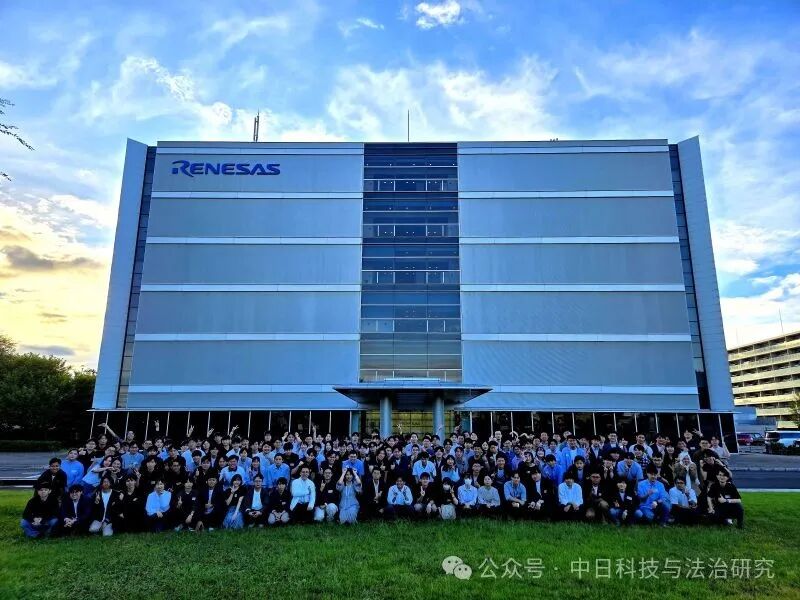
 (Photo Credit: Renesas Electronics)
| In the global semiconductor industry landscape, Japanese semiconductors once held a significant position. From the 1970s to the 1980s, Japanese semiconductor companies achieved great success in the DRAM (Dynamic Random Access Memory) market, capturing over 80% of the global market share at one point. However, over time, the Japanese semiconductor industry gradually faced challenges, with its market share being eroded in competition with countries and regions such as the United States and South Korea. In this context, Renesas Electronics Corporation has become one of the important pillars of the Japanese semiconductor industry, and some even regard it as Japan’s “last hope” in semiconductors. |
**************************************Table of Contents1. Company Overview2. Development History3. Business Performance4. Lessons Learned**************************************1. Company Overview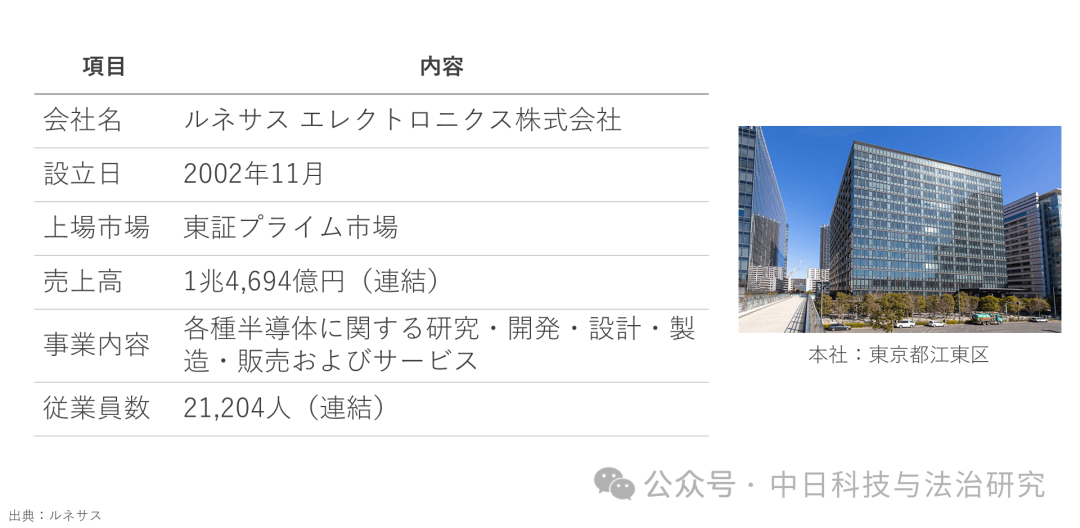 Renesas was established in 2002 and is listed on the Tokyo Stock Exchange. Its sales revenue is 1 trillion 469.4 billion yen (approximately 73.5 billion RMB, estimated at the average exchange rate in 2023). Its business scope includes research, development, design, manufacturing, sales, and services of semiconductors, with a particular advantage in automotive semiconductors. The company has 21,204 employees and is headquartered in Koto, Tokyo.The group consists of a parent company and 95 subsidiaries (5 in Japan and 90 overseas) as of December 31, 2023.
 As a semiconductor manufacturer, Renesas primarily engages in the research, design, manufacturing, sales, and services of various semiconductors. The R&D and design functions are not only handled by the parent company but also by overseas subsidiaries such as Renesas Electronics America, Renesas Semiconductor Design Beijing, Renesas Design Vietnam, and Renesas Electronics Europe. The manufacturing functions are mainly managed by domestic and overseas production subsidiaries, flexibly utilizing external foundries as needed. Sales and service functions in Japan are mainly conducted through cooperative authorized sales stores, while overseas sales are primarily handled by subsidiaries or distributors such as Renesas Electronics America, Renesas Electronics Europe, and Renesas Electronics Hong Kong. The company group is divided into two major business segments:Automotive Business Segment,Industrial, Infrastructure, and IoT Business Segment.Automotive Business Segmentcovers automotive engine, hybrid vehicles, and otherin-vehiclecontrol semiconductors, as well as in-vehicle navigation,in-vehicle and external environmental monitoring sensor systems,in-vehicle infotainment systems (IVI), and dashboardsfor in-vehicle information devices. Core products include microcontrollers, system-on-chip (SoC), analog semiconductors, and power semiconductors.Industrial, Infrastructure, and IoT Business Segmentcovers the industries supporting smart society,infrastructure, and IoT fields. The company mainly provides microcontrollers, system-on-chip (SoC), and analog semiconductors,which are widely used infactory automation (FA), data centers, base stations, and other fields.
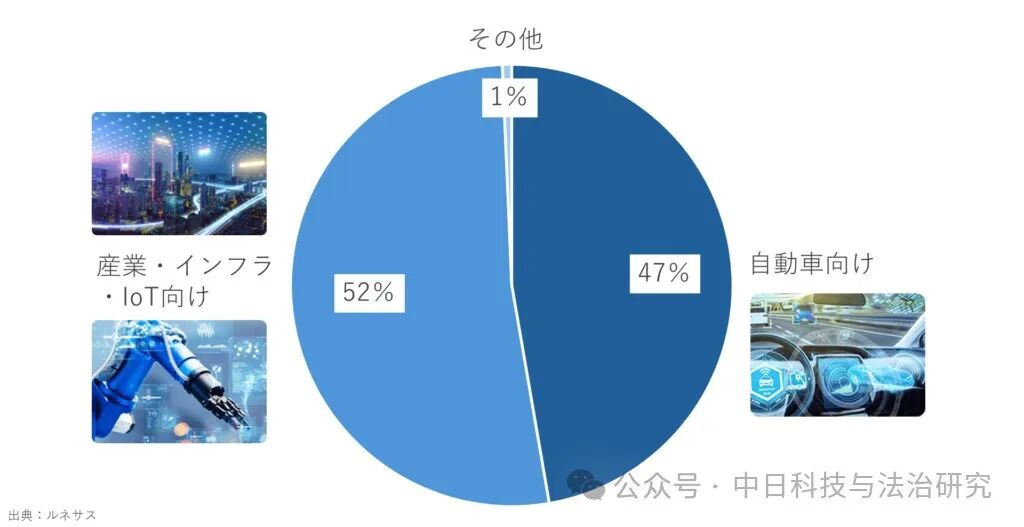 As shown in the above image, in terms of total sales, the automotive business accounts for 47%, making it Renesas’s core business. The industrial, infrastructure, and IoT business accounts for 52%. During the Great East Japan Earthquake in 2011, Renesas’s core factory, the Naka Factory, was severely damaged, leading to a crisis where “without Renesas products, cars could not be produced.” In response, a post-disaster reconstruction team centered around Toyota Group quickly restored the factory to pre-earthquake production levels within six months. This also indicates that Renesas is a key enterprise supporting the lifeblood of Japanese industry.2. Development History
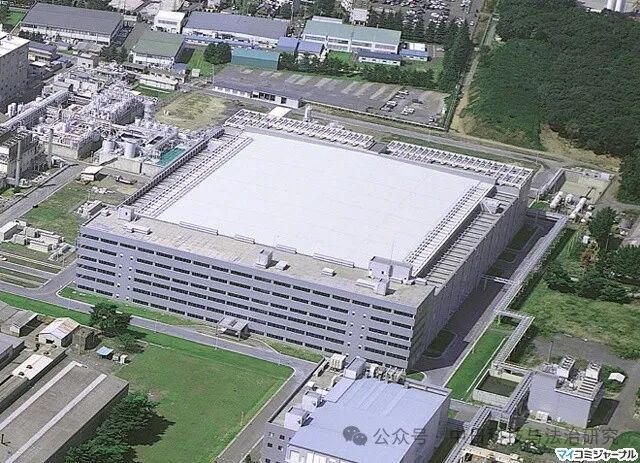
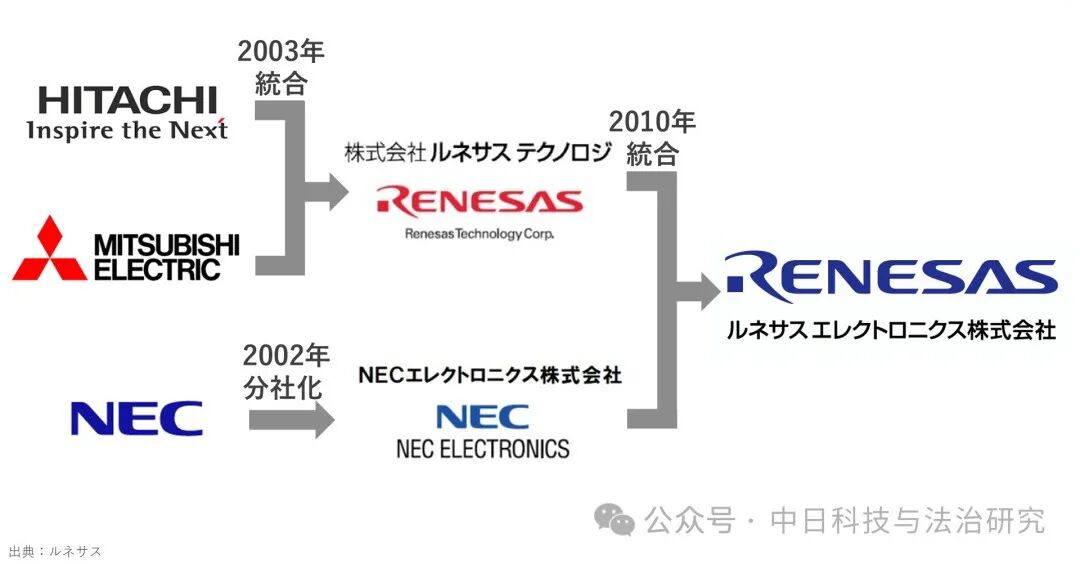 Renesas Electronics was formed through the integration of Hitachi, Mitsubishi, and NEC.In 2003, Hitachi and Mitsubishi Electric (excluding power semiconductor business) integrated their semiconductor businesses to establish Renesas Technology. In 2010, NEC’s semiconductor business entity, NEC Electronics (excluding general DRAM business), was merged into Renesas Technology, forming the current Renesas Electronics.As a large-scale corporate integration, the industry initially had high hopes for its synergy effects. However, due to the unique corporate cultures in semiconductor design and processes among the companies, the coordination work in the early stages of integration faced challenges. Nevertheless, Renesas overcame these difficulties and ultimately grew to become the leading company in sales among Japanese semiconductor manufacturers. Renesas is headquartered in Koto, Tokyo. The Musashi Business Unit is primarily responsible for the design and development of semiconductor chips and software, and it is the largest core base in Japan in terms of employee numbers. The front-end processes (wafer manufacturing, etc.) are conducted at the Naka Factory and Takasaki Business Unit. The back-end processes (packaging, testing, etc.) are conducted at the Yonezawa Factory, Oita Factory, and Nishiki Factory.Renesas’s core factory—the Naka Factory (Naka Wafer Fab)—has a remarkable technological achievement: in 2001, it became the first in the world to achieve mass production of 300mm (12-inch) wafer production lines; in 2009, it also initiated the world’s first 32nm process R&D production line. Even today, the Naka Factory continues to conduct mass production of Japan’s most advanced 40nm process. For a long time, Renesas has been leading the development of the Japanese semiconductor industry through technological breakthroughs at this factory. (The image below shows the exterior of the Naka Factory.)
 3. Business PerformanceAs a top semiconductor manufacturer in Japan, Renesas has broad development prospects. The image below shows the sales ranking of semiconductor manufacturers in Japan.
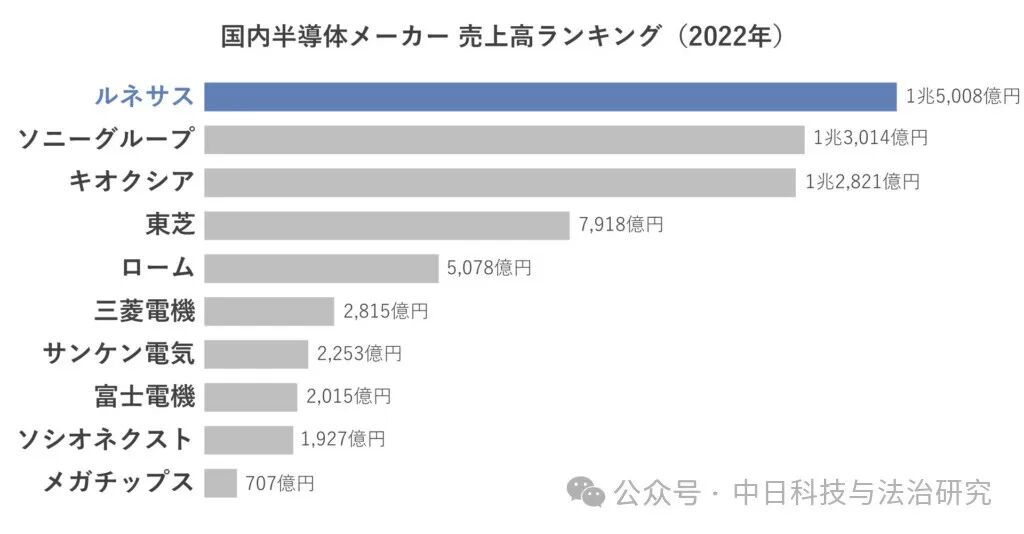 In recent years, while Kioxia has consistently ranked first in sales among Japanese semiconductor manufacturers, Renesas jumped to the first position in sales ranking among Japanese semiconductor manufacturers in 2022, influenced by its strong performance.At the same time, Renesas has a significant advantage in the automotive semiconductor field, and as a leading company in sales in the Japanese semiconductor industry, its development prospects are widely regarded as promising.The image below shows the global market share of semiconductors “microcontrollers (MCU)” used for automotive and industrial equipment control.
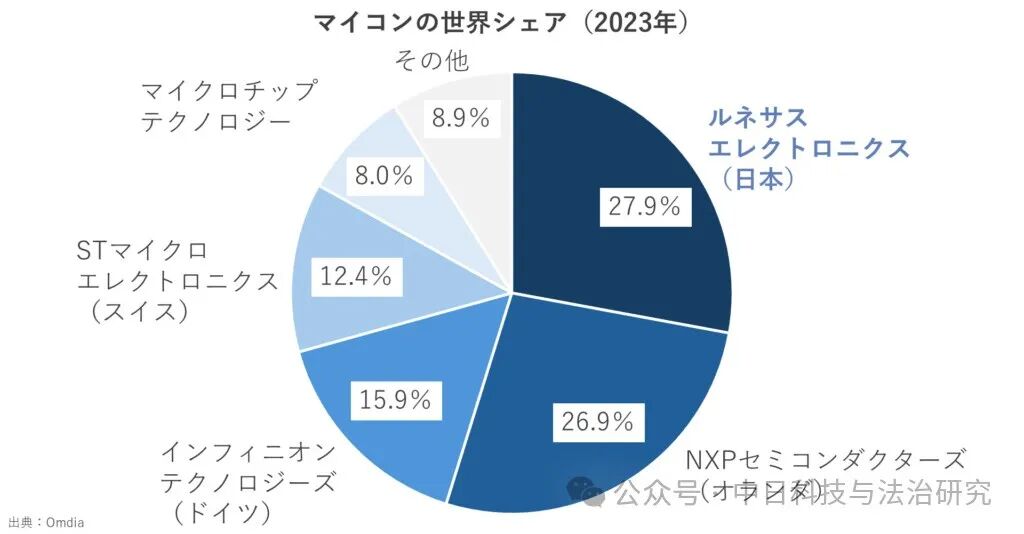 In the global market for microcontrollers (MCU), Renesas holds a market share of 27.9%, ranking first in the global market. With the electrification of vehicles, the proliferation of ADAS (Advanced Driver Assistance Systems), and autonomous driving technology, the demand for automotive semiconductor chips will continue to increase. This undoubtedly provides a strong impetus for Renesas, which has advantages in the automotive semiconductor field, and thus its future development prospects are widely regarded as promising.
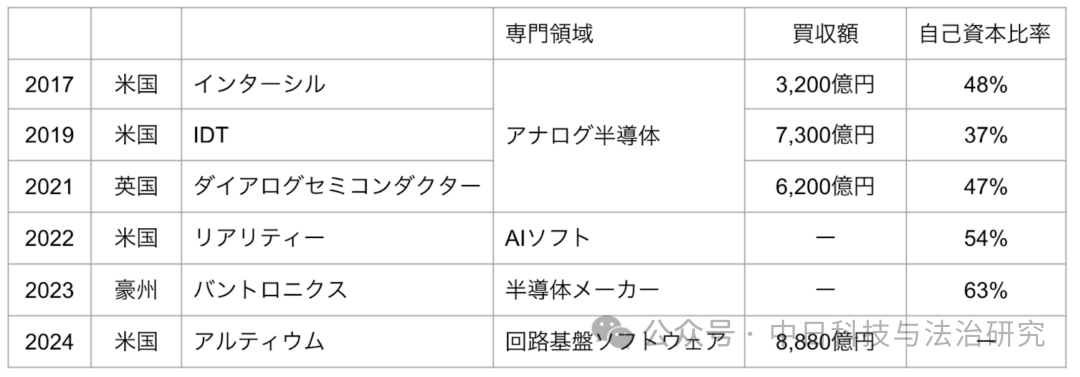 In the fiscal year 2023, Renesas’s operating profit margin was 34.1%. In comparison, the operating profit margin of Toyota, a representative of excellent enterprises, was only 7.3%, indicating that Renesas is a highly profitable company.By actively pursuing overseas acquisitions and operational reforms, Renesas continues to drive profit margin improvements.High profit margins enable it to actively engage in future investments, allowing for equipment investments based on market demands and resource allocation for new technology development.4. Lessons LearnedRegarding the development experience and insights of Renesas Electronics in Japan, I believe the following three points are worth noting:First, from the internal environment perspective, corporate mergers and acquisitions (M&A) have brought positive effects.In the mid-2010s, a wave of restructuring swept through semiconductor manufacturing companies. At that time, NXP, ranked second in the microprocessor industry, spent about 2 trillion yen to acquire the fourth-ranked company. As a result, Renesas relinquished its top position in the microprocessor market share.In response, Renesas took action by engaging in mergers and acquisitions in the analog semiconductor field, which is highly related to microprocessors.As the beginning of its acquisition actions, it first acquired Intersil for 320 billion yen. This amount was equivalent to four times its net profit for the fiscal year ending March 2016, making it a significant gamble. The outcome was successful. Despite experiencing difficult times in 2019 due to reduced automotive demand, Renesas achieved balanced growth in the automotive and industrial-related fields in which it excels. More importantly, for Renesas, the significance of mergers and acquisitions also lies in acquiring global corporate culture and management models.Ordinary corporate mergers and acquisitions often involve the parent company injecting its own culture and technical know-how into the acquired company. However, Renesas’s approach to mergers and acquisitions is to “respect the acquired company while absorbing its excellent corporate culture, thereby successfully achieving globalization.” For example,when Renesas acquired Intersil for 700 billion yen in 2017, it learned from the Silicon Valley model, emphasizing a proactive spirit in work, and absorbed the corporate culture of IDT. Specifically, this is the “Wing Combination” solution-based marketing model. Previously, Renesas had always sold products such as microprocessors and analog semiconductors separately. The Wing Combination, for instance, when targeting the automotive sector, is a solution-based marketing approach that follows up with related component combinations. By packaging about 500 solutions, it aims to win customers. Additionally, through the acquisition of the global Dialog Semiconductor, Renesas has gradually built a management model that adapts to diverse cultures, among other initiatives.In the future, Renesas will continue to promote mergers and acquisitions (M&A) and strive to expand production capacity and improve inventory management capabilities. By reducing costs and enhancing value through models like “Wing Combination.”Second, from the perspective of external influencing factors, aligning with market demand is the foundation for corporate development.As an external environmental factor, in addition to the depreciation of the yen, it is essential to mention the increasing demand for automotive-related semiconductors. The COVID-19 pandemic led to the closure of production bases and logistical chaos, causing a slowdown in semiconductor production (coincidentally, Renesas’s main factory experienced a fire). After the pandemic eased, the semiconductor production situation has not fully recovered. Following the end of the pandemic, with the recovery of production and life, the semiconductor shortage issue has persisted. It can be said that these external environmental pushes, along with internal environmental changes, have jointly promoted Renesas’s favorable development trend.Third, do not blindly chase trends, but steadily advance based on one’s own development positioning and existing advantages.Currently, artificial intelligence (AI) is booming. However, Renesas’s successful performance can be said to have almost no correlation with “AI semiconductors.” As Renesas mentioned in its fiscal year 2023 financial results briefing: “Although the demand related to AI is very strong, the business aimed at AI data centers accounts for only 2-3% of sales.” Fundamentally, the AI semiconductor field has overly strong competitors such as NVIDIA and TSMC, making it difficult for Renesas to increase its market share even if the market expands in the future. While it will gradually strive for market share in the AI semiconductor field, Renesas seems relatively calm in the face of the AI semiconductor boom, as it focuses more on transformation trends that align with its development positioning and existing advantages—namely, the transformation in the mobile mobility sector.The transformation in mobile mobility reflects the development trend of CASE. CASE is an acronym for Connected, Automated/Autonomous, Shared & Service, and Electrification, representing the four transformative trends in the mobile mobility sector. How to better meet the market demands triggered by these four transformations will be Renesas’s focus in the future.Based on the demand growth driven by the CASE development trend for the high-end development of future vehicles, Renesas’s stock price has shown a more stable upward trend compared to other semiconductor manufacturers, which has also become one of the highlights attracting investment for Renesas. **************************************Based on publicly available Japanese materials, compiled, excerpted, and translated. This article is for research and discussion purposes only; please delete if infringing.**************************************