Today, at the 2025 China Operating System Industry Conference held in Beijing, the country’s first commercial desktop and server operating system with a 6.6 kernel, Galaxy Kylin V11, was released.In response to the strong demand for computing power in the AI era, the Galaxy Kylin V11 system comes pre-installed with an AI subsystem and AI assistant, supporting one-click activation of local and cloud computing power. At the inference layer, the AI subsystem can achieve heterogeneous computing power scheduling among CPU (Central Processing Unit), GPU (Graphics Processing Unit), and NPU (Neural Processing Unit), balancing energy efficiency and enhancing model concurrency capabilities, thereby assisting users in upgrading their intelligent office efficiency.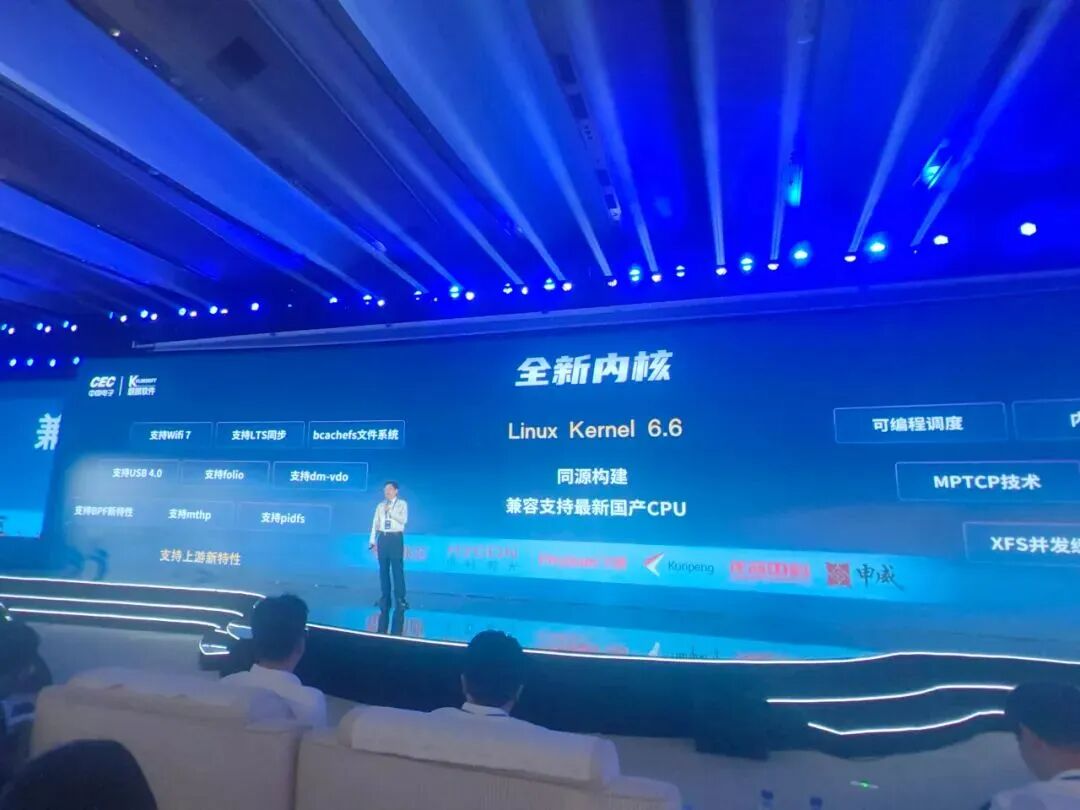
As the specific technical parameters of Galaxy Kylin V11 have not yet been announced, let’s take a look at another operating system developed by Kylin Software, “Open Kylin.” “Open Kylin” is China’s first desktop operating system developer platform, created through the open-source approach of sharing the operating system’s source code, resulting in an open-source desktop operating system with independent innovative technology, jointly completed by Kylin Software and over ten companies including the National Cybersecurity Center, PwC Software, Zhongke Fangde, Kylin Security, Ningsi Software, Yiming Software, ZTE New Pivot, Yuanxin Technology, China Electronics Technology Group 32nd Research Institute, Jide Systems, Beijing Linzhuo, and the Advanced Operating System Innovation Center.
What is the Open Kylin Operating System?At its core, the Open Kylin Operating System is an open-source Linux distribution primarily developed in China, aimed at providing a secure, efficient, and user-friendly operating system for desktops, laptops, and even specialized hardware. It is often referred to as a domestic Linux distribution because its construction focuses on domestic needs, such as supporting processors made in China and fostering a self-sufficient software ecosystem. Unlike many Western distributions, the Open Kylin Operating System emphasizes sovereignty, meaning it is designed to reduce dependence on foreign technology, which is significant in the context of geopolitical tensions and data security.The Open Kylin Operating SystemThe Open Kylin Operating System is based on the Linux kernel and draws on the stable foundation of Debian, making it reliable for everyday use. It is equipped with desktop environments like UKUI (a stylish modern interface based on Qt) and Kylin, providing out-of-the-box support for Wayland and X11 sessions for better graphics performance and compatibility. What sets it apart? It is optimized for a range of architectures beyond the usual x86, including ARM, RISC-V, and LoongArch—processors that are becoming increasingly popular in China and beyond.Consider the Open Kylin Operating System as China’s response to Ubuntu, but with a twist: it has deeply integrated AI features in recent versions, positioning itself as the “AI PC Operating System.” This means that built-in AI tools can handle everything from smart assistants to local AI model processing, making it attractive to users in education, government, and emerging technology sectors. By 2025, it is gaining momentum not only in China but globally, thanks to its open-source nature, inviting contributions from anyone.The History Behind the Open Kylin Operating SystemTo truly appreciate the Open Kylin Operating System, we need to trace back its origins. The story began in 2001 with Kylin OS, developed by scholars from the National University of Defense Technology as part of the national 863 program (a government initiative to promote high-tech independence). Kylin was initially based on FreeBSD and designed for military and government use, prioritizing security and performance. It achieved significant milestones, such as becoming the first 64-bit operating system without a Linux kernel to receive Linux Standard Certification in 2006.By version 3.0, Kylin transitioned to a Linux-based architecture, enhancing compatibility with global standards. In 2010, NeoKylin emerged through collaboration with China Standard Software Co., targeting enterprise and defense sectors. Meanwhile, an independent but related project, Ubuntu Kylin, was released in 2013, customizing Ubuntu for Chinese users through localization features.A significant shift occurred in July 2022 when Open Kylin was released as a fully open-source version of Kylin, opening the door to community-driven development. This move is strategically significant, aligning with China’s efforts to promote open-source innovation amid the backdrop of Sino-U.S. tech competition. By 2020, Kylin OS v10 was compatible with over 10,000 hardware and software products, even supporting Android applications. Open Kylin evolved from this foundation into a distribution that is not only secure but also innovative, supported by state-owned enterprises, universities, and a growing developer community.Fast forward to 2025: Open Kylin has matured, with events like the 2025 RISC-V China Summit showcasing its advancements in hardware such as XR, AI, and RISC-V laptops. This demonstrates how the Open Kylin Operating System has evolved from a niche military tool to a global open-source competitor.Key Features of the Open Kylin Operating SystemWhat makes the Open Kylin Operating System stand out in the crowded Linux world? Let’s break down its core features based on the latest official insights.First, multi-architecture support is a game-changer. The Open Kylin Operating System can run smoothly on x86 (Intel/AMD), ARM (such as Raspberry Pi), RISC-V (such as VisionFive2 or Milk-V Pioneer boards), and LoongArch processors. This is crucial for developers working on edge computing or IoT device development, as non-x86 hardware is common in these fields.The desktop environment is user-friendly: UKUI offers a modern, customizable interface with dual modes for PCs and tablets, while Kylin provides a more traditional feel. Both support Wayland for better security and performance, while also supporting X11 for compatibility with legacy applications.Security is built-in, inheriting Kylin’s military-grade roots, with enhanced encryption and compliance with Chinese standards. It uses APT for package management but includes a custom software center for easier application discovery, supporting over 4,000 applications.Robust multilingual support covers Chinese, English, Arabic, French, Spanish, and 52 other languages, making it accessible globally. For advanced users, it is optimized for high-performance computing, as seen in its use with supercomputers like Tianhe-1 and Tianhe-2.A lesser-known feature is the Enlightened Package Format (Kaiming Package Format), a new standard proposed at LAS 2025 that simplifies application distribution and integration. Let’s not forget ecosystem compatibility—under certain settings, it can even run Android applications seamlessly.Latest Versions and Releases of the Open Kylin Operating SystemFor any operating system, staying up to date is crucial, and the Open Kylin Operating System does not disappoint. According to the official download page (updated as of August 2025), the latest stable version is Open Kylin 2.0 SP1, released on December 20, 2024, covering multiple architectures. Open Kylin 2.0 SP1 X86
- is ideal for standard desktops, suitable for Intel/AMD systems. Open Kylin 2.0 SP1 LoongArch
- is tailored for China’s Loongson processors. Open Kylin 2.0 SP1 RISC-V
- supports boards like VisionFive2, SpacemiT K1, and RuyiBook. Open Kylin 2.0 SP1 ARM
- is suitable for Raspberry Pi and Phytium Pi.
For those eager for cutting-edge features, there is Open Kylin 2.0 SP2 Beta1 X86, released on June 26, 2025. This beta emphasizes AI enhancements, branding itself as the “AI PC Operating System,” with improved AI integration.Older versions like Open Kylin 1.0 (July 2023) are still available for specific RISC-V hardware, but for most users, version 2.0 SP1 is recommended. It can be downloaded via images on the official website, with ISO files available for easy installation. The release notes highlight stability improvements, bug fixes, and expanded hardware support.Community and Ecosystem Around the Open Kylin Operating SystemThe Open Kylin Operating System thrives on its community, adopting a contribution-based model where contributors drive progress. The Open Kylin community includes developers from universities, enterprises, and independent developers, facilitating collaboration through forums, Git repositories, and events.The ecosystem is growing, but it is still in its early stages compared to Ubuntu. It supports thousands of applications, but third-party options may require adjustments. Advantages include integration with Chinese hardware and software, such as domestic browsers and office suites. Challenges? Lower update frequency and inconsistent multilingual support, but the community is addressing these issues.Get updates through the official X account (@openkylin) or join the forum on the website. It’s a vibrant space for those interested in open-source with an Asian flair.Comparison of Open Kylin Operating System with Other Linux DistributionsThe Open Kylin Operating System has its own advantages but also occupies a unique niche market. Compared to Ubuntu: Open Kylin is more hardware-agnostic (for example, supporting LoongArch), but lags behind in the variety and refinement of applications. Ubuntu excels in global community and usability, while Open Kylin shines in security and AI tailored for Chinese scenarios.Compared to Fedora or Arch, Open Kylin is more stable (based on Debian) but not as cutting-edge. Its AI focus distinguishes it from most distributions, similar to emerging AI-integrated systems.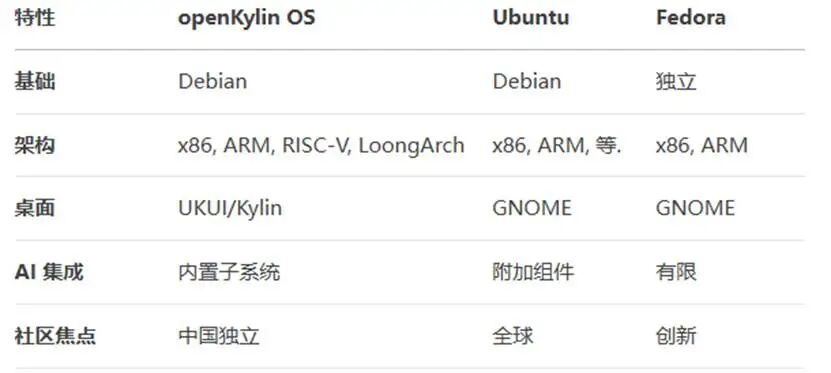 If sovereignty is important, the Open Kylin Operating System is a top choice.The Role of AI in the Open Kylin Operating SystemVersion 2.0 marks the Open Kylin Operating System as an AI powerhouse. It includes a built-in AI subsystem for local and cloud-based models, supporting features such as AI assistants for tasks like translation or code generation. This “AI PC Operating System” integrates AI at its core, from smart search to LLM (Large Language Model) on devices.For example, the Enlightened Package Format simplifies AI application deployment. Demonstrations at events like the RISC-V Summit showcased AI on RISC-V devices. This positions the Open Kylin Operating System for future AI-driven computing, especially in education and research fields.The Future of the Open Kylin Operating SystemLooking ahead, the Open Kylin Operating System is poised for growth. With ongoing AI enhancements and expanded architecture support, it may become a model for other countries seeking technological autonomy. Anticipate more stable versions, better international localization, and deeper ecosystem integration. With China’s investment in open-source, Open Kylin could compete with global giants, especially in emerging markets.