Recently, orders for humanoid robots have been actively secured. Last Friday, UBTECH won a humanoid robot equipment procurement order worth nearly 100 million yuan from a certain automobile company, making it the largest globally. In the first half of the year, companies like Yushu have successively received orders from research institutions, universities, and industrial scenarios, bringing hope for the commercialization of humanoid robots.
This week, Tesla’s robots have attracted attention, with rumors of order recovery. Musk stated in yesterday’s second-quarter earnings call that the third-generation robots will be launched in the next three months, with production starting early next year; the goal is to produce 100,000 units per month over the next five years, reaching an annual production of 1 million units by 2030. This aligns with the first-quarter earnings call (when it was stated that the annual production would reach 1 million units by 2029-2030), meeting expectations.
PEEK materials are known for their high-temperature resistance and strong corrosion resistance, making them suitable for high-temperature and electrical insulation applications, traditionally used in aerospace and medical fields. In the robotics sector, compared to metals like magnesium, aluminum, and steel, PEEK materials can significantly reduce weight, enhance mobility and flexibility, lower energy consumption, and extend battery life, ultimately reducing total costs over the long term.
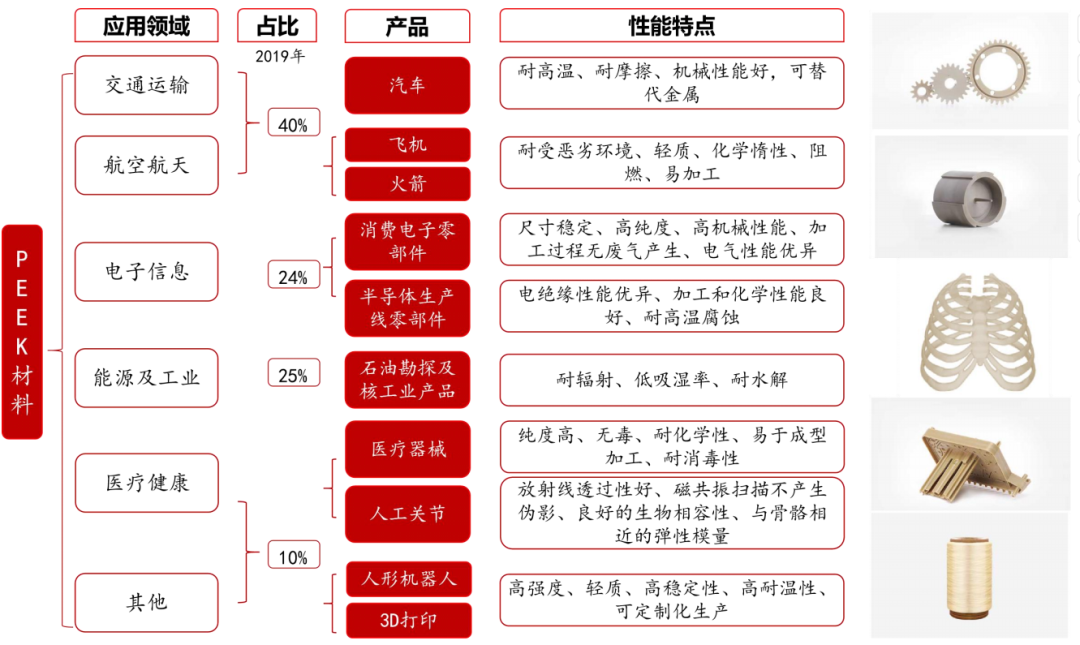
The applications of PEEK materials in robots include: structural components (limb skeletons, joints, robotic arms), transmission and connection components (gears, chains, bearings, bolts), protective casings (sensor and actuator housings and decorative parts), and energy and storage components (battery housings and insulating parts).
The upstream raw materials for the PEEK material supply chain include fluoroketone and sodium carbonate, with fluoroketone being the core raw material. Approximately 0.8 tons of fluoroketone monomer are consumed for every ton of PEEK material produced, accounting for about 50% of the cost in the production of crude powder of pure PEEK resin. By 2024, the domestic production rate of fluoroketone raw materials in China is expected to increase from 30% in 2020 to 70%, which can reduce production costs by about 12% and improve the self-sufficiency rate of the domestic PEEK industry, ensuring the stability of the supply chain.
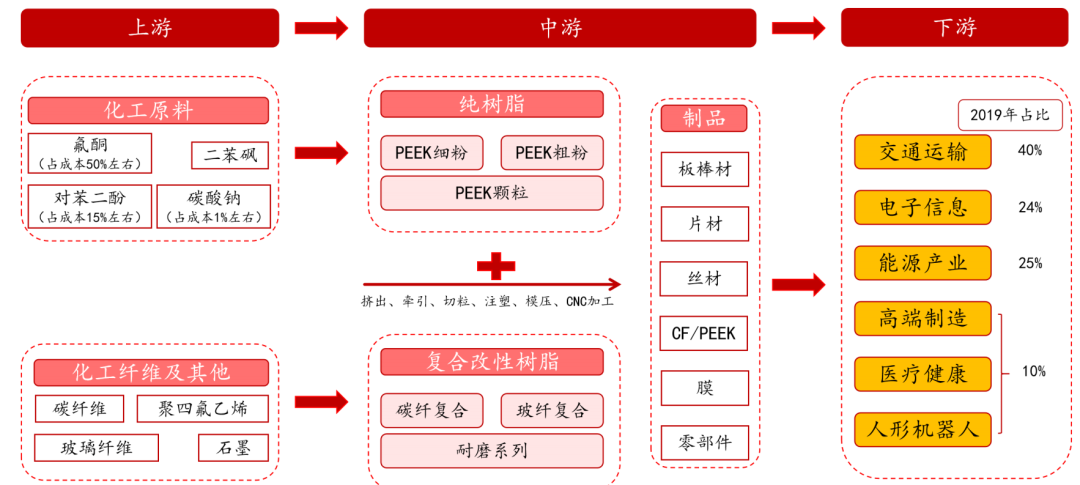
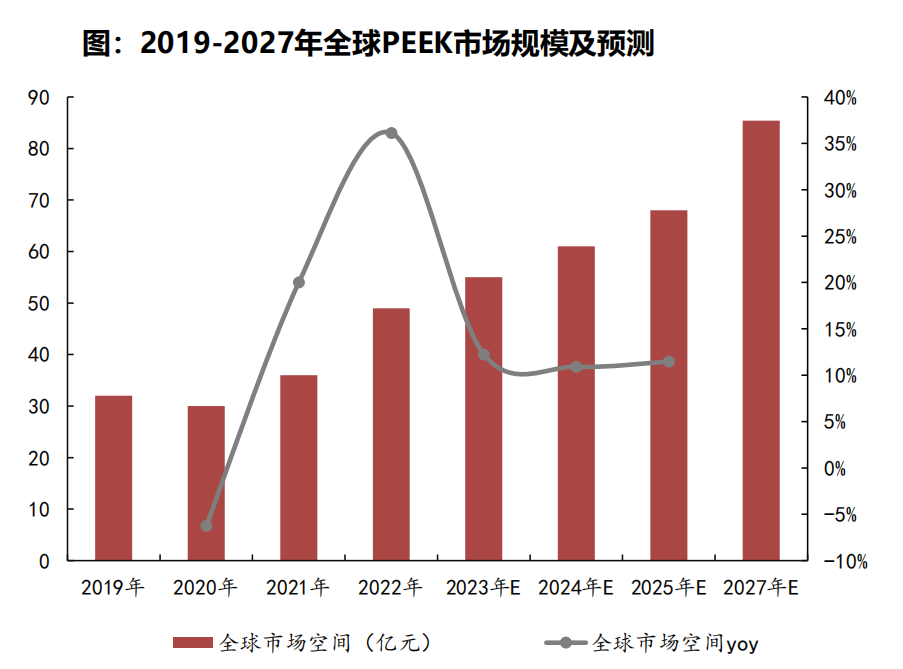
Downstream applications include aerospace, electronics, automotive, and medical fields. In terms of market size, the global PEEK market is expected to reach approximately $900 million in 2024, with a year-on-year growth of about 5%; it is projected to reach $1.23 billion by 2025 and $1.85 billion by 2030, with a compound annual growth rate of about 8.4% from 2025 to 2030.
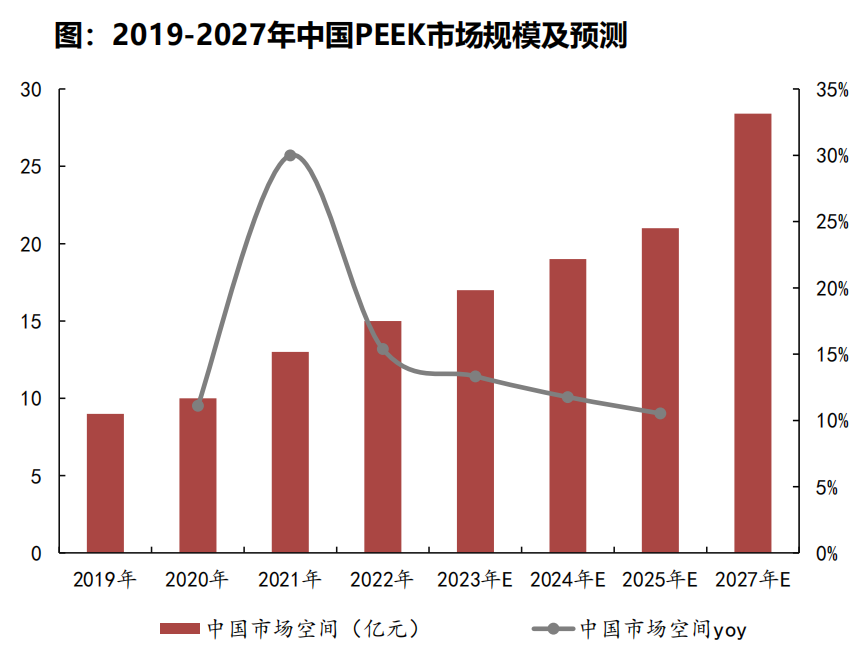
In 2024, the domestic PEEK market size is expected to be approximately 1.92 billion yuan, accounting for 41.8% of the global market. However, it faces challenges such as import dependence and cost pressure, with high-end capacity utilization at only 42%; in 2024, China’s PEEK export volume is expected to be around 400 tons, with export prices ranging from 350,000 to 400,000 yuan per ton, which is half of the import price.
The global PEEK production landscape is characterized by a “one strong, many strong” pattern, with major market shares held by UK-based Victrex, Belgium’s Solvay, and Germany’s Evonik;
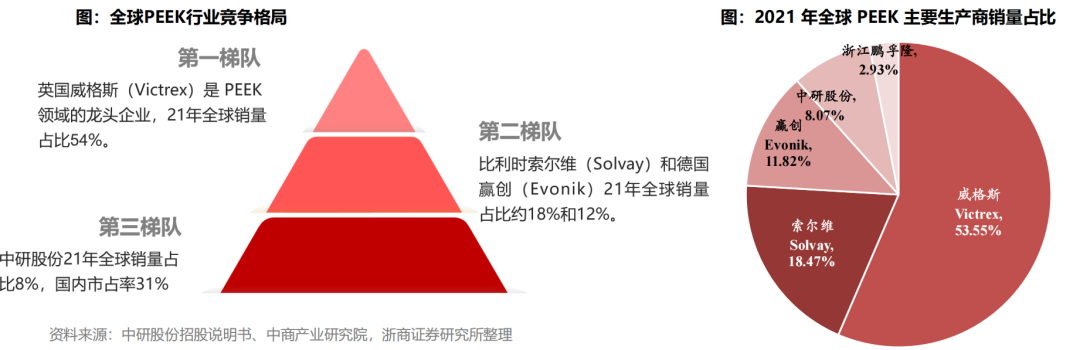
Domestic companies are rising to promote domestic alternatives, with Zhongyan Co., Ltd. having the highest domestic market share. In 2024, Zhongyan Co., Ltd. is expected to have a PEEK production capacity of 1,000 tons/year, with resin sales of 966 tons and a capacity utilization rate of about 97%; in 2021, it ranked fourth globally in PEEK sales, with a domestic market share of about 31%, replacing international leaders like Victrex. The company has the first domestic 5000-liter supercritical reaction kettle and is collaborating with Siasun Robot to develop collaborative robot joint modules, which can reduce weight by 25% and achieve a repeat positioning accuracy of ±0.2 mm.
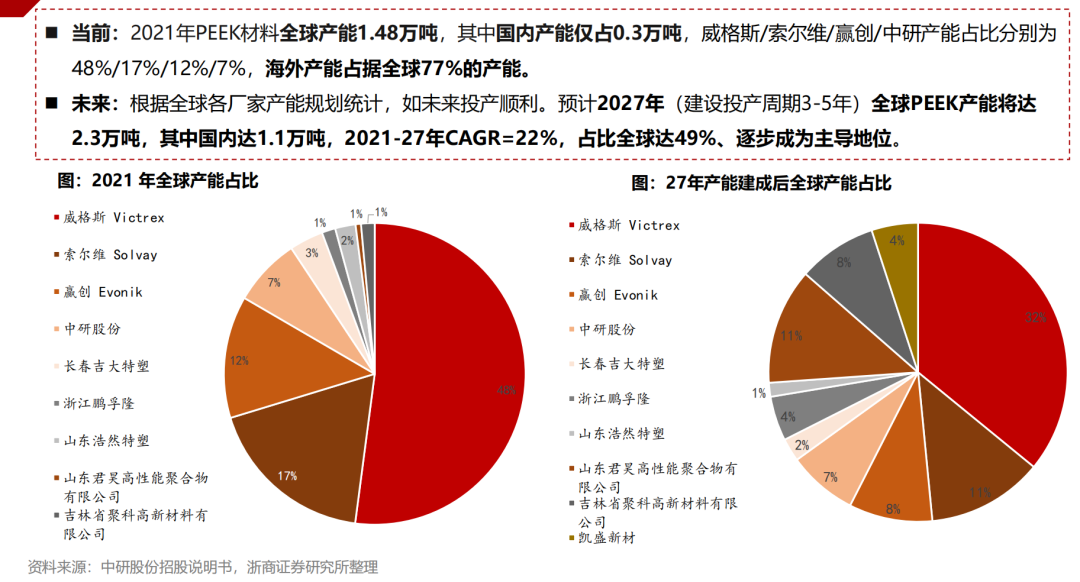
Among other companies in the layout, Hongfu Co., Ltd. is developing PEEK material research and trial production, providing samples for a certain client; Zhaomin Technology is engaged in the development of PEEK products based on its precision injection molding capabilities and experience in developing special engineering plastics, with products used for robotic components and interfacing with downstream clients; Weike Technology is involved in the development of robot-related components, including PEEK skins, and is interfacing with domestic humanoid robot manufacturers; Water Co., Ltd. has completed fire protection, environmental protection, and trial production evaluations for the first phase of its Chongqing SP project and PEEK project, overcoming high-temperature and high-pressure synthesis processes, with products that can withstand temperatures exceeding 260°C, suitable for replacing metals in core components of drones, and is currently cooperating with downstream clients for validation testing.