In the vast realm of industrial automation, PLC programming shines like a brilliant star, illuminating every corner of the production process. From its inception to the present day, it has undergone multiple transformations, and its application fields continue to expand. Today, let us explore the development history and diverse application areas of PLC programming, look forward to its future trends, and provide some learning suggestions for industrial control professionals.
1. The Birth and Emergence: Solving Industrial Control Challenges
In the late 1960s, the industrial sector faced numerous challenges with traditional relay control, such as complex wiring, high costs, and difficult maintenance. At that time, the rise of electronic computer technology led to attempts at industrial control, but the high operational requirements and costs were also significant drawbacks.In 1968, General Motors proposed a 10-point bidding specification for designing a new type of electric controller,where the point of “simple programming and on-site program modification” became a key opportunity for the birth of PLC.
In this bidding process, Digital Equipment Corporation (DEC), Information Instrumentation Company (3-I), and Bedford Associates all provided prototypes. Ultimately,the Modicon 084 controller developed by Bedfordstood out due to its simple programming method, becomingthe world’s first commercial PLC and its founder,Dick Morley is hailed as the “Father of PLC.” The success of Modicon 084 was also attributed to the introduction ofladder diagram programming, a programming symbol derived from electrical engineering sequential operation function instructions, which allowed electrical engineers and electricians to quickly get started, greatly promoting the popularity of PLC.
2. Growth and Development: Technological Innovations Drive Transformation
From 1975 to 1976, countries such as the United States, Japan, and Germany applied microprocessors to the central processing unit of PLCs, replacing magnetic core memory with integrated circuit memory, and combined with microcomputer technology, PLCs achieved large-scale integration and entered a practical stage. At the same time, PLC manufacturers developed graphical programming devices using microprocessors, evolving from initially single-purpose handheld programmers that could only work with the same manufacturer’s PLCs to dedicated graphical programming terminals equipped with keyboards and floppy disk drives that could adapt to different PLC models. Although large and expensive, this also reflected technological progress.By the 1980s, PLC programming software running on computers began to emerge, gradually replacing programmers and bringing more convenience to programming tasks.
With the development of PLCs, programming languages became diversified. France and Germany respectively introducedGRAFCET (the predecessor of SFC sequential function charts) andDin 40719 function charts. To unify PLC programming software and application development, the International Electrotechnical Commission (IEC) initiated the development of PLC standard specifications in 1982, completing the final text of IEC1131-3 in 1992 and officially launching it in 1993, later renaming it IEC61131-3.This standard unified the American ladder logic language, German function chart language, French GRAFCET, and the commonly used instruction list language in Japan, and also developed a structured text language similar to PASCAL, significantly promoting the development of standardized PLC programming languages. Since then, the PLC standard has continued to be updated, such as the issuance of the second edition of IEC 61131-3 in 2003 and the third edition in 2013, incorporating important improvements such as object-oriented features.
3. Diverse Applications: The Backbone of Industrial Automation
1. Manufacturing: The Intelligent Brain of Production Lines
In the automotive manufacturing sector, PLC programming controls welding robots for precise operations, ensuring strong welds; the painting line sprays each car body evenly according to preset processes; and the assembly line coordinates actions at various stations to efficiently complete car assembly, significantly improving production efficiency and product quality. In the food and beverage industry, PLCs accurately control processes such as canning, sealing, and labeling based on preset weights or quantities, monitoring key quality points in real-time to ensure food safety and production continuity.
2. Process Control: Stabilizers in Chemical, Energy, and Other Industries
In industries such as chemicals, oil, and natural gas, PLCs monitor chemical reaction processes, fluid transport states, and parameters such astemperature and pressure in real-time, ensuring stable and safe production processes, optimizing resource utilization, and reducing energy consumption. In the energy sector, including electricity, solar, and wind energy, PLCs monitor grid status and automatically adjust generation and transmission equipment, enhancing the efficiency and reliability of energy production and distribution.
3. Water Treatment and Wastewater Treatment: The Unsung Heroes of Water Quality Assurance
In water treatment plants, PLCs intelligently schedule pumps, control valve openings and closings, and accurately add chemicals based on information such aspipeline water pressure, flow rate, and water quality parameters, ensuring efficient operation of treatment processes and producing clean water that meets standards. In wastewater treatment plants, PLCs manage processes such asaeration, sedimentation, and filtration, ensuring proper purification of wastewater and protecting the water environment.
4. Building Automation: Creating Intelligent and Comfortable Spaces
In smart buildings, PLCs coordinate lighting systems, automatically adjusting brightness based on time and personnel activity; control air conditioning systems to maintain comfortable temperature and humidity; and manage security systems to ensure building safety. By optimizing energy management, they achieve energy savings and emissions reductions, enhancing the overall intelligence level and living experience of the building.
5. Traffic Control: The Conductor of Smooth Roads
In traffic control systems, PLCs manage the switching of traffic lights, dynamically adjusting timing based on traffic flow to reduce congestion; they collaborate with monitoring cameras and vehicle detection systems to ensure road traffic safety and order, improving traffic operation efficiency.
4. Future Trends: New Breakthroughs Under Technological Integration
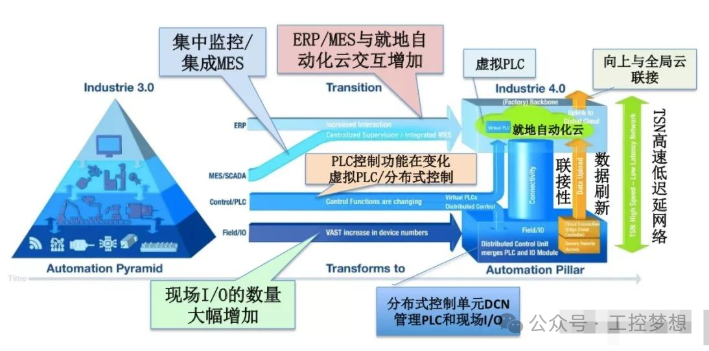
With the deepening of Industry 4.0 and smart manufacturing, PLC programming is evolving towards a more intelligent, efficient, and open direction.
Deep integration with the Internet of Things (IoT) will be an important trend. Future PLCs will possess stronger networking capabilities, able to collect a large amount of operational data from devices in real-time and upload it to cloud platforms. Through big data analysis, predictive maintenance will be achieved, allowing for early detection of potential faults and reducing downtime. At the same time, with the help of IoT, operators can monitor and control devices remotely in real-time, greatly enhancing management flexibility and convenience.
The integration of artificial intelligence (AI) technology will make PLCs more “intelligent.” PLCs can autonomously learn patterns in production processes through AI algorithms, optimizing control logic and achieving adaptive adjustments. For example, in complex production environments, PLCs can automatically adjust production parameters based on subtle changes in raw materials, ensuring the stability of product quality.
The further simplification and standardization of programming languages will also continue to advance. More intuitive and user-friendly programming interfaces will lower the programming threshold, allowing more non-professionals to participate in writing and modifying PLC programs. At the same time, cross-platform programming standards will make program migration between different brands of PLCs more convenient, improving overall industry efficiency.
5. Learning Suggestions for Industrial Control Professionals
Learning industrial control technology knows no age limit—whether you are a young person just entering the workforce or a seasoned professional with years of experience, as long as you have an interest in the field of industrial control, you can bravely embark on the learning journey. Interest is the best teacher; it can drive you to overcome difficulties in learning and continuously explore new knowledge.
In this era of rapid technological iteration, failing to improve may lead to obsolescence, and continuous learning is a way of life. For industrial control professionals, it is essential to keep pace with technological developments, continuously learn new PLC programming skills, and understand emerging industrial automation technologies. This can be achieved through various means such as participating in professional training courses, reading industry books and materials, and exchanging experiences with peers.
At the same time, it is important to emphasize the combination of theory and practice. PLC programming is a highly practical skill; only through actual operation can one truly understand programming logic and master problem-solving methods. You can start with simple projects, gradually accumulate experience, and continuously enhance your practical skills.
From solving industrial control challenges at its inception to its widespread application in various fields today, PLC programming has always been advancing on the path of promoting industrial automation development. In the future, with continuous technological innovation, PLC programming will shine in more fields, and the continuously learning industrial control professionals will realize their self-worth in this process, contributing to the development of the industry.
Previous Recommendations
5 Fatal Pitfalls in Learning PLC! The 3rd One Cost Me 3 Months of Work【A Must-Read Guide for Beginners】
“Industrial Control Audio” — From Multimeters to Programming Screens: The PLC Comeback Story of Old Electrician Wang!
Welcome to discuss cooperation with various universities!
On-site training🗝
[The Fastest Method to Test for Leakage] 9 out of 10 Electricians Are Unwilling to Teach, Learn This Trick to Quickly Judge!
A Must-Have for Electricians! 187 Circuit Diagrams Explained, From Start-Stop Control to Overload Protection, Skip 3 Years of Trial and Error!
Mitsubishi FX Beginners, Look Here! 21 Cases, Modify Programs to Learn Practical Skills, Equivalent to 10 Manuals
Teacher Zeng Xin’s On-Site Lecture
On-site PLC training, integrating practice, guidance, and improvement to cultivate all-round PLC talents
Come to Jicheng Training for a Growth Appointment
How to Obtain an Electrician Certificate, A Must-Read for Beginners!
Complete Installation Guide for TIA Portal Software V19 (Including Pitfall Guide)
Computer Configuration Guide for Learning PLC Programming (From Beginner to Advanced)