
On the evening of August 25, Beijing time, NVIDIA announced the launch of its Jetson AGX Thor robot chip module, specifically designed for robotics and autonomous driving computing platforms. This chip, referred to as the “robot brain,” will begin shipping next month, allowing customers to create robot prototypes with it. The new Jetson AGX Thor developer kit starts at $3,499, and is now available for global customers, including those in China.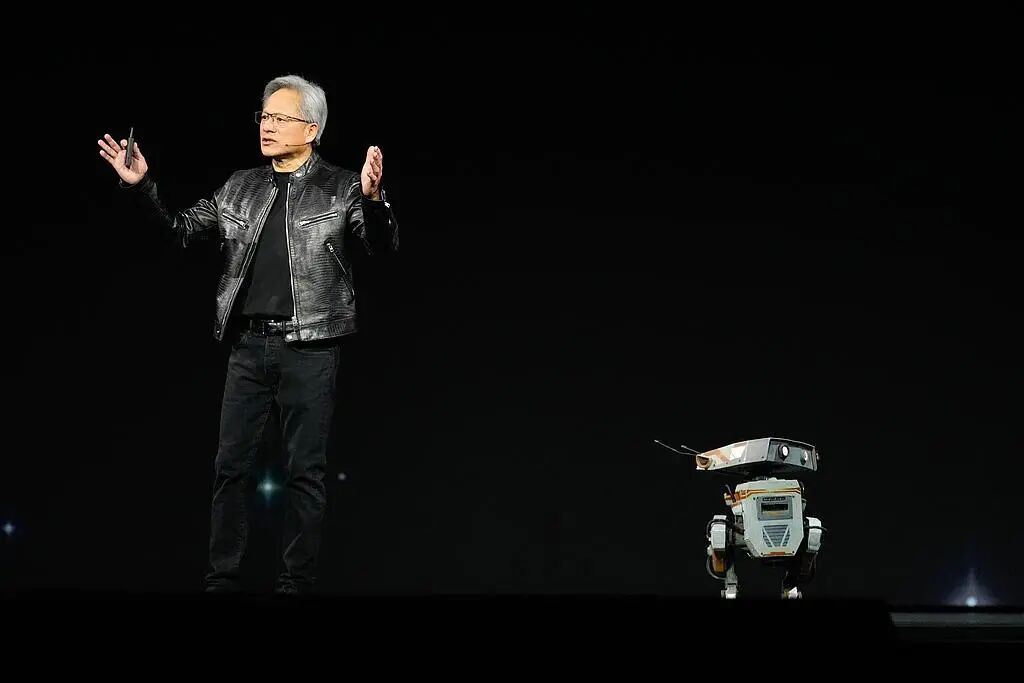
Thor is named after the Norse god of thunder. Compared to the previous generation Orin chip, the Thor chip utilizes the new generation Blackwell architecture, the same as NVIDIA’s AI data center GPUs. Based on the Thor chip, NVIDIA also launched the robot computing platform Jetson Thor and the autonomous driving computing platform DRIVE Thor. DRIVE Thor is currently available for pre-order and will start shipping in September.

As Huang Renxun described it as the “new brain for robots,” the Jetson Thor computing platform integrates CPU, GPU, memory, connectivity, and power management modules. In terms of computing performance, the Jetson Thor achieves 1035 TFLOPS (trillion floating-point operations per second) of AI computing power under the FP8 standard (a low-precision 8-bit floating-point format, while the industry commonly uses the 16-bit floating-point format FP16 or FP8 to measure AI computing power), and reaches 2070 TFLOPS under the FP4 standard, which is 7.5 times that of the previous generation Jetson Orin. It is equipped with 128GB of LPDDR5X memory, with a bandwidth of 273GB per second, and supports Ethernet with a bandwidth of 100Gbit per second.
While having stronger performance, the overall power consumption of Jetson Thor is only 40 to 130 watts, with an energy efficiency ratio (AI computing power/power consumption) that is 3.5 times that of Orin.
“If you want to build humanoid robots or autonomous vehicle applications, the performance of Orin is no longer sufficient. Many of our customers use 2-4 or even more Orins. Now, one Thor can meet the demand. Thor supports real-time operation of LLM, VLM, and VLA models, with performance improvements of over 7 times, significantly advancing the development of general-purpose robotics,” NVIDIA’s Vice President of Robotics and Edge Computing, Deepu Talla, introduced to reporters from Jiemian News and others at the new product launch media conference.
He also mentioned that the biggest challenge in deploying robots is the high cost and long time required to build, test, and deploy physical robots. NVIDIA can provide “three computers” to solve this problem: the data center computing device DGX is responsible for training AI models, generating the “synthetic data + real data” needed for robots; the 3D simulation platform Omniverse is responsible for simulation testing, and Jetson Thor acts as the “brain” responsible for computing after the robot is deployed.
According to Deepu Talla during the interview, many companies in China have already used Orin and are preparing to upgrade to Thor. Currently, in the robotics field, several of the most important domestic robotics star companies, such as Yushu Technology, Zhiyuan Robotics, Zhongqing Robotics, and Galaxy General, are NVIDIA’s customers, while customers in the autonomous driving field include almost all leading automotive companies, including BYD, Xiaomi, Zeekr, and Li Auto.
NVIDIA CEO Huang Renxun has always focused on the robotics industry, repeatedly calling robots the “next major opportunity after AI” on multiple occasions. During his visit to Beijing for the Chain Expo in July this year, he emphasized again in his opening speech that the next wave of AI will be robots, and future robots will possess reasoning and execution capabilities, as well as the ability to understand the physical world.
Moreover, the Chinese market is crucial for NVIDIA’s robotics industry layout.
At the 2025 CES Global Consumer Electronics Show, Huang Renxun appeared on stage with robot products from 14 humanoid robot companies collaborating with NVIDIA, six of which are from China. He has previously pointed out that China will be in a leading position in the robotics field driven by three factors: the proportion of the labor population in the economic structure, a strong supply chain and manufacturing capability, and the AI and robotics-related technology ecosystem. In China, over 1.5 million developers have already conducted secondary development based on NVIDIA’s platform.
Source:Jiemian News
