At the recent RISC-V Summit held in Shanghai, NVIDIA’s Vice President of Hardware Engineering, Frans Sijstermans, officially announced during the keynote speech that NVIDIA’s core CUDA software platform will begin to support the RISC-V instruction set architecture. Although the announcement was not made with much fanfare, the industry generally believes that this decision will have far-reaching implications.
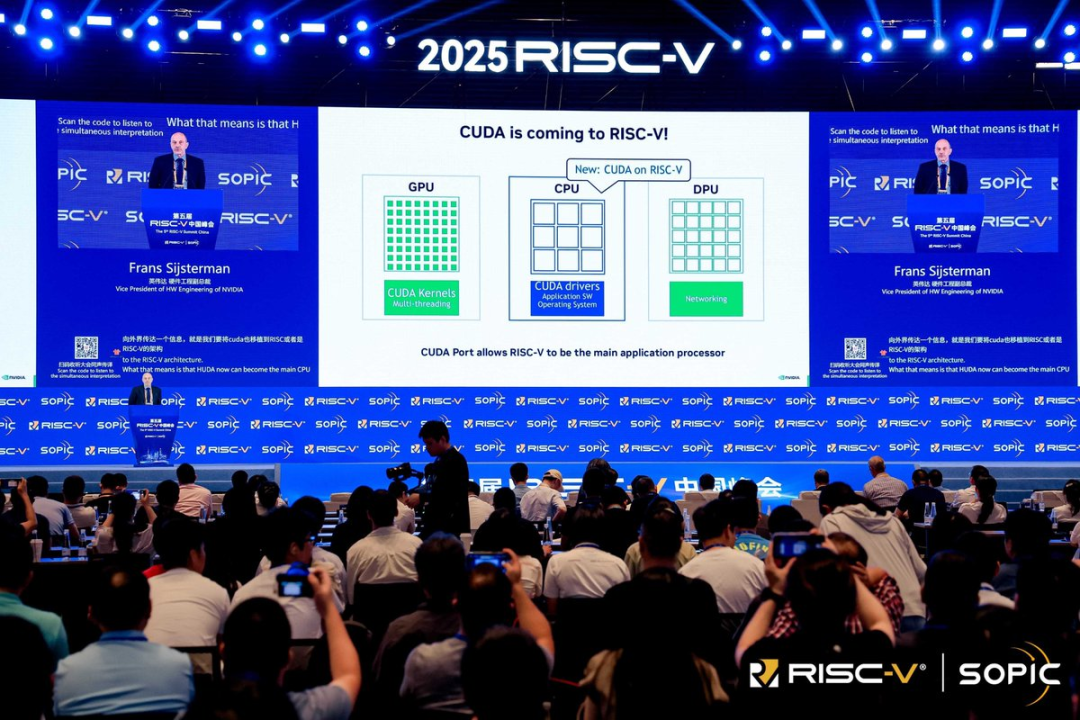
Image: Frans Sijstermans during the conference (Source: RISC-V International)
From a technical perspective, this means that RISC-V can now serve as the main processor in CUDA-based systems, a role previously only fulfilled by Intel and AMD’s x86 processors or Arm architecture CPUs. The system architecture diagram presented by NVIDIA shows that the GPU is dedicated to handling parallel computing tasks, while the RISC-V processor is responsible for running CUDA drivers, application logic, and the operating system, with the entire system also equipped with a DPU specifically for handling network transmission. This configuration allows the CPU to fully coordinate the GPU’s work within the CUDA environment.
Looking back at the 2022 GTC Summit, NVIDIA had clearly stated that there were no plans to add RISC-V support to CUDA. However, the situation has fundamentally changed over the past three years. The U.S. semiconductor export controls against China have put NVIDIA in a difficult position in the Chinese market, with top products like GB200 and GB300 unable to be exported normally. As a massive market, the importance of China is self-evident, and NVIDIA clearly does not want its CUDA ecosystem to lose influence here.
More importantly, the development speed of RISC-V in China has exceeded many people’s expectations. China is currently vigorously promoting the use of RISC-V chips through relevant policy guidance.
Chinese tech companies are also actively positioning themselves. For example, Alibaba has not only developed the Xuantie RISC-V processor but has also announced plans to invest over $50 billion in AI and cloud computing over the next three years. Similar investments are happening across China, and the entire RISC-V ecosystem is rapidly developing.
Following the announcement, the capital market reacted strongly. Stocks of Chinese semiconductor companies such as Chipone, Aowei Technology, and Anlu Technology surged significantly, with some even hitting the daily limit. Investors clearly see opportunities in this emerging market.
Globally, the growth momentum of RISC-V is indeed remarkable. Industry forecasts indicate that by 2025, over 20 billion RISC-V cores will be in use, with a compound annual growth rate exceeding 30%. Such growth rates are uncommon in the mature semiconductor industry. Currently, over 3,000 companies worldwide are actively developing RISC-V-based solutions, surpassing the experimental stage and becoming a true industry trend.
Of course, RISC-V still faces many challenges in truly competing with x86 and Arm. The biggest obstacle may be the construction of its software ecosystem. x86 and Arm have developed comprehensive operating systems, compilers, and development tool support over decades, while RISC-V still needs time to accumulate in this area. However, with the support of a heavyweight software platform like NVIDIA CUDA, the construction of RISC-V’s software ecosystem will undoubtedly accelerate.
However, for traditional chip manufacturers, NVIDIA’s decision may not be good news. Intel and AMD are already facing strong competition from NVIDIA in the AI chip market, and now even the traditional processor field may be affected. If RISC-V can work well with NVIDIA GPUs, customers who originally needed to purchase Intel or AMD processors may consider the cheaper RISC-V options.
Arm’s situation is similarly delicate. The company has always positioned itself as a representative of “the future of server efficiency,” but now even NVIDIA, which once attempted to acquire it, is starting to embrace RISC-V, making the situation somewhat awkward. Especially in the Chinese market, government policy guidance has become very clear, and Arm’s licensing fee model may face increasing resistance.
However, from a technical standpoint, NVIDIA’s support for RISC-V is not particularly surprising. NVIDIA’s driver design is relatively modular, having previously supported IBM’s POWER architecture and even had applications on Itanium and SPARC platforms. Moreover, NVIDIA has already been using RISC-V in its GPUs—those control cores responsible for managing various GPU functions have largely transitioned from proprietary designs to RISC-V-based solutions.
Furthermore, this is not the first time RISC-V has intersected with CUDA. A few years ago, researchers from the U.S. and South Korea implemented CUDA code execution on a RISC-V GPU project called Vortex, but that was more of an academic exploration. Now, NVIDIA’s official support carries a completely different significance—it means RISC-V has officially gained entry into the AI computing field.
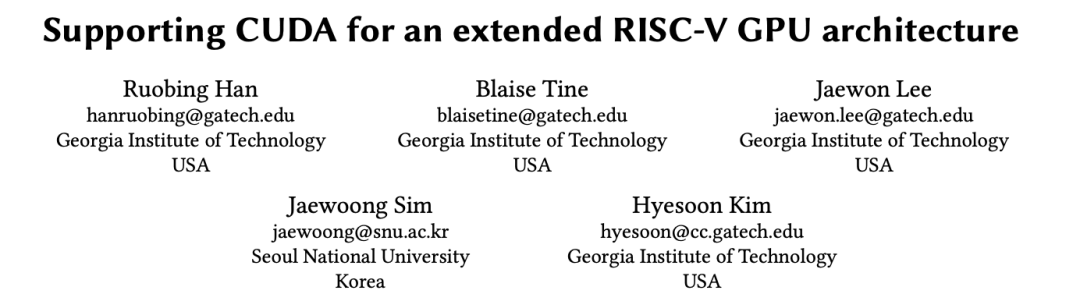
Image: Related paper (Source: arXiv)
In the future, the combination of NVIDIA’s CUDA and RISC-V is most likely to achieve success first in edge computing and embedded AI devices. Modular products like Jetson, if they can replace expensive Arm chips with cheaper RISC-V processors, will be very attractive to cost-sensitive customers. As for high-end applications like data centers, RISC-V may still need more time to prove its capabilities.
On the other hand, from a geopolitical perspective, NVIDIA’s decision may raise concerns among some U.S. policymakers. They have long worried that China could use RISC-V’s open-source characteristics to bypass U.S. technology restrictions, and now NVIDIA is proactively providing tools for this possibility. However, this also reflects the objective laws of technological development—restrictions often give rise to alternatives, and these alternatives sometimes exhibit greater vitality.
For China’s AI industry, NVIDIA’s decision is undoubtedly a significant boon. Although RISC-V-based AI chips currently cannot compete with NVIDIA’s top products in terms of performance, the cost advantage is evident. For applications that do not require cutting-edge performance but are price-sensitive, the RISC-V + CUDA combination may have strong competitiveness.
NVIDIA’s pivot, to some extent, also reflects the profound changes the entire technology industry is undergoing. Simple technological leadership is no longer sufficient to guarantee market advantage; the importance of geopolitical factors, supply chain security, and cost control is rising. In this context, embracing open source and maintaining the openness of the ecosystem may align better with long-term interests than closed-door development.
Of course, NVIDIA has its own calculations in doing this. CUDA has always been an important moat for them, and as long as they can keep more developers and companies using CUDA, the underlying processor used is not the most critical factor. By supporting RISC-V, NVIDIA is actually seeking more hardware carriers for its software ecosystem, and this strategy seems quite wise in the current environment.
References:
1.https://www.tomshardware.com/pc-components/gpus/nvidias-cuda-platform-now-supports-risc-v-support-brings-open-source-instruction-set-to-ai-platforms-joining-x86-and-arm
Operation/Typesetting: He Chenlong

 01/ Chinese Scientists Challenge Silicon Dominance, Build Ideal Ballistic Transport Transistor, Achieve Major Breakthrough in Two-Dimensional Indium Selenide Semiconductor02/ The Rise of Context Engineering: 15 Scientists from China, the U.S., and Australia Define Core Disciplines of a New AI Era, Revealing Fundamental Asymmetries in Large Models03/ The First “Baby Photo” of the Solar System is Born! Scientists Capture the Initial Stage of Planet Formation, Helping to Unravel the Mystery of Planet Origins04/ Scientists Design an “AI Engine” Covering the Entire Immune Process, Predicting Virus and Tumor Cell Mutations Faster, Aiding Vaccine Design and Precision Immunotherapy05/ Over 40 Scientists Rarely Collaborate to Write: AI Can Now Use Human Language to Simulate Thinking, Monitoring AI Reasoning Has Only a Brief Window Left