July 2025, Shanghai — As artificial intelligence accelerates from the cloud to the edge, the demand for edge intelligence is growing. Today, Nuclei System Technology officially launched its next-generation edge AI accelerator IP product — NACC (Nuclei Neural-Network Accelerator), designed to meet the AI computing needs of the RISC-V ecosystem, featuring high energy efficiency, high parallelism, and highly scalable matrix computing capabilities, along with a complete software stack adaptation, aiming to create the AI computing core for the next generation of smart terminals.
Rapid Development of Edge AI, Micro-NPU as a Key Engine
Artificial intelligence is rapidly transitioning from the cloud to the edge, widely integrating into industries such as healthcare, automotive, and consumer electronics. Compared to cloud-based solutions,the greatest advantage of edge AI lies in its powerful local real-time processing and decision-making capabilities, enabling efficient responses without relying on network connections, ensuring system stability and continuity of use, while also providing inherent advantages in privacy protection and data security. This places higher demands on AI chips in terms ofcomputing power, power consumption, integration, and flexibility.
In this context,Micro-Network Processors (Micro-NPU) have become the key engine for deploying edge AI, which possess:
High energy efficiency, capable of performing complex AI inference tasks at low power consumption;
High parallel throughput capability, suitable for multi-task concurrent execution;
Local execution of AI inference, eliminating the need to upload sensitive data to the cloud, enhancing privacy and security;
Low development threshold and flexible deployment, accelerating the pace of AI innovation application implementation;
Low cost, supporting high energy-efficient computing power with limited hardware resources on the chip.
For these reasons, it is foreseeable that in the future, Micro-NPUs will become standard in chips for MCU, AIoT, and other scenarios, and Nuclei’s Micro-NPU — NACC is launched in response to this trend, focusing on “edge intelligence” application scenarios, providing higher AI computing power, lower power consumption, and a more mature software ecosystem to help customers build more powerful and efficient smart terminal products.
New NACC Launch, Providing High-Performance Scalable AI Acceleration Capability
NACC is a new Micro-NPU IP launched by Nuclei Technology, specifically designed for edge intelligent scenarios under the RISC-V architecture, featuring the following key characteristics:
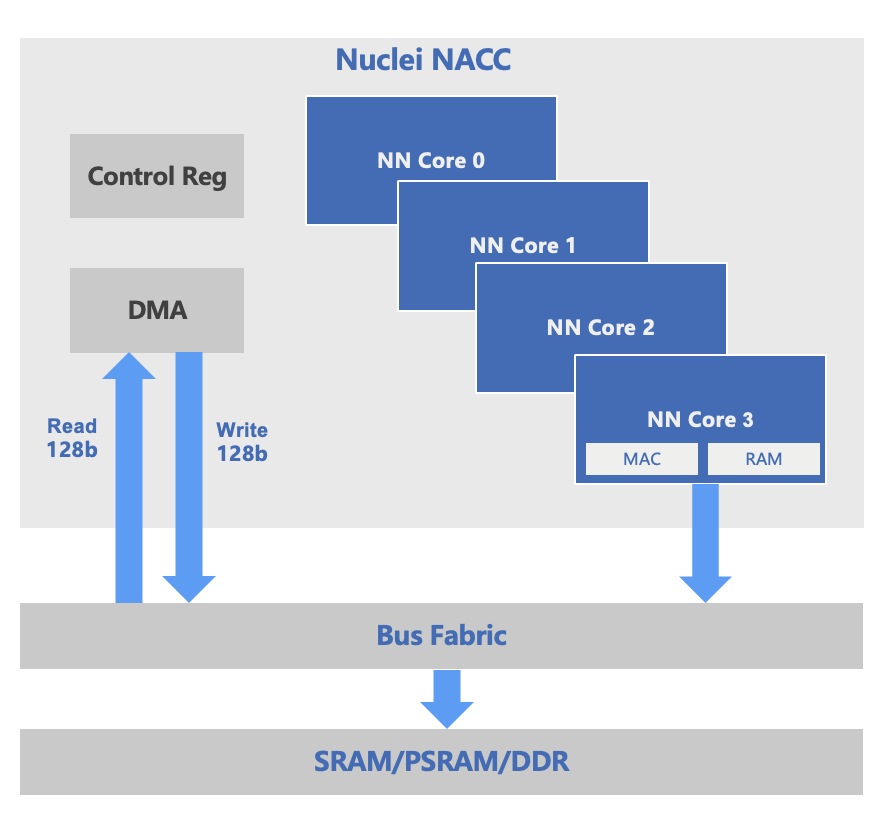
Support for int8 and int16 data types;
Support for 1 to 32 core NN Core architecture, with each core equipped with 64 MAC operation units;
Operating frequency up to 1GHz under T22 process, with peak computing power configurations reaching 4TOPS;
Built-in DMA controller and bus interconnect structure, supporting 128-bit or 512-bit wide data read/write, compatible with SRAM/PSRAM/DDR and other storage media;
Providing complete software-hardware collaborative capabilities, deeply coupled with Nuclei’s full range of RISC-V CPUs, covering N/U/NX/UX processors;
Collaborating with RISC-V CPUs to handle serial logic, data preprocessing, control scheduling, etc., achieving complementary synergy between AI acceleration and general computing;
Deep optimization for frequently used operators;
Providing a complete NN, DSP, AI algorithm library, supporting inference frameworks such as TFLM, TinyMaix, MCUNet;
Capable of deploying typical AI models such as face recognition, speech recognition, gesture recognition, action detection, etc.
Full-Stack AI Software Platform, Lowering the Development Threshold for Edge AI
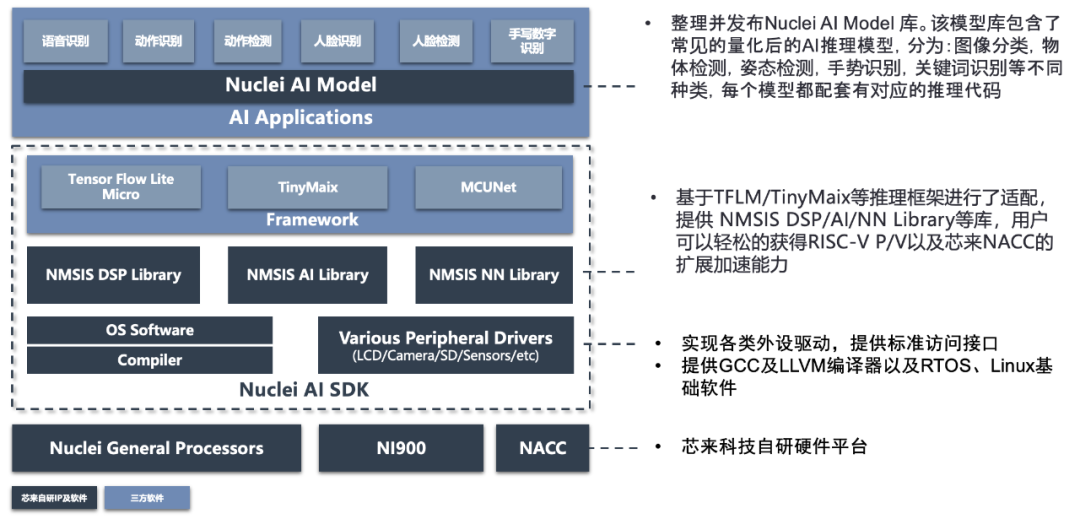
To help developers build edge AI applications more efficiently, Nuclei Technology has constructed a complete AI software platform around NACC, significantly lowering the development threshold for AI chips and accelerating the productization process.
The platform includes:
Nuclei AI Model Library:
Integrating a rich set of quantized AI inference models covering common AI tasks such as image classification, object detection, gesture recognition, keyword recognition, and face detection, with corresponding inference code for each model, facilitating rapid application integration.
Lightweight Inference Framework Adaptation:
The platform has completed adaptations for mainstream embedded AI frameworks such as TensorFlow Lite Micro (TFLM), TinyMaix, and MCUNet, supporting rapid deployment on RISC-V architecture.
NMSIS Software Library Integration:
Providing optimized NMSIS DSP, AI, NN, and other functional libraries, allowing users to easily access the hardware acceleration capabilities of RISC-V P/V extensions and NACC co-processor.
Comprehensive Low-Level Software Support:
Covering GCC/LLVM compilers, RTOS/Linux basic software, and various peripheral drivers (LCD, camera, SD card, sensors, etc.), achieving efficient integration through standard interfaces.
Unified AI SDK System:
Integrating all the above components into the Nuclei AI SDK, along with Nuclei’s self-developed CPU and NACC platform, providing end-to-end complete toolchain support for AI developers.
This platform not only achieves software-hardware collaborative optimization but also provides a stable and unified development environment, enabling customers to quickly complete the development, debugging, and deployment of AI applications, promoting the widespread implementation of AI functions under the RISC-V architecture.
Highly Coupled CPU Subsystem, Supporting AI + General Computing Integration
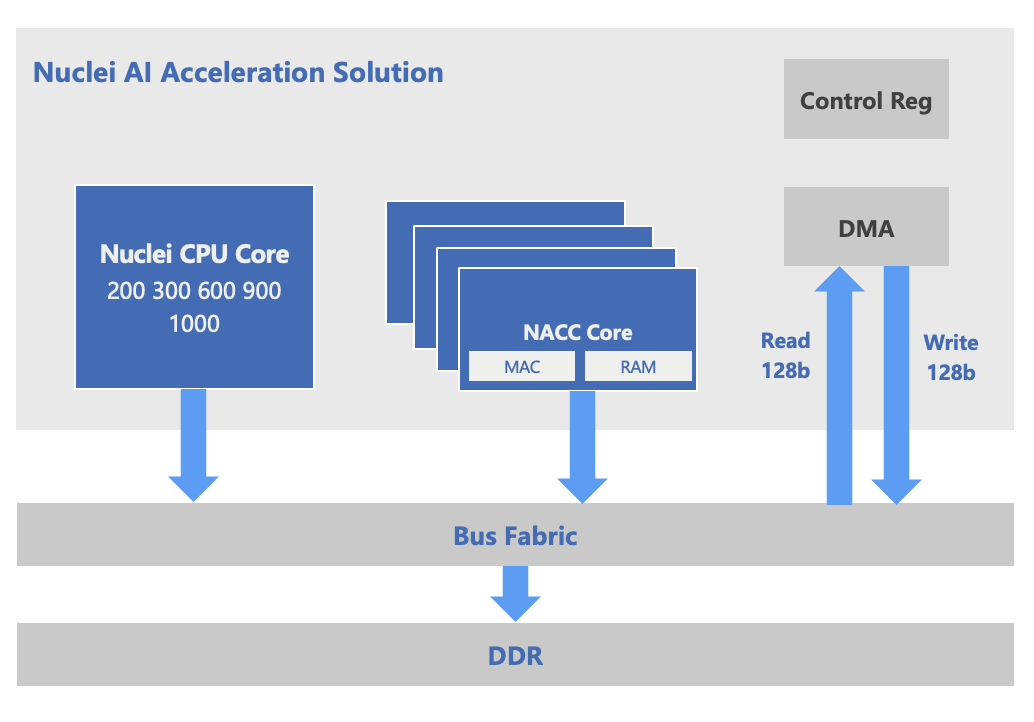
Nuclei NACC can form a tightly coupled heterogeneous computing subsystem with Nuclei’s self-developed RISC-V processors, helping customers build a complete AI subsystem platform through collaborative DMA, bus, image IP, and other modules. Its advantages include:
High Synergy and Complementarity:
Data preprocessing, serial computation, or special function calculations can be handled by Nuclei’s DSP and Vector extensions based on RISC-V CPU cores, providing better performance and lower power consumption; AI processing tasks requiring parallel computation can be assigned to NACC, thus achieving the most effective balance in a wide range of AI applications.
More Unified Software Stack:
The complete AI software stack provided by Nuclei Technology, including AI frameworks, software optimization libraries (DSP, NN, AI), offers a more simplified and efficient resource allocation and task scheduling through a unified software system.
Rich Customization:
Different AI applications may require different processing capabilities and features, allowing customers to freely choose Nuclei’s processors and NACC features according to their needs. Through highly configurable RISC-V processors and NACC, developers can optimize the execution efficiency of AI algorithms.
Overall Subsystem Integration Optimization:
Nuclei provides overall subsystem services, helping customers quickly integrate CPU + NACC + DMA + bus + peripheral IP, optimizing the overall system, accelerating the product development cycle, and reducing customer resource consumption.
NACC completed prototype verification as early as 2024 and has already been implemented in multiple customer projects, applied in edge AI sensors, smart networks, and other intelligent perception scenarios, demonstrating excellent edge inference acceleration capabilities.
Future-Oriented, Building the RISC-V AI Computing Core
AI computing is moving from the center to the edge, and RISC-V’s advantages in openness and scalability make it an ideal infrastructure for AI chips. According to market forecasts, by 2030, the RISC-V-based AI SoC market will exceed $42 billion, with a compound annual growth rate of 49.2%. The launch of NACC is an important manifestation of Nuclei Technology’s proactive layout in the RISC-V AI computing track.
Nuclei Technology will continue to promote the development of RISC-V + AI integration technology to provide customers with sustainable evolving AI computing solutions, accelerating the implementation and popularization of smart terminals.
About Nuclei TechnologyNuclei Technology was established in 2018 and has been focusing on the research and development of RISC-V CPU IP and corresponding platform solutions, representing a leading enterprise in the domestic RISC-V field.
Nuclei Technology has built four general CPU IP product lines (N/U, NX/UX) and three dedicated CPU IP product lines (NS, NA, NI) from scratch, adhering to self-research. Among them:
* N/U (supports SV32 MMU) is a 32-bit architecture, mainly used for edge computing, low power consumption, and IoT scenarios;* NX/UX (supports SV39 and SV48 MMU) is a 64-bit architecture, mainly used for data centers, network security, storage, and other high-performance application scenarios;* NS (Security) is aimed at high-security scenarios such as payments;* NA (Automotive) is aimed at functional safety automotive electronics scenarios;* NI (Intelligence) is aimed at high-performance computing scenarios such as AI.Currently, over 300 domestic and international officially authorized customers are using Nuclei Technology’s RISC-V CPU IP, covering multiple fields such as AI, automotive electronics, 5G communication, network security, storage, industrial control, MCU, and IoT.For more details, visit:www.nucleisys.com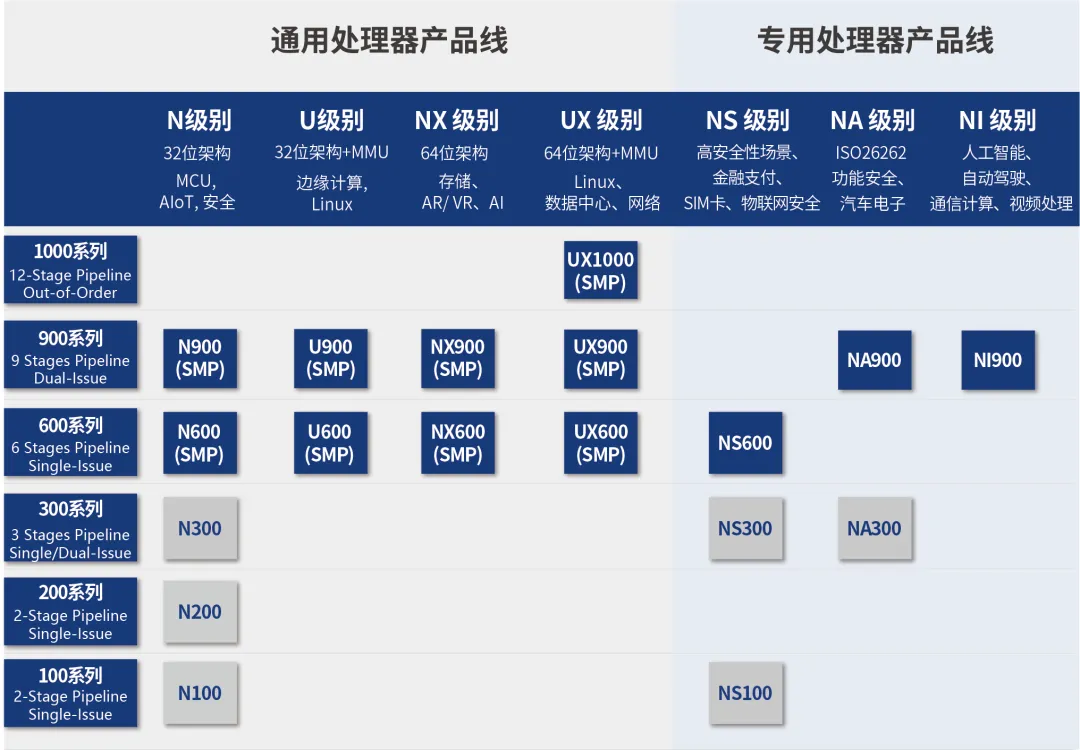
▼Previous Highlights▼
Silicon Labs, Nuclei, and Ideal Star Ring OS Begin In-Depth Adaptation
Nuclei’s Hu Zhenbo: RISC-V Should Move Towards the General Market, RVA23 Will Lead the Breakthrough
RV China Summit 2025 | Nuclei Aids Ecosystem Construction, RV Accelerates Technological Innovation
Silicon Labs, Nuclei, and Vector Collaborate on High-Performance Automotive RV MCU Software Platform
Nuclei NA900 Automotive Electronics Customer Silicon Labs and PwC Reach Strategic Cooperation
Nuclei Technology Launches UX1030H, Fully Supporting RVA23
Nuclei Aids Gateron, Opening a New Chapter in Sensor Fusion
Nuclei Partners with Zhaosong ZCC Compiler to Achieve Performance Improvement for NA Series
Nuclei and Xinxin Jointly Launch NUCLEI Full Series RV CPU System Simulation PlatformASIL-D Automotive MCU Chip DF30 Embarks on Cold Region Performance TestingNuclei Technology Selected as One of Shanghai’s First Batch of Key “Little Giant” Enterprises in the New Round