As a cutting-edge project in AI-native development, MoonBit made another appearance at the IDEA conference this year.
“Everyone who follows IDEA has heard of MoonBit,” said Shen Xiangyang, the founding chairman of IDEA, at the event. “This is a project developed by a team led by researcher Zhang Hongbo, providing a new programming language and development platform for the AI era.”
He pointed out that every era of computing has seen the emergence of highly influential languages. Today, with the rapid development of large models and AI applications, there is a growing demand for new languages in the AI era.
MoonBit is not just a language; it is a full-stack platform for developers, integrating multi-backend support and AI-friendly tools, providing programmers with a complete development solution from low-level syntax to application building.
MoonBit
Defining the Developer Platform for the AI Era
Over the past year and a half, MoonBit has evolved from a programming language supporting multiple backends into a complete full-stack toolchain (including a native toolset designed specifically for AI), ultimately building a developer platform that integrates developer toolchains and intelligent agent development ecosystems.
As a general-purpose programming language, MoonBit has achieved language features comparable to Java in just three years, which is a remarkable feat for a small R&D team of a dozen people. Through multi-backend support, it covers all scenarios including WebAssembly edge computing, C/LLVM system programming, and JavaScript front-end development. It performs particularly well in cloud-edge scenarios: the WebAssembly backend code size is 30% smaller than Rust and 50% smaller than TypeScript and Go; in benchmark tests for digital computation, its performance surpasses Java by nearly 10 times, thanks to value type optimization; the generated JavaScript code efficiency has also significantly improved.
This year, MoonBit launched the world’s first language-native intelligent agent development environment, MoonBit Pilot, which intelligently assists in generating the MoonBit toolkit, allowing for rapid expansion of the MoonBit ecosystem. For intelligent agent development scenarios, three native optimizations have been implemented:
• Structured Concurrency: Achieving high concurrency and fault tolerance for large model calls based on MoonBit’s asynchronous model
• First-Class Citizen JSON: Native support for JSON data processing, simplifying function calls and Scheme validation
• Safe Refactoring System: Allowing AI to autonomously modify agent code while ensuring the safety of refactoring
The intelligent agent platform developed with the MoonBit programming language, MoonBit Agent SDK, will be officially open-sourced this December, supporting multiple programming languages.
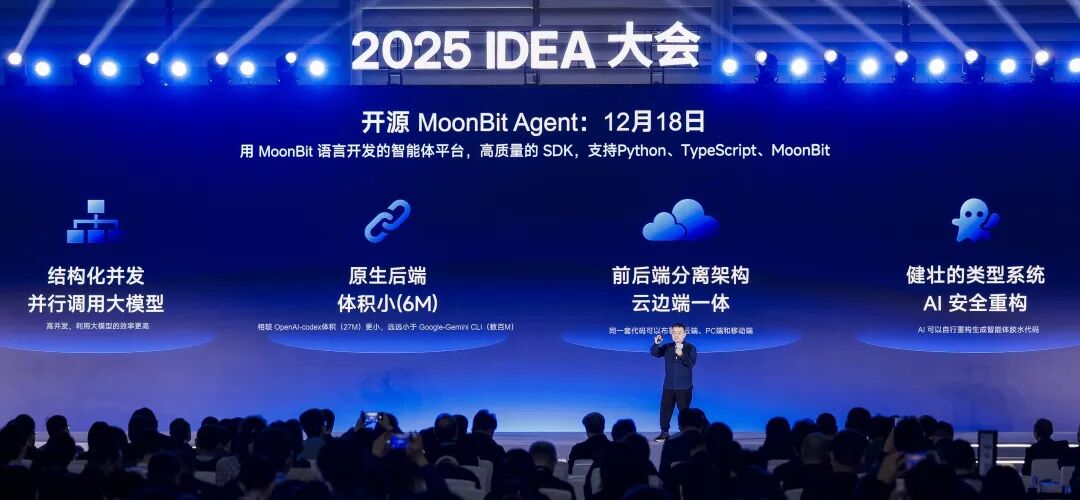
Zhang Hongbo introduced the upcoming open-source development platform at the 2025 IDEA conference
The MoonBit Agent SDK has the following advantages:
• Multi-language support (not limited to MoonBit), also supporting Python, TypeScript, and other programming languages
• Structured concurrency framework
• Size (6M) is much smaller than OpenAI Codex (27M) and Gemini CLI (hundreds of M)
• Front-end and back-end separation architecture, supporting integrated deployment capabilities across cloud and edge
• AI safe refactoring support
Accelerating the establishment of a mature ecosystem
MoonBit has received widespread recognition both domestically and internationally
The MoonBit ecosystem is gradually maturing, growing from a few thousand users in 2024 to nearly 30,000 users, and today has developed to 100,000 users, with an expected growth to 1 million users by the end of 2026.

Zhang Hongbo stated that by 2026, MoonBit will become
the first development platform with global influence to emerge from China
Currently, the community has contributed over 3,000 high-quality libraries, nearly 10 million lines of code, and it is expected that by the end of 2025, there will be hundreds of millions of lines of code and tens of thousands of high-quality libraries.
It is worth mentioning that MoonBit has not only officially entered the classrooms of Tsinghua University and Peking University in China, but its global influence is also continuously expanding: leading US tech news media NewStack has reported on it multiple times on the front page, and a US AI service consulting company rated MoonBit as the best programming language born in the late AI era of 2025 (alongside Rust). The team has been invited to speak at the Colorado Developer Conference (LambdaConf 2025) and the Barcelona WebAssembly 2025 Summit.