Click the blue text
Follow us
Microsoft has released common design patterns and use cases for Agents on its official website, aimed at helping users quickly develop powerful automated AI employees.
Compared to traditional RPA and automation scripts, Agents not only provide automation capabilities but also can reason and collaborate based on actual business scenarios, bridging the gap between knowledge and outcomes, uncovering new insights, and thus providing greater business value.
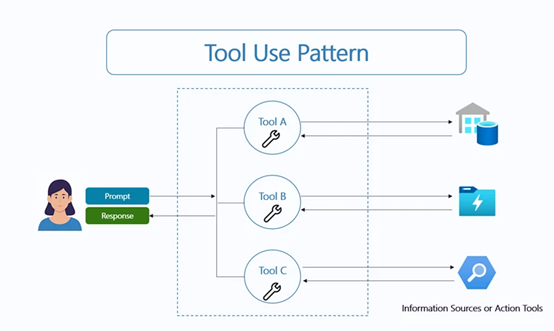
Tool Usage Model
Today’s intelligent agents can interact directly with enterprise systems, capable of retrieving data, calling application programming interfaces (APIs), triggering workflows, and executing transactions. Agents can not only provide answers but also complete tasks, update records, and coordinate end-to-end workflows.
In the past, there was always an unavoidable manual step in enterprise processes, where employees had to sequentially open databases, log into CRMs, switch to payment gateways, and finally return to email systems, with each step requiring manual confirmation. Through the tool usage model, agents can integrate previously fragmented actions into a seamless pipeline by calling APIs, triggering workflows, and executing transactions.
In the past, Fujitsu’s sales proposal process required multiple steps: first, analysts needed to extract data from databases, then market researchers needed to gather information about competitors online, and finally, copywriters would compile this information into a PPT, a process that consumed a lot of time.
By developing three dedicated agents, data analysis, market research, and document creation could work collaboratively, significantly improving work efficiency. The data agent extracts customer historical orders from the ERP system, the market agent immediately calls external intelligence APIs to supplement industry trend information, while the document agent inputs the results into the typesetting engine. Overall time was reduced by 67%.
Reflection Model
Once agents have the ability to act, the next step is to enter the reflection phase to evaluate and enhance their output capabilities. Reflection allows agents to identify errors and iterate without fully relying on humans, thus improving quality.
In high-risk areas such as compliance and finance, errors can lead to significant costs. Through self-checking and review cycles, agents can automatically correct missing details, recheck calculation results, or ensure information meets standards.
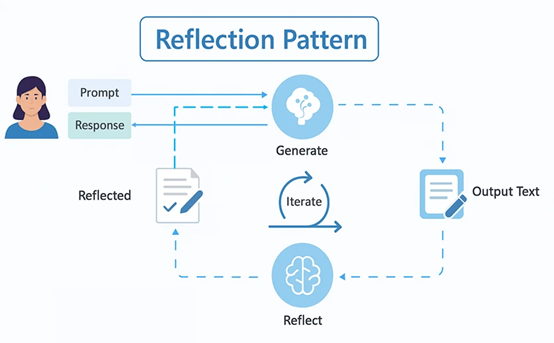
In the finance industry, when an agent is responsible for automatically generating a client’s financial product yield report, it may incorrectly record the annualized yield of an investment due to improper data retrieval. At this point, the reflection model initiates a self-check mechanism: first, it verifies whether the original data matches the values in the report, identifies discrepancies, recalculates, and then checks whether the yield calculation logic meets industry standards, ultimately automatically correcting errors and generating a new report.
The entire process requires no human intervention, effectively avoiding customer complaints or compliance risks due to erroneous yield figures. Even code assistants like GitHub Copilot rely on internal testing and optimization before sharing outputs. This self-improvement cycle reduces errors, allowing businesses to trust that AI-driven processes are safe, consistent, and auditable.
Planning Model
Most real business processes are not single steps—they are complex processes with dependencies and branching paths. Planning agents address this by breaking down high-level goals into executable tasks, tracking progress, and adjusting as demands change.
For example, ContraForce’s intelligent security delivery platform (Agentic Security Delivery Platform, ASDP) automates the delivery of security services for its partners using planning agents. These agents break down events into steps such as reception, impact assessment, script execution, and escalation.
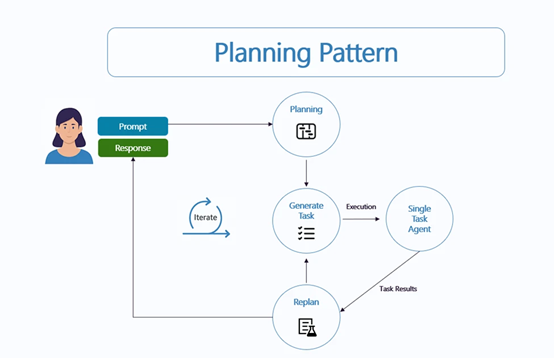
After completing each stage, the agent checks the next step to ensure nothing is missed. Results show that 80% of event investigations and responses have now been automated, with the complete event investigation processing cost being less than $1.
Planning often combines tool usage and reflection, demonstrating how these models enhance each other. The key advantage lies in flexibility: plans can be dynamically generated by large models or follow predefined sequences, both of which can meet demands.
Multi-Agent Model
No single agent can accomplish all tasks. Businesses create value through specialized teams, and the multi-agent model embodies this by connecting specialized agents focused on different stages of workflows into a network—these agents are unified under a coordinator’s management. This modular design achieves agility, scalability, and ease of evolution while maintaining clarity of responsibility and governance.
Modern multi-agent solutions adopt various coordination modes, often used in combination to meet real business needs. These modes can be driven by large models or deterministic: for example, in sequential coordination, agents progressively refine documents; in parallel coordination, agents run concurrently and merge results; in group chat/creator-checker mode, agents discuss and validate outputs together; in dynamic handoff, real-time classification or routing occurs; in magnetic coordination, a managing agent coordinates all subtasks until completion.
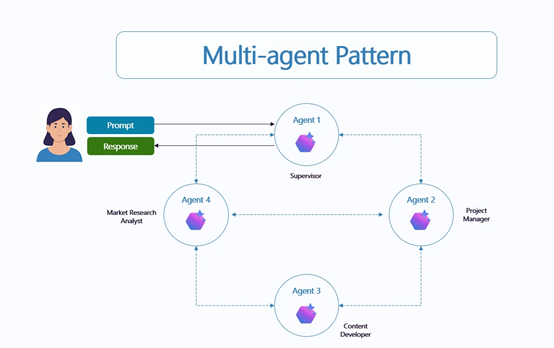
JM Family successfully deployed business analyst and quality assurance agents Genie using this approach for requirement analysis, story writing, coding, documentation, and quality assurance. Under the coordinator’s management, their development cycle achieved standardization and automation, reducing the time for requirement analysis and test design from weeks to days, saving up to 60% of deployment time.
ReAct Model
The ReAct (Reasoning + Action) model empowers agents to solve problems in dynamic environments, especially when static plans cannot meet demands. Unlike following preset scripts, ReAct agents alternate between reasoning and action to respond to challenges—taking one action, observing the results, and then deciding on the next action. This model enables agents to flexibly respond to uncertainty, changing demands, and unclear paths.
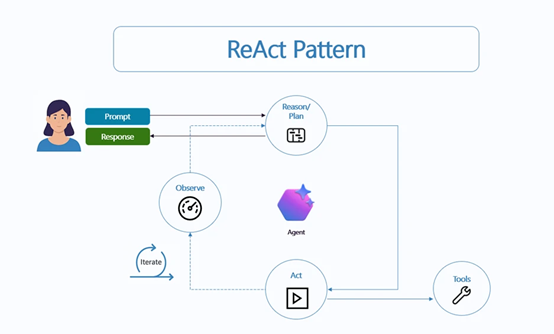
In the field of enterprise IT support, virtual agents driven by the ReAct model can diagnose problems in real-time: they clarify issues by asking questions, check system logs, test possible solutions, and adjust strategies based on new information. If the problem becomes more complex or exceeds their capabilities, the agent escalates the case to a human expert, providing a detailed summary of attempted solutions.
These models are designed to be used in collaboration. The most effective agent solutions combine tool usage, reflection, planning, multi-agent collaboration, and adaptive reasoning to achieve faster, smarter, safer, and real-world applicable automation.
Microsoft’s Azure AI Foundry now supports multi-agent model development, with agents in each business area encapsulated as independent modules, where interfaces serve as protocols. Team A’s order parsing agent can be embedded into Team B’s logistics scheduling process without modification, allowing knowledge, strategies, and even compliance rules to be shared across the organization.
Over 1,400 ready-made connectors integrate SharePoint, Bing, various SaaS, and core business systems directly into the agent’s “toolbox,” automatically carrying enterprise identity and policies during invocation, eliminating the need to write additional code for each integration.
Native support for mainstream models like A2A and MCP allows user-developed agents to interact with external agents on AWS and GCP, as well as reconcile with partners’ private models, making the entire ecosystem no longer limited by cloud service providers.
Every step at runtime is automatically broken down into traceable links: each action the agent takes to call models, access databases, or trigger approval flows generates time-stamped metrics and logs; built-in evaluators continuously score quality, compliance, and cost, with anomalies triggering immediate alerts.
In terms of security, each agent is bound to a managed Entra ID from the moment of creation, with RBAC, representative authentication, and policy engines providing full support, combined with virtual network isolation, ensuring that “the right agent accesses the right resources” becomes the default setting.

Scan to follow
Contact us
Tel: 021-33680778
Mail: [email protected]
You may also like:Essential for Enterprises Going Global: Azure Cloud Platform Ensures Data Compliance and Intelligence!Cloudflare: The Ultimate Solution for Enterprise Network Security and Performance OptimizationQincheng Information Partners with Moduspace Forum to Discuss AI Agent-Driven Business TransformationAzure AI Foundry: From Concept to Practice in AI SolutionsQincheng Information Participates in Semiconductor CAD Alliance Forum to Discuss Innovations in AI Technology in the Semiconductor Field