Click the blue text above to follow us

📋📋📋 The table of contents is as follows: 🎁🎁🎁
Contents
💥1 Overview
📚2 Results
🎉3 References
🌈4 MATLAB Code Implementation



1 Overview
Since artificial intelligence (AI) has gained favor among human professional players in chess, shogi, and Go, expectations for AI have been rapidly increasing. One reason for the rapid development of AI is the significant improvement in computer processing speed, which has made it possible to virtually simulate rapid repetitive matches (such as Othello, shogi, Go, etc.) on computers. Ultimately, AI has gained capabilities that surpass human professionals. Similarly, in control engineering, if the gain tuning experiments of controllers can be virtually executed on computers, it is expected that control performance can be significantly improved using methods similar to AI. “V-Tiger” stands for “Virtual Time-response based Iterative Gain Evaluation and Redesign”. It iteratively: 1) calculates the virtual time response of the closed-loop system when inserting a certain controller based on one-time experimental data, 2) measures overshoot and settling time based on the virtual time response, and 3) evaluates and redesigns the controller gain, considering stability margin. Keywords: data-driven control, time response, gain tuning. V-Tiger is a method for automatically adjusting controller gain, aimed at optimizing settling time, overshoot, and stability margin. It uses the input/output step response of the controlled object to design PID controllers. The advantage of this method lies in the ability to adjust controllers through computer simulation, thereby improving control performance. The trend in the control field is data-driven control, which utilizes a large amount of experimental data to fit control models for better control outcomes. V-Tiger calculates the virtual time response of the closed-loop system when inserting a certain controller using one-time experimental data. This data-driven model approach is not only faster but also allows for the construction of more accurate models from actual processes, leading to higher quality control outcomes. Through the V-Tiger method, controller gain can be quickly evaluated and redesigned, considering stability margin. Stability margin is a key factor in ensuring that the steady-state error, damping ratio, and overshoot of the closed-loop system are within reasonable limits. In control system design, it is often necessary to make trade-offs between settling time, overshoot, and steady-state error. The V-Tiger method can better balance these factors, achieving better control outcomes. V-Tiger is a data-driven, virtual experiment-based method that can significantly improve control performance through iterative calculations and redesign of controller gain. It is an important part of the trend in the control field and will bring broader prospects for the design and optimization of future control systems.


2 Results
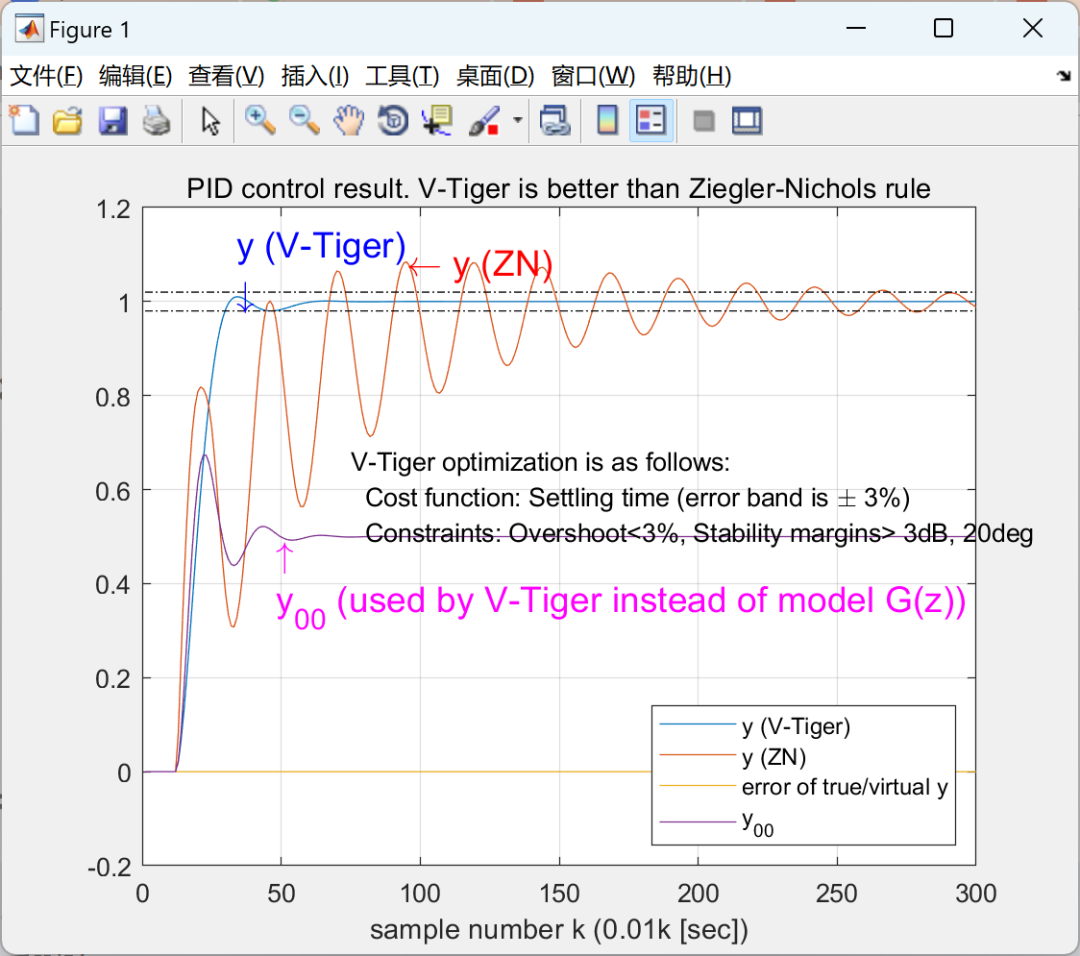
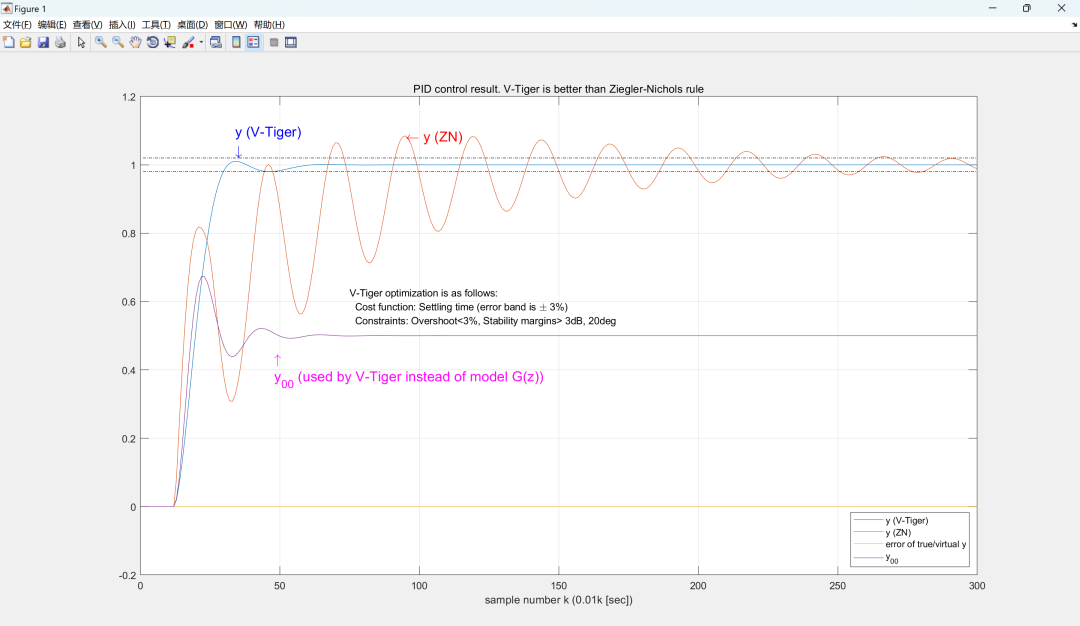
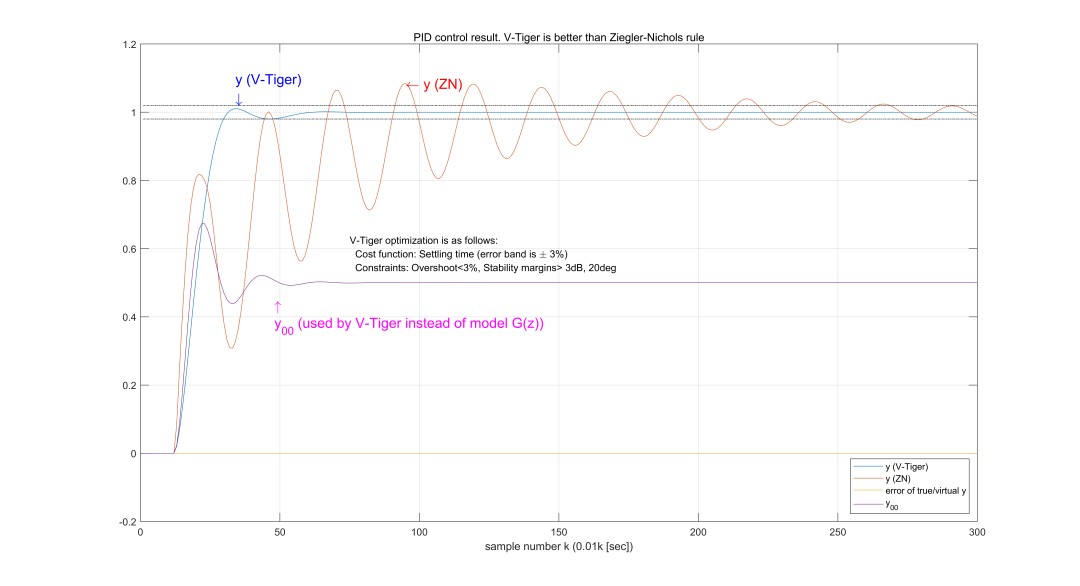
% Main function code:

ts=0.01;    % sampling time [s]
s=tf('s');  % complex variable of Laplace transform
z=tf('z',ts);   % shift operator
p=(1-1/z)/ts;   % differential operator based on backward Euler's rule
Gs = 5/(0.01*s^2+0.2*s+10)*exp(-0.1*s);   % plant G(s) to be controlled
G = c2d(Gs,ts); % G(z) is derived by discretizing G(s) with zero order holder

% Design initial controller K0 using  The Ziegler-Nichols rule
[Ku,Pm,Wu,Wcp] = margin(G);    % get Gaim margin Ku at Wu[rad/s]
Tu = 1/(Wu/2/pi);   % When K=Ku, self-excited vibration with period Tu[s] will occur.
kp0=0.6*Ku; ki0=kp0/(0.5*Tu);    kd0=kp0*0.125*Tu;  % ZN classical parameters
K0 = kp0 + ki0/p + kd0*p;   % ZN PID controller K0(z)

% Measuring one-shot data y00(t) and u00(t)
u00=ones(300,1);    % input u00(t) is a step function
u00(1)=0;   % initial value must be different from the other values <-- IMPORTANT!
y00=lsim(G,u00);    % y00 is simulated
r=u00;  % reference input to feedback system

% Step 1) Make step responses to cyclic, and get frequency data.
freq.y0jw = fft4step(y00);  % y0(j w) from y00(t)
freq.u0jw = fft4step(u00);  % u0(j w) from u00(t)
freq.r0jw = fft4step(r);    % r0(j w) from r(t)
freq.p = fft4tf(p,length(u00)*2);   % p(j w) from differential operator p
freq.r = r;   % r(t) is reference input to feedback system
freq.wST=0.02;% Error band of settling time for cost function
freq.OVr=2;   % Overshoot [%] for constraints
freq.GMr=3;   % Gain margin [dB] for constraints:  Regulator 3-10dB, 20-inf deg
freq.PMr=20;  % Phase margin [deg] for constraints:Servo    10-20dB, 40-60  deg

% Step 2) Optimize PID gains by evaluating overshoot, settling time,
%         and stability margins using virtual time response.
[kp,ki,kd] = vtigerPID(freq,[kp0 ki0 kd0]);   % Get optimum PID gains. [kp0 ki0 kd0] is initial value for optimization
K = kp + ki/p + kd*p;  % PID controller by V-Tiger

disp('-----------------------------------------------------')
% Verify the controller of V-Tiger and ZN by simulations
y,u = freq2yu(freq,K); % Virtual time responses predicted by V-Tiger when K is used
Gcl = feedback(ss(G*K),1);  % closed loop transfer function. feedback(a,b)=a/(1+a*b). ss(G) is ss(Gcl);  % State space representation from G
yt=lsim(Gcl,r); % yt is true y(t) simulated using true plant model G(z)
yZN=lsim(feedback(ss(G*K0),1),r);% y(t) by K0 (ZN) is simulated using true plant model G(z)
figure(1),
p1=plot([yt yZN y-yt y00]);
hold on
vtigerPID(freq,[kp ki kd],1);
hold off; grid; xlabel('sample number k (0.01k [sec])')
legend(p1,'y (V-Tiger)','y (ZN)','error of true/virtual y','y_{00}','Location','southeast');
title('PID control result. V-Tiger is better than Ziegler-Nichols rule')
disp('V-Tiger has completed controller design using y00 instead of the plant model.')
disp(['Plant G(s) to be discretized with sampling time ts=' num2str(ts) '[s] is as follows:']),
[yZN,iZN]=max(yZN); text(iZN,yZN,'\leftarrow y (ZN)','Color','red','FontSize',14);
[yvt,ivt]=max(yt); text(ivt,yvt+0.06,['y (V-Tiger)';'\downarrow '],'Color','blue','FontSize',14);
text(length(y)*0.16,y00(end)*0.8,['\uparrow                                      ';
    'y_{00} (used by V-Tiger instead of model G(z))'],'Color','magenta','FontSize',14);
text(length(y)*0.25,max(y)*0.58,[
    'V-Tiger optimization is as follows:                       ';
    '  Cost function: Settling time (error band is \pm 3%)     ';
    '  Constraints: Overshoot<3%, Stability margins> 3dB, 20deg'])
Gs, disp('');
disp('Fig.1 shows step responses. V-Tiger is better than ZN method.'),
disp('press any key to type code of "vtiger_demo.m".'),
pause
disp('-----------------------------------------------------')
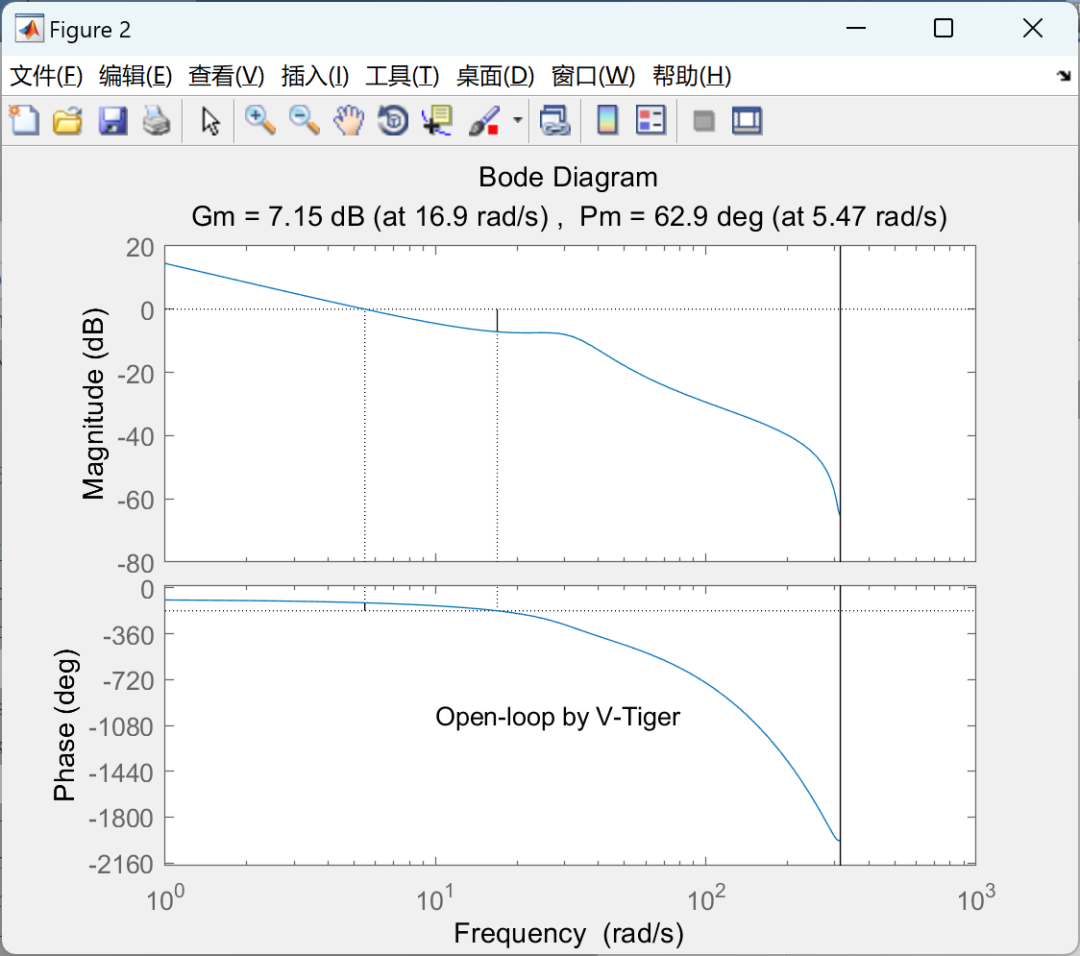
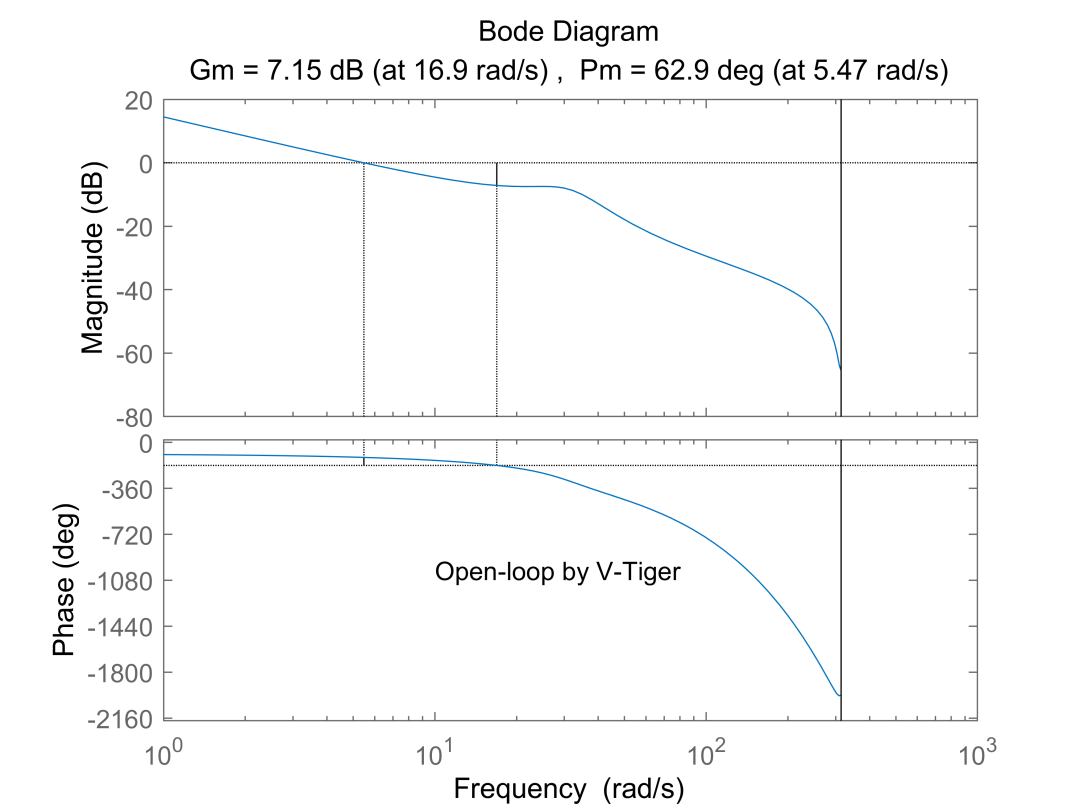
figure(2), margin(G*K);    text(10,-1000,'Open-loop by V-Tiger')
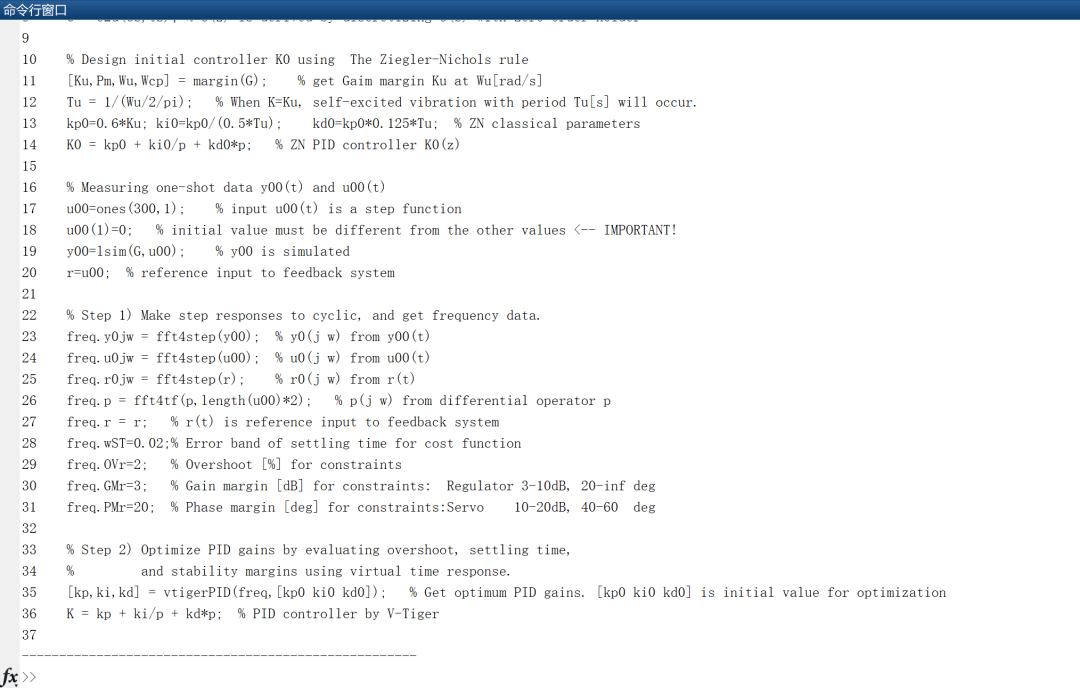
dbtype vtiger_demo 1:37
disp('-----------------------------------------------------')


3References
Some content in this article is sourced from the internet, and references will be noted. If there are any omissions, please feel free to contact us for removal.

[1] Li Puxian. Design and Performance Evaluation of Controllers for Systems with Large Delays [D]. Beijing University of Chemical Technology, 2017. DOI: CNKI:CDMD:2.1017.288686.
[2] Li Gang, WANG, Qing-lin. Performance Evaluation and Tuning of PID Controllers Based on Step Tracking Response [J]. Journal of System Simulation, 2008. DOI: JournalArticle/5aed4d1fc095d710d40a9782.
[3] Wang Haiyan, Yan Wei. Design and Simulation of a Fuzzy Control System with Self-Tuning PID Parameters [J]. Automation Technology and Applications, 2015. DOI: JournalArticle/5b3bb7b8c095d70f008a1d1f.



4 MATLAB Code Implementation
Public Account
Lychee Research Society