Are you ready to take your C++ skills to the next level? The Boost library is the “Swiss Army knife” that every C++ developer should master. This article outlines a clear learning path from beginner to expert, making it an indispensable guide for both newcomers to C++ and seasoned engineers seeking breakthroughs. Unlock the powerful capabilities of Boost to make your code more elegant, robust, and efficient!
Official website: https://www.boost.org/
Github: https://github.com/boostorg/boost
Why Boost?
If the standard library is the “infrastructure” of C++, then Boost is the “super plugin library” for C++. It contains over 165 high-quality open-source libraries covering algorithms, containers, threads, regular expressions, smart pointers, serialization, networking, and metaprogramming, which can solve almost all common problems you encounter.
More importantly, Boost is an important incubator for the C++ standard library—many features of C++11/14/17 originated from Boost, such as <span>shared_ptr</span>, <span>regex</span>, <span>thread</span>, etc. In other words, learning Boost not only enhances your efficiency but also helps you adapt to new C++ standards more quickly.
Installing and Configuring Boost
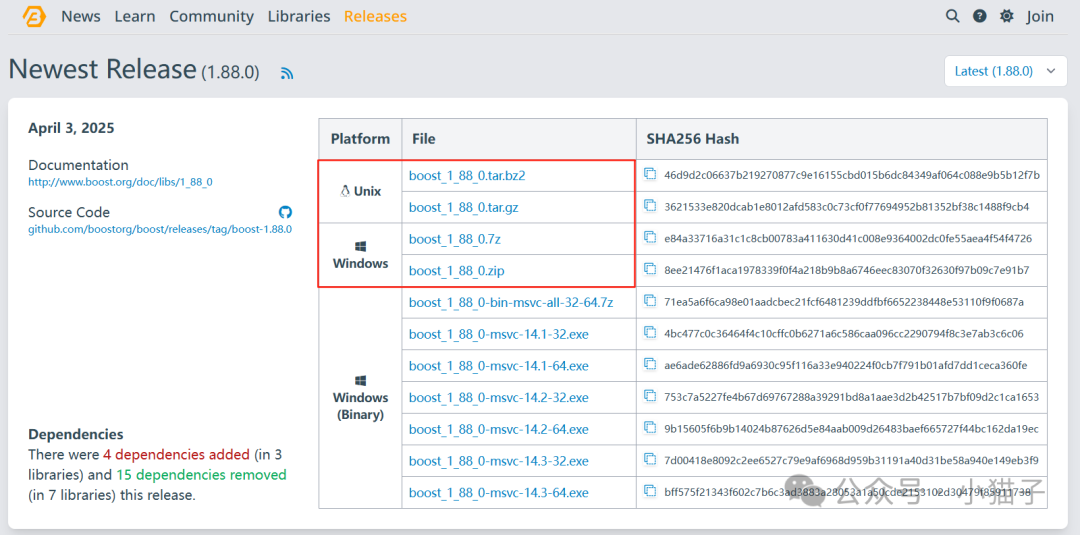
1. Download
- Official address: https://www.boost.org
- Select the compressed package that matches your compiler version.
2. Installation Methods
(1)Windows
bootstrap.bat
b2 install
(2)Linux / macOS
# Generate Boost's build system and configure the project
./bootstrap.sh
# Compile and install the Boost library to the system directory
./b2 install
PS: For Ubuntu, you can also download directly from the repository
sudo apt update
sudo apt install libboost-all-dev
3. Usage Methods
- Header-only libraries can be included directly with
<span>#include</span>, such as<span>Boost.Any</span>and<span>Boost.Optional</span>. - Compiled libraries (require linking with
<span>.lib</span>/<span>.so</span>) like<span>Boost.Thread</span>and<span>Boost.Regex</span>, need to add<span>-lboost_xxx</span>during compilation.
Overview of Core Boost Modules
There are many Boost libraries, but they can be categorized by functionality into the following major types:
1. Smart Pointers and Memory Management
<span>boost::shared_ptr</span>: Reference-counted smart pointer<span>boost::weak_ptr</span>: Weak reference to solve circular reference issues<span>boost::scoped_ptr</span>: Automatically released at the end of the scope
#include <boost/shared_ptr.hpp>
#include <iostream>

int main() {
    boost::shared_ptr<int> p(new int(42));
    std::cout << *p << std::endl;
}
2. Strings and Regular Expressions
<span>boost::regex</span>: Regular expression matching<span>boost::algorithm::trim</span>: String trimming
#include <boost/algorithm/string.hpp>
#include <string>
#include <iostream>

int main() {
    std::string s = "   Hello Boost   ";
    boost::trim(s);
    std::cout << "[" << s << "]" << std::endl;
}
3. Time and Date
<span>boost::posix_time</span>: High-precision time handling
#include <boost/date_time/posix_time/posix_time.hpp>
#include <iostream>

int main() {
    using namespace boost::posix_time;
    ptime now = second_clock::local_time();
    std::cout << now << std::endl;
}
4. Multithreading and Concurrency
<span>boost::thread</span>: Cross-platform thread library<span>boost::mutex</span>: Mutex
#include <boost/thread.hpp>
#include <iostream>

void worker() {
    std::cout << "Thread is running" << std::endl;
}

int main() {
    boost::thread t(worker);
    t.join();
}
Boost.Thread also depends on Boost.System and Boost.Chrono, and you need to link these libraries during compilation:
g++ thread.cpp -o thread -lboost_thread -lboost_system -lboost_chrono -pthread
5. Filesystem
<span>boost::filesystem</span>: Cross-platform file path operations
#include <boost/filesystem.hpp>
#include <iostream>

int main() {
    boost::filesystem::path p("/tmp/test.txt");
    std::cout << "Filename: " << p.filename() << std::endl;
}
Boost.Filesystem depends on Boost.System, and you need to link these two libraries during compilation:
g++ file.cpp -o file -lboost_filesystem -lboost_system
6. Networking and Serialization
<span>Boost.Asio</span>: Asynchronous network programming (TCP/UDP/SSL)<span>Boost.Serialization</span>: Object serialization and deserialization
Conclusion
Boost is the “magic library” of the C++ world, significantly enhancing your development efficiency.Mastering Boost means mastering the future C++ standard library in advance.
Whether you are a C++ novice or a seasoned engineer, Boost is worth your time to learn. Start today by adding Boost to your skill set and let your code soar!