The release of the “Opinions” marks a strategic shift in China’s healthcare system from a “city-centered” approach to a “grassroots-centered” one. For practitioners, this represents both a challenge—shifting from a passive waiting for patients to an active ecosystem building—and an opportunity, as policy benefits are accelerating towards grassroots levels. There are significant market gaps in specialty upgrades for county hospitals, innovative community healthcare models, and the expansion of integrated medical and elderly care.
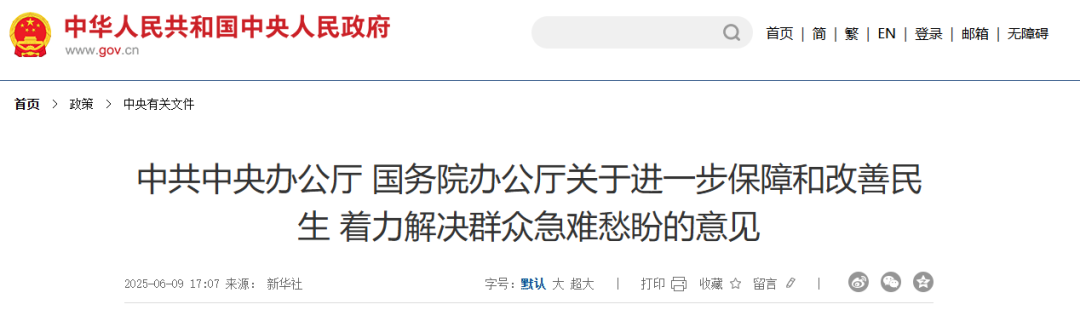 On June 9, the General Office of the CPC Central Committee and the General Office of the State Council published the previously issued “Opinions on Further Ensuring and Improving People’s Livelihoods and Focusing on Solving Urgent Problems for the Public,” which systematically deploys core areas such as the sinking of medical resources, the construction of county medical communities, and the integration of medical and elderly care.This policy not only empowers grassroots medical capabilities but also delineates a new development track for the industry over the next five years.Industry colleagues must seize the policy window, shifting from “passive adaptation” to “active layout” to gain an advantage in the new round of healthcare reform.This article dissects three core signals based on the policy text and industry trends, providing insights for healthcare practitioners.
01
Signal One: Sinking of Medical Resources
Comprehensive upgrade from “quantity” to “quality”The “Opinions” propose to “implement a strong foundation project for healthcare, promote the sinking of urban medical resources to county hospitals and grassroots healthcare, and gradually achieve full coverage of the construction of closely-knit county medical communities,” emphasizing “support for high-level hospital personnel, services, technology, and management to extend to grassroots levels.”1. From “Equipment Sinking” to “System Reconstruction”In the past, the sinking of grassroots medical resources was often limited to equipment donations or short-term expert consultations, leading to a “vacuum of technology”. This policy for the first time includes “management sinking” as a core category, meaning that top-tier hospitals need to provide standardized management systems, discipline construction experience, and quality control systems to grassroots levels.2. Telemedicine as “New Infrastructure”The policy clearly promotes the “distributed examination and centralized diagnosis” model, facilitating the implementation of 5G remote electrocardiograms, ultrasound, and other technologies at the grassroots level. This model has already been piloted in Zhejiang: grassroots health centers upload imaging data to regional medical centers through remote diagnosis systems, receiving reports from top-tier hospitals within two hours, reducing misdiagnosis rates by 35% and decreasing the referral rate of grassroots patients by 28%.3. Innovative Talent Sinking MechanismTo address the issue of “difficulty in attracting talent” at the grassroots level, the policy proposes to “support high-level medical talents to sink into county hospitals”, and explore policies such as “flexible management of staffing” and “preferential evaluation of professional titles”. For example, Jiangsu has piloted the “county-managed hospital recruitment” system, allowing county hospitals to independently recruit physicians with master’s degrees, with salary levels on par with urban hospitals, and a 40% commission on contracted service income, effectively enhancing talent attraction.
02
Signal Two: Positioning of County Hospitals from
“Referral Hubs” to “Guardians of Health”The “Opinions” emphasize the need to “cultivate grassroots specialty characteristics according to local conditions, improving the diagnosis and treatment levels of common and frequently occurring diseases,” and position county medical communities as the core unit of “balanced distribution of medical resources”.The core competitiveness of grassroots healthcare lies in the diagnosis and treatment of common diseases and chronic disease management; what needs to be supplemented is not “large and comprehensive,” but rather “precise and lacking”.1. Specialty Construction Focused on “Essential Needs + Benefits”
- Pediatrics / Gynecology: The birth rate of newborns in counties is high, but there is a 40% shortage of pediatricians. County hospitals are encouraged to establish “joint pediatric outpatient clinics” with urban maternal and child health hospitals, introducing child growth and development monitoring technology to drive annual outpatient volume growth.
- Rehabilitation Medicine: Aging has spurred rehabilitation demand, and the policy encourages grassroots development of “traditional Chinese medicine therapy + postoperative rehabilitation”.
2. Chronic Disease Management as the “Second Growth Curve”The policy requires grassroots to strengthen the management of common diseases such as “hypertension and diabetes,” promoting an integrated approach of “prevention – treatment – management”. For example, a community health service center in Zhejiang has piloted a “three highs joint management package,” bundling medication guidance, nutritional intervention, and exercise monitoring into an annual fee service, resulting in a 22% reduction in the incidence of complications among signed residents and an 85% annual retention rate.3. Integration of Medical and Elderly Care from “Concept” to “Essential Scenarios”The policy clearly states that “the proportion of nursing beds in newly built elderly care institutions should not be less than 80%” and supports grassroots medical institutions in expanding “day care + home care” services.
03
Signal Three: Community Healthcare from “Auxiliary Role” to “Main Service Front”
The “Opinions” propose to “develop community services at the doorstep of the masses,” supporting “inclusive services such as elderly care, childcare, and healthcare into communities,” and allowing “leasing ordinary residences to set up service points.”
1. The “Light Asset Model” of Embedded Community Healthcare
The policy breaks the restriction that “medical services must rely on public institutions,” encouraging social forces to establish “micro medical points” in communities. For example, Chengdu has piloted “community health stations,” allowing qualified general practitioner teams to lease residential ground floors to provide “basic diagnosis and treatment + chronic disease management” services, with health insurance funds paying service fees based on the number of signed individuals (120 yuan per person per year), with a single store’s service radius reaching 1.5 kilometers.
2. Family Doctor Contract Services with “Value Layering”
The “Opinions” point out the need to implement a strong foundation project for healthcare, promoting the sinking of urban medical resources to county hospitals and grassroots healthcare, gradually achieving full coverage of the construction of closely-knit county medical communities. This provides a more solid medical resource foundation for family doctor contract services, enabling family doctor teams to leverage the support of higher-level hospitals to provide more differentiated and tiered services for residents, which is an important prerequisite for achieving “value layering”.
In the basic service package list for family doctor contracts released by the National Health Commission, a precise stratification strategy of “basic services + personalized services” is adopted, constructing a differentiated service system for the general population and key populations, where the general population can enjoy basic guarantees such as health record management, outpatient diagnosis and treatment, and referral services; key populations, such as the elderly, chronic disease patients, and disabled individuals, can receive in-depth customized services such as annual home health visits, long-term prescriptions of 4-12 weeks, and rehabilitation needs screening and community resource connection.
The release of the “Opinions” marks a strategic shift in China’s healthcare system from a “city-centered” approach to a “grassroots-centered” one. For practitioners, this represents both a challenge—shifting from a passive waiting for patients to an active ecosystem building—and an opportunity, as policy benefits are accelerating towards grassroots levels. There are significant market gaps in specialty upgrades for county hospitals, innovative community healthcare models, and the expansion of integrated medical and elderly care.
This is both an expansion of survival space and a push for capability upgrades.
Attached is the original policy text:General Office of the CPC Central Committee and General Office of the State CouncilOn Further Ensuring and Improving People’s Livelihoods and Focusing on Solving Urgent Problems for the Public
(March 2, 2025)
To further ensure and improve people’s livelihoods, focusing on solving urgent problems for the public, and promoting more equitable, balanced, inclusive, and accessible livelihood construction, the following opinions are proposed with the consent of the CPC Central Committee and the State Council.
1. Enhance the Fairness of Social Security
(1) Effectively expand the coverage of social security.Strengthen the main role of social insurance in the social security system, improve the social insurance system for flexible employment personnel, migrant workers, and new employment forms, completely eliminate the household registration restrictions for participating in social insurance at the place of employment, improve the incentive and constraint mechanisms for participation, and enhance the transfer and connection mechanisms. Gradually increase the proportion of urban employed persons participating in basic pension insurance and medical insurance. Optimize the payment levels for basic pension insurance for urban and rural residents, reasonably determine the level of payment subsidies, increase payment flexibility, and improve the incentive mechanism for more contributions leading to more benefits. Provide social insurance subsidies for eligible college graduates, unemployed individuals, and others. Improve the financing mechanism for basic medical insurance for urban and rural residents, linking payments to the per capita disposable income of urban and rural residents, and increasing the maximum payment limit for serious illness insurance for those who continuously participate in insurance and have zero reimbursements in the current year. Gradually promote the cross-province mutual assistance of personal accounts for basic medical insurance. Continue to expand the eligibility for skill enhancement subsidies to include those receiving unemployment insurance. Support and guide localities with conditions to directly issue maternity insurance maternity allowances to insured individuals according to procedures. Strengthen the connection between social insurance and social assistance, and social welfare systems, accurately implement the policy of paying social insurance fees for difficult groups, and enhance the risk resistance capacity of low-income populations.(2) Strengthen the bottom-up support for low-income groups.Fully utilize methods such as big data comparison and on-site investigations to strengthen dynamic monitoring and early warning, and timely include eligible individuals into the social assistance scope. Formulate identification methods for low-income populations and verification methods for the economic status of low-income families, and comprehensively carry out identification of families on the edge of minimum living security and families with rigid expenditure difficulties. Reasonably determine and adjust the minimum living security standards, linking them to the per capita consumption expenditure of urban and rural residents, effectively ensuring the basic living of difficult groups. Strengthen the coordination of minimum living security standards with other social assistance standards. Improve the adjustment mechanism for minimum wage standards, reasonably increase minimum wage standards, and formulate reference guidelines for minimum wage classification for skilled talents. Implement development-oriented assistance actions for low-income rural populations to increase income, and establish a mechanism for assisting low-income rural families with labor injuries. Increase the implementation of work-for-relief projects, prioritizing the absorption of low-income populations for local employment and income increase.
2. Improve the Equity of Basic Public Services
(3) Improve the quality and efficiency of basic public services in all aspects.Based on national basic public service standards, refine and formulate lists of basic service items, basic quality standards, and balanced evaluation methods by region and field. According to the level of economic and social development and fiscal affordability, timely include incremental service items that involve the immediate interests of the public into national basic public service standards. Promote the supply of basic public services to be coordinated with population changes, optimizing the construction and operation management of service facilities according to the requirements of reasonable service radius, moderate scale, applicable functions, and strong guarantees. Support localities in establishing and improving the coordinated utilization mechanism of existing public service facilities. Taking counties as the basic unit, comprehensively promote the planning layout, facility construction, resource allocation, and talent deployment of public services in an integrated manner between urban and rural areas. Support the provision of flexible basic public services to rural areas in difficult and remote regions. Optimize the supply methods of basic public services, prioritizing the provision of new basic public service items through government procurement of services. Promote the deep integration of digital intelligent technology with public services, accelerate the sharing of information and data, and promote the cancellation of household registration restrictions for commonly used services such as marriage registration, allowing nationwide processing, and expanding the coverage of high-quality digital public service resources.(4) Implement basic public services provided by the place of residence.Gradually adjust basic public services to be provided by the place of residence through direct provision, cross-regional collaborative handling, and improved transfer and connection. Promote cities with concentrated population inflows to formulate implementation measures for providing basic public services at the place of residence based on “one city, one policy,” and ensure that eligible migrant populations enjoy the same rights as local registered residents. Steadily promote the participation of flexible employment personnel in the housing provident fund system. Support localities in coordinating funding channels, increasing the supply of affordable housing, and guiding and supporting social forces to operate long-term rental housing.
3. Expand the Inclusiveness of Basic Livelihood Services
(5) Promote the improvement and quality of educational resources.Implement action plans to improve and enhance basic education, expanding the supply of existing quality primary and secondary school and public kindergarten places by tapping potential and increasing capacity, and including weak schools in compulsory education into quality school group management or support. Gradually achieve full coverage of standardized construction for compulsory education schools within about five years. Build and expand more than 1,000 quality ordinary high schools, focusing on improving the basic conditions for ordinary high schools in counties. Accelerate the expansion of the enrollment quota for quality ordinary high schools to regional junior high schools, primarily based on student scale, and tilt towards rural schools. Promote the quality and expansion of higher education, with new higher education resources moderately tilted towards populous provinces in central and western regions. Support the layout of new research-oriented universities and high-level Sino-foreign cooperative education, gradually increasing the scale of undergraduate enrollment in quality universities. Deepen the reform of industry-education integration, guiding universities to improve the adjustment mechanism for discipline and professional settings based on the needs of economic and social development, strengthening practical training in industry and enterprises, and supporting universities in developing “micro-majors” for urgently needed skills in society to enhance students’ employment and entrepreneurship capabilities.(6) Promote the sharing of high-quality medical and health resources.Promote the expansion and sinking of high-quality medical resources and regional balanced layout, optimize the construction model, management system, and operation mechanism of regional medical centers. Implement a strong foundation project for healthcare, promoting the sinking of urban medical resources to county hospitals and grassroots healthcare, gradually achieving full coverage of the construction of closely-knit county medical communities. Support high-level hospital personnel, services, technology, and management to sink into grassroots medical and health institutions, promoting the construction of urban medical alliances. Support high-level medical talents to sink into county hospitals, focusing on strengthening the construction of short-board specialties in grassroots medical and health institutions, cultivating grassroots specialty characteristics according to local conditions, improving the diagnosis and treatment levels of common and frequently occurring diseases, and promoting grassroots medical and health institutions to enhance service capabilities. Promote the establishment of a remote medical service network, and promote the “distributed examination, centralized diagnosis” medical service model. Improve the adjustment mechanism for the drug catalog of basic medical insurance, and formulate and issue innovative drug catalogs for commercial health insurance to better meet the multi-level medication guarantee needs of the public.(7) Vigorously develop inclusive services for the elderly and children.Promote various channels to expand the supply of low-cost facilities for elderly and child services. Support institutions providing elderly and child services to offer quality-assured, affordable, and sustainable inclusive services. Improve the pricing formation mechanism for inclusive elderly care and childcare services, strengthening guidance on basic service charges. Focus on the care of disabled elderly individuals, enhancing the capacity of elderly care institutions to provide integrated medical and elderly care services, increasing the supply of nursing beds, and ensuring that the proportion of nursing beds in newly built elderly care institutions is not less than 80%. Support the incremental resources for inclusive elderly care services to tilt towards communities, enhancing capabilities for day care, rehabilitation care, and home services, and actively developing family elderly care beds, improving family elderly care support policies. Actively develop mutual assistance elderly care services in rural areas, guiding qualified township elderly care homes to provide services to meet the needs of elderly individuals who are lonely, disabled, or from low-income families. Increase the supply of public childcare places through multiple channels, vigorously develop embedded childcare services in communities, and support qualified kindergartens in extending childcare services, aiming to gradually achieve over 80% coverage of embedded inclusive childcare in qualified large cities within about ten years. Promote inclusive childcare to be included in the employee welfare system of enterprises and institutions, allowing expenditures for inclusive childcare services to be covered by employee welfare funds, with trade union funds of the employing unit being able to provide appropriate supplements.
4. Enhance Accessibility of Diverse Social Services
(8) Develop community services at the doorstep of the masses.Taking communities as the main scene and front line, strengthen the overall coordination and integration of various convenient service resources, promote the compound utilization of service facilities, improve embedded community service facilities, and provide one-stop convenient services. Support inclusive social services such as elderly care, childcare, housekeeping, meal assistance, and assistance for the disabled to enter communities, allowing business entities providing urgently needed services for community residents to lease ordinary residences to set up service points, ensuring safety and compliance. Fully utilize social resources to develop elderly meal assistance services according to local conditions. Strengthen community support for family education, build community public cultural spaces that are accessible and perceptible to the masses, and support communities in widely carrying out neighborly mutual assistance services.(9) Improve the quality of diverse living services.Improve the public service system for national fitness, promote the construction of sports parks, fitness trails, and support the construction of social sports venues, developing multifunctional sports venues, and steadily increasing the supply of sports venues. Promote the integrated development of culture, tourism, health, and sports. Actively promote the free or low-cost opening of frequently used small and medium-sized sports venues and national fitness centers to the public. Support cultural venues such as museums, libraries, and art galleries to open at night in qualified regions. Support qualified areas to rely on high-quality outdoor sports resources and advantageous projects to create high-quality outdoor sports destinations with complete facilities, quality services, and rich events. Promote national reading, building practical, convenient, and efficient reading facilities covering urban and rural areas.(10) Promote Inclusive and Shared Development.Implement the principle of prioritizing children and the concept of child-friendly in public policy formulation, public facility construction, and public service provision. Enhance the daily care, basic medical care, basic rehabilitation, educational rights protection, and social work capabilities of child welfare service institutions. Deepen the pairing care of “loving mothers” to help solve practical problems for left-behind children and children in difficulty regarding emotional companionship and safety care. Improve policies to promote youth development, providing more support for youth in education, work, marriage, childbirth, and social integration. Guide and support the supply of dormitory-type and small-sized youth apartments that balance work and residence in affordable housing. Eliminate unreasonable policy regulations that restrict the social participation of the elderly, support the promotion of the “elderly helping elderly” service model, and develop diverse job positions suitable for older workers. Vigorously develop user-friendly smart technology products and applications for the elderly, promoting the installation of elevators in public facilities and residential buildings. Improve the dynamic adjustment mechanism for living subsidies for disabled individuals and nursing subsidies for severely disabled individuals. Improve basic services for prenatal check-ups for pregnant women, encouraging qualified regions to vaccinate eligible girls against the human papillomavirus (HPV). Fully promote the child-friendly, elderly-friendly, and barrier-free renovation of urban and rural public spaces. Improve family development support policies in social insurance, social welfare, and taxation.
5. Safeguard Measures
All regions and relevant departments must, under the centralized and unified leadership of the CPC Central Committee, implement the Party’s leadership in all areas and processes of livelihood work, and effectively implement these opinions based on actual conditions. According to the division of fiscal responsibilities and expenditure responsibilities between the central and local governments, play the role of fiscal transfer payments in promoting the equalization of basic public services. Increase the proportion of budgetary investment supporting social undertakings. All localities should strengthen responsibility implementation, adhere to the principle of doing their best and within their capacity, optimize the structure of fiscal expenditure, strengthen financial support for basic livelihoods, continuously improve support policies in key livelihood areas such as education, health, social security, and employment, and effectively safeguard the bottom line of people’s livelihoods. Improve the list system of livelihood practical matters for governments at all levels. Strengthen the cross-departmental coordination of major livelihood policies, and pay attention to assessing the impact on social expectations from the perspective of social equity when evaluating the consistency of macro policy orientation. Scientifically evaluate the implementation effects of livelihood policies, and for national-level expected livelihood indicators, avoid layer-by-layer decomposition and “one-size-fits-all” assessments.