1083 – Palindrome Numbers
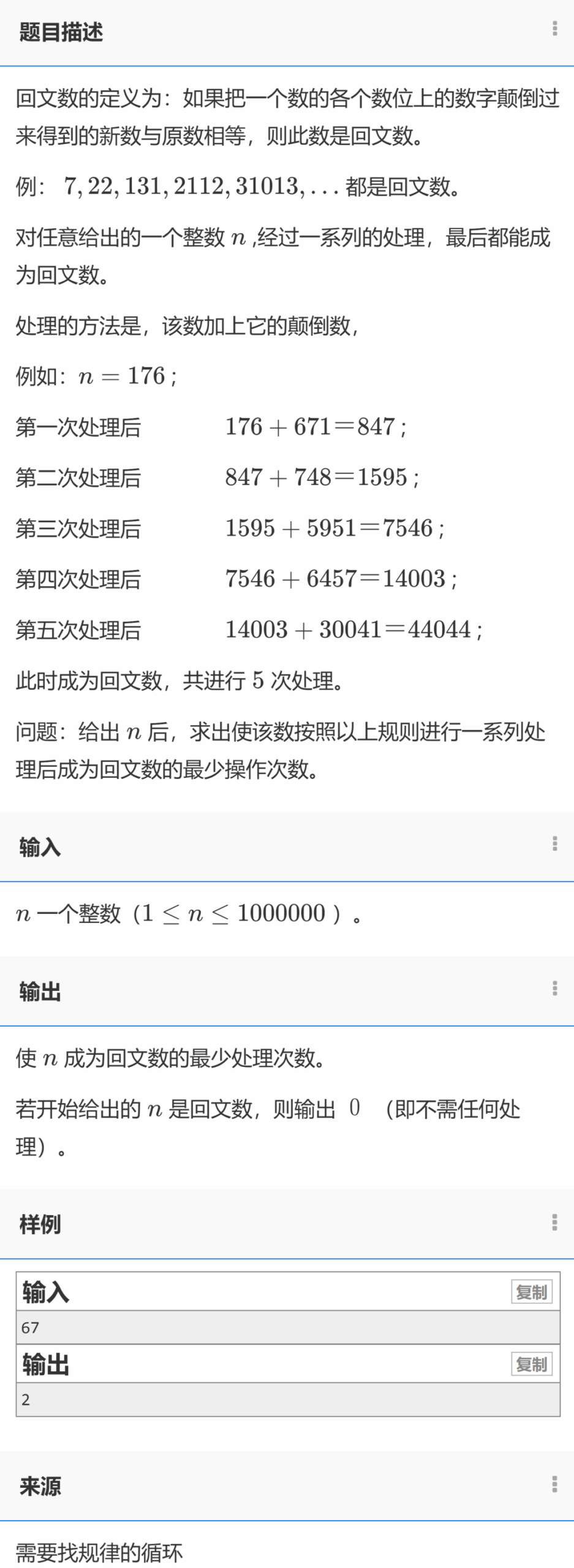
This program addresses an interesting mathematical problem: Calculating how many times a number needs to undergo the “reverse and add” operation to become a palindrome (a number that reads the same forwards and backwards, such as 121).
How does the program work?
-
First, the user inputs a number (for example, 57).
-
The program performs the following actions:
-
Reverses the number (57→75).
-
Checks if it is a palindrome (57≠75, it is not).
-
If it is not, it adds the original number and the reversed number (57+75=132).
-
Records this as the first operation.
Repeats this process for the new number:
-
132→231.
-
132≠231, continue adding (132+231=363).
-
Records the second operation.
Now 363 is a palindrome (363 reversed is still 363), stop!
Finally, informs the user: 2 operations were used.
Special Note::
-
The program uses the
<span>ji</span>variable to record the number of operations. -
It will stop when the number becomes 1 (this is a special setting).
-
The final output of
<span>ji-1</span>is because the first check does not count as a real operation.
Reference Code
#include<iostream>  // Include input-output library, allows using cin/coutusing namespace std; // Use standard namespace to avoid writing std::int main() // Main function of the program, execution starts here{    // Define variables:    int n;    // Store the user input number    int ni;   // Store the result of the reversed number    int ce;   // Temporary variable to hold the number during reversal    int ji=0; // Counter to record the number of operations
    cin>>n; // Read the user input number from the keyboard
    // Main loop: continue while n is not equal to 1 (this is a special setting)    while(n!=1){        ni=0;  // Clear the reverse result before each iteration        ce=n;   // Save the current number to temporary variable ce        ji++;   // Increment operation count
        // Number reversal process (core algorithm)        while(ce!=0){          // Continue while ce still has digits            ni=ni*10+ce%10;    // Add the last digit of ce to the end of ni            ce=ce/10;          // Remove the last digit from ce        }
        // Check if it is a palindrome        if(n!=ni){       // If it is not a palindrome            n=n+ni;      // Add the number and its reversed number        }    }
    cout<<ji-1; // Output the number of operations (subtract 1 because the first check does not count as an operation)    return 0;   // Program ends normally}
1. What does the program do?
This program calculates how many times you need to repeatedly “add its reverse” to any given number to obtain a palindrome. For example:
-
Input 56 → 56+65=121 → 1 operation.
-
Input 57 → 57+75=132 → 132+231=363 → 2 operations.
2. Program Structure Analysis
① Preparation Stage
-
<span>#include<iostream></span>: Equivalent to preparing paper and pen, allowing the program to input and output. -
<span>using namespace std</span>: Equivalent to saying “the cin/cout I write later are from the standard library”.
② Variable Explanation
-
<span>n</span>: The number provided by the user (which will change continuously). -
<span>ni</span>: The appearance of the number after reversal. -
<span>ce</span>: Temporary variable, helps with the reversal calculation. -
<span>ji</span>: A “notebook” for recording the number of operations (starting from 0).
③ Core Algorithm
-
Number reversal (like looking in a mirror):
-
<span>ce%10</span>: Extract the last digit (123%10=3). -
<span>ce/10</span>: Remove the last digit (123/10=12). -
<span>ni=ni*10+digit</span>: Append the digit to the right of ni.
Palindrome check:
-
Compare
<span>n</span>and<span>ni</span>for equality. -
If different, add:
<span>n = n + ni</span>
3. Example of Execution Flow
Assuming input is 57:
-
First loop:
-
Reverse 57→75.
-
57≠75 → Add to get 132.
-
ji=1.
Second loop:
-
Reverse 132→231.
-
132≠231 → Add to get 363.
-
ji=2.
Third loop:
-
Reverse 363→363.
-
363=363 → Stop.
Output ji-1=1 (this may be controversial, see notes).
4. Important Details
-
Why use ji-1: Because the first check has not performed any addition operation yet.
-
while(n!=1): This is a special setting; normally it should be
<span>while(n!=ni)</span>. -
Number Reversal Principle:
Example: Reverse 123
Step 1: ni=0 * 10+3=3, ce=12
Step 2: ni=3 * 10+2=32, ce=1
Step 3: ni=32 * 10+1=321, ce=0
5. Cautions
-
Potential Issues:
-
In the original code,
<span>while(n!=1)</span>may be a bug; it should be<span>while(n!=ni)</span>. -
Some numbers may require many steps to become a palindrome.
Improvement Suggestions:
-
A maximum step limit can be added to avoid infinite loops.
-
Add intermediate step printing for easier debugging.
-
Handle cases of negative number inputs.
6. Learning Suggestions
Beginners can practice as follows:
-
Simulate the program’s operation with paper and pen (choose a small number).
-
Try modifying the code to print each operation process.
-
Consider: What happens if the input is 1?
-
Challenge: How to make the program handle larger numbers?
This program effectively demonstrates:
-
The use of loop structures.
-
Techniques for manipulating digit positions.
-
The basic ideas of algorithm design.
I hope this explanation helps you fully understand! If you have any questions, I recommend running the program and observing its behavior.