1229 – Solving the Number of Interception Systems for Missiles
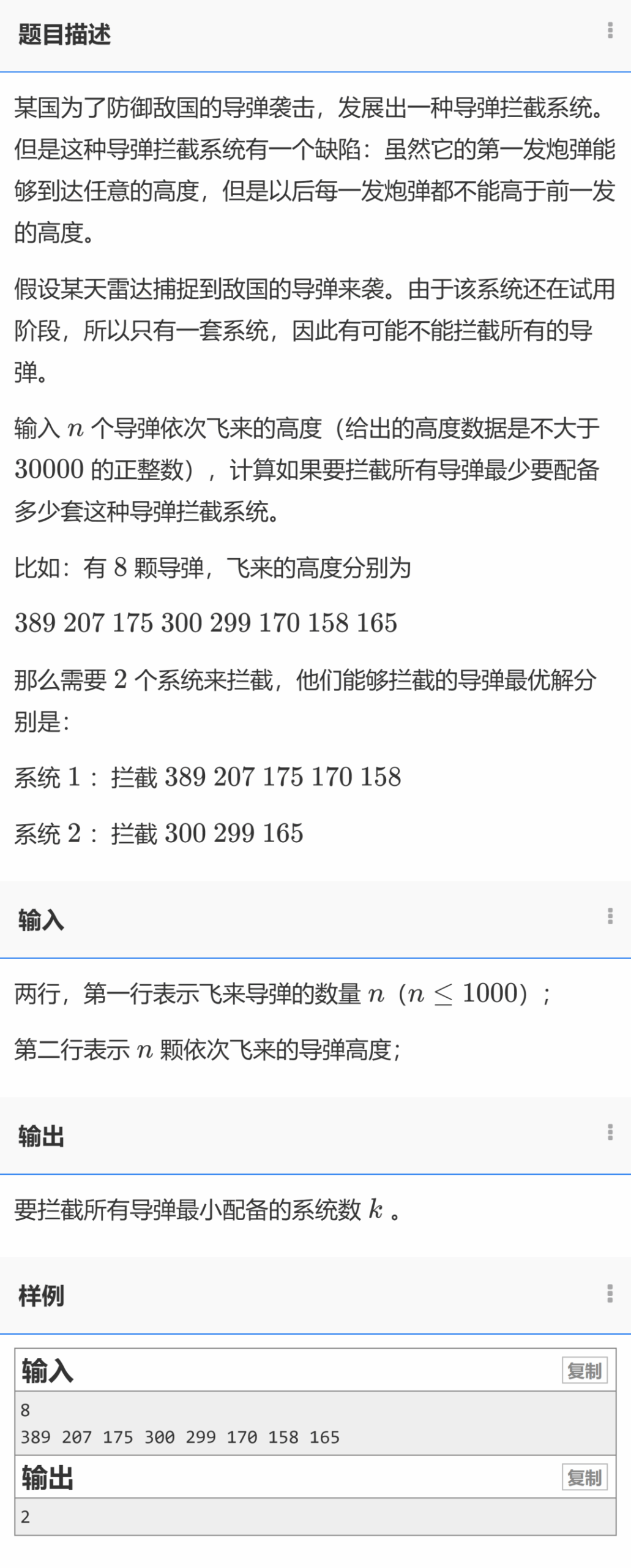
Analysis of Missile Interception System Problem
This program addresses a classic missile interception problem, calculating the minimum number of systems required to intercept a given sequence of missiles. The program achieves this goal through a greedy algorithm and array processing.
Detailed Design Approach:
-
Data Structure Design:
- Use an array
<span>a</span>to store the current interception height of each interception system - Variable
<span>k</span>records the current number of systems, initialized to 1 - Variable
<span>f</span>serves as a flag indicating whether the current missile can be intercepted
Input Processing:
- Read the total number of missiles
<span>n</span> - First, read the height of the first missile and store it in the array
<span>a[1]</span>
Interception Strategy:
- Loop to read the heights of the remaining missiles
<span>b</span> - Search for a system that can intercept
<span>b</span>among the existing systems - If found, update the interception height of that system and mark
<span>f=1</span> - If not found, add a new system
Reference Code
#include<bits/stdc++.h>  // Include almost all standard library headers
using namespace std;     // Use standard namespace
int a[1005];  // Define global array a to store the current interception height of each system
int main() {    // Define variables    int n, b, k = 1;  // n - total number of missiles, b - current missile height, k - number of systems (initially 1)
    cin >> n;         // Read total number of missiles    cin >> a[k];      // Read the height of the first missile and store it in a[1]
    // Loop to process the remaining n-1 missiles    for(int i = 1; i < n; i++) {        cin >> b;     // Read the current missile height        bool f = 0;   // Initialize flag f to 0 (indicating no intercepting system found yet)
        // Search for a system that can intercept the current missile among existing systems        for(int j = 1; j <= k; j++) {            // If the system can intercept the current missile            if(a[j] >= b) {                a[j] = b;  // Update the interception height of that system                f = 1;     // Mark as found an intercepting system                break;     // Exit the loop after finding            }        }
        // If no system can intercept the current missile        if(!f) {            k++;          // Increase the number of systems by 1            a[k] = b;     // Set the interception height of the new system to the current missile height        }    }
    cout << k;  // Output the minimum number of systems required
    return 0;   // Program ends normally
}
1. Program Overview
This program is used to solve the missile interception problem, calculating the minimum number of systems required to intercept a given sequence of missiles. Each interception system can only intercept missiles that are not higher than its current interception height, and the program efficiently solves for the minimum number of systems using a greedy algorithm.
2. Problem Description
-
Input:
- First line: Number of missiles n
- Second line: n integers representing the sequence of missile flight heights
-
Output: An integer representing the minimum number of interception systems required
-
Example:
- Input:
5 50 40 60 30 10 - Output: 2
3. Algorithm Principles
3.1 Data Structure
- Use an array
<span>a</span>to store the current interception height of each system - Variable
<span>k</span>records the current number of systems - Variable
<span>f</span>serves as a flag to record whether an intercepting system has been found
3.2 Greedy Strategy
- Initialize the interception height of the first system to the height of the first missile
- For each subsequent missile:
- Search for a system among existing systems that can intercept it
- If found, update the interception height of that system
- If not found, add a new system
<span>k</span> is the minimum number of systems required4. Code Analysis
4.1 Variable Description
| Variable Name | Data Type | Description |
|---|---|---|
| a | int[1005] | Stores the interception height of the systems |
| n | int | Number of missiles |
| b | int | Current missile height |
| k | int | Number of systems |
| f | bool | Interception flag |
| i,j | int | Loop counters |
4.2 Key Code
-
Input Processing:
cin >> n; cin >> a[k]; -
System Search:
if(a[j] >= b) { a[j] = b; f = 1; break; } -
System Addition:
if(!f) {
    k++;
    a[k] = b;
}
5. Execution Flow
- Read the number of missiles n
- Read the height of the first missile and store it in a[1]
- For the remaining n-1 missiles:
- Read height b
- Search for an intercepting system
- Update or add a system
6. Learning Points
- Greedy Algorithm: Understand the application of greedy strategies in resource allocation problems
- Array Operations: Learn to traverse and update arrays
- Loop Control: Master the use of nested loops
- Flag Variables: Understand the usage scenarios of the variable f
- Problem Modeling: Learn how to translate real-world problems into program logic
7. Frequently Asked Questions
Q: Why is k initialized to 1?A: Because the program first reads the height of the first missile and stores it in a[1], which means there is already one system.
Q: Why is the array size set to 1005?A: To ensure it is large enough to handle larger input data.
Q: What is the time complexity of this algorithm?A: In the worst case, it is O(n²), as each missile may need to traverse all systems.
Q: What happens if all missile heights are the same?A: Only one system is needed to intercept all missiles, and the program will output 1.