The recent news about the active expansion in the PCB industry has caught everyone’s attention. Whether it is Shenghong or Pengding, the expansion is in full swing. Additionally, companies in the equipment sector have shifted their overall logic from simple orders and downstream expansions to equipment orders, evolving towards high-end and domestic production. The drilling equipment landscape and the leading positioning advantages are quite favorable, while the domestic substitution logic for PCP equipment is the most straightforward. This active expansion is evident in both upstream and downstream sectors. With the release of the GB series, PCB is certainly undergoing a comprehensive expansion process. Currently, supply cannot meet demand, and customers are scrambling to secure products, indicating that the industry is indeed very vibrant. However, upon closer inspection, PCB prices have already risen significantly. Here, I would like to discuss a specific segment within the PCB industry: copper foil, which I believe is filled with expectation gaps and will have opportunities for a “Davis Double Play” starting this year.
Copper foil, as the upstream of PCB, faces higher demands due to the rapid development of AI, which has raised requirements for PCBs in terms of high frequency, high speed, and low loss. Traditional copper foil cannot meet these demands and must be upgraded to HVLP to support these performances. Currently, mainstream HVLP products are in the 2-4 range, with the 5th generation being developed and tested as the next generation product. The continuous improvement in requirements for copper foil products, especially with the significant increase in high-layer and HDI ratios, has led to an upgrade in CCL material requirements to M8 or even M9 levels. In this context, copper foil needs to gradually upgrade from HVLP 2 or 3 products to 4 and 5 products, with lower dielectric loss to meet the demands of higher generation products. In terms of processing costs, HVLP 2 product processing costs are around 100,000 yuan, while the third generation costs about 150,000 yuan, and the fourth generation costs about 200,000 yuan. Compared to traditional product processing costs of 15,000 yuan and RTF processing costs of 30,000 to 70,000 yuan, the processing costs of HEVLP products across generations will see a significant increase, leading to a notable enhancement in profit elasticity. Currently, GB200 and GB300 mainly consist of 2 to 4 generation copper foil products, and with the volume shipment of these servers, the supply-demand gap for copper foil is very certain.
Many people may wonder why there is suddenly a shortage of copper foil. I can clearly state that ordinary copper foil is in oversupply and is not lacking; what is lacking is high-end copper foil. The processing cost of ordinary copper foil has dropped to 10,000 yuan/ton; HVLP 2 generation processing costs about 100,000 yuan, while the 4th generation can reach 200,000 yuan, with net profit margins increasing from 5% to over 40%, indicating a significant elasticity. The copper foil market is already experiencing price increases, with Mitsui being a representative of the current leading enterprise. However, it is also limited by insufficient production capacity, so the future trend will likely involve price increases to filter customers. According to Fubon Investment Consulting, HVLP 4/5 has become the mainstream M9 material. Currently, the overall market capacity for HVLP 1-4 is about 1,200 tons, but if it actually transitions to HVLP 4, it will be lower than this capacity data. According to supply chain investigations, major Japanese manufacturers are expected to have a monthly capacity of about 350 tons for HVLP 4 copper foil by 2025, while current Taiwanese and Luxembourg manufacturers are about 700 tons/month; after the expansion of Japanese manufacturers in 2026, capacity can be increased to 450-550 tons/month, still below the delivery demand for 2026, indicating a supply-demand imbalance. Since 50% of the global RTF copper foil supply is concentrated in Taiwanese company Jinjue, and its capacity cannot meet the incremental demand from the downstream NVIDIA supply chain, a price increase strategy is being adopted. This strategy is used to filter customers and redistribute production lines to match the significant increase from Taiguang.
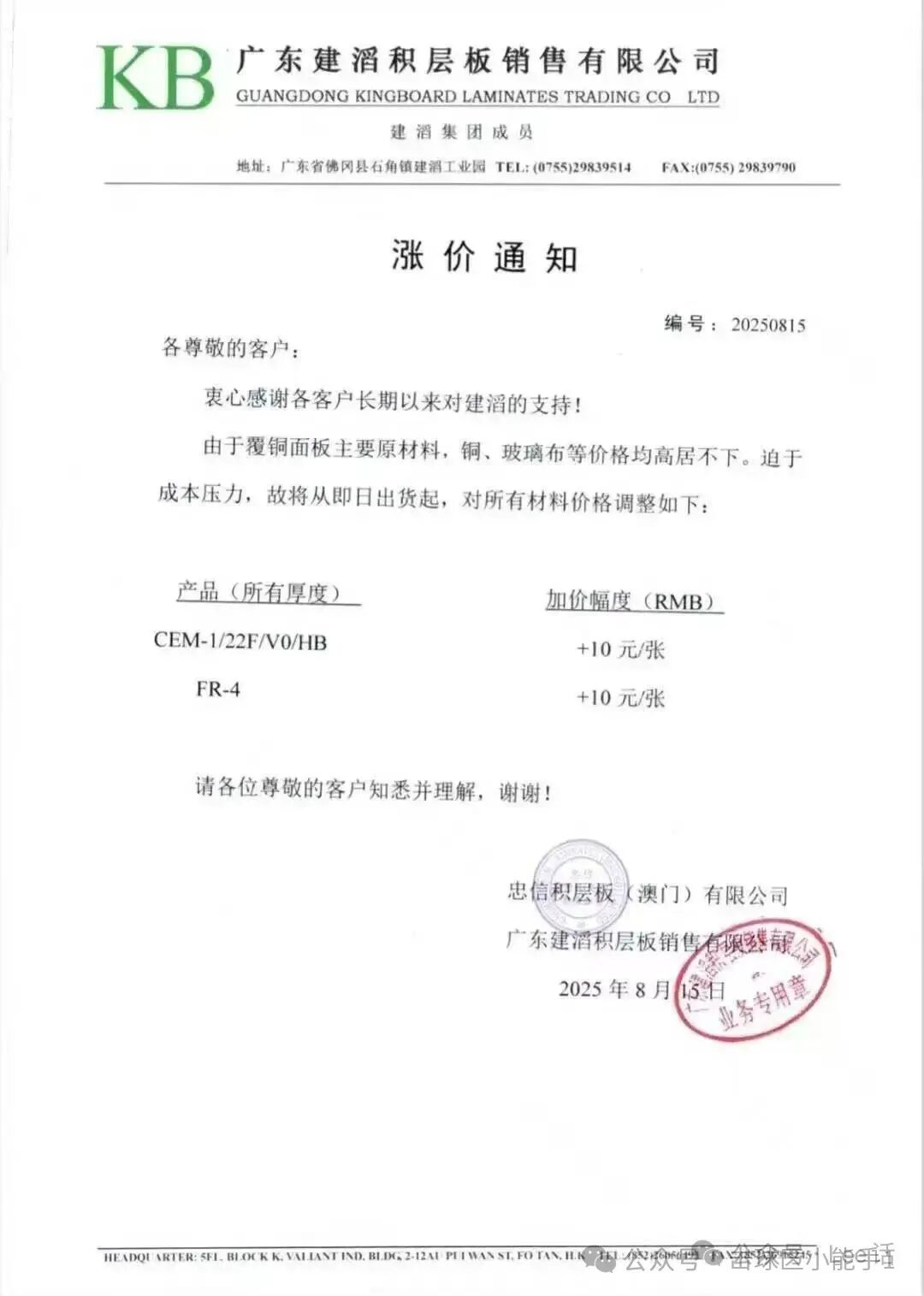
Moreover, a crucial point is that the difficulty of expanding copper foil production is much higher than we imagine. Many companies are producing lithium battery copper foil and have mature production lines, so isn’t it reasonable to convert these production lines to high-end copper foil production? Absolutely not! Take Cuprum and Defu as examples; compared to overseas expansion decisions, which are conservative and limited, our domestic companies have the fastest expansion speed due to their response time and decision-making speed. For instance, Cuprum decided in July this year to transform a 20,000-ton lithium battery copper foil production line into a PCB production line, but even so, the fastest they can achieve is only 5,000 tons in 3 months, and it will take about 12 months to fully transform the 20,000-ton target production line. Cuprum has paid the price of a complete lithium battery boom cycle, almost over the past six or seven years, during which Cuprum was almost absent in lithium battery development and invested significant effort in PCB development, thus gaining supply chain opportunities with Taiguang. Once the supply chain matches Taiguang and meets customer needs, the incremental share will be substantial, and orders will come in continuously. Defu’s path is different; it acquired the Luxembourg copper foil giant, which is a global leader. Through this strong alliance, Defu can supply NVIDIA via Luxembourg’s customer channels and, under Luxembourg’s technical guidance, transform these copper foil production lines for high-end HVLP production, which will accelerate the process. The expectation gap for Defu is significant, with both domestic and international resonance and simultaneous expansion. Moreover, Defu is not lacking in resources, and having a giant like Luxembourg is like adding wings to a tiger.
Therefore, with the entry of these two companies, it means that even if there is price competition or overcapacity in the future, they will still enjoy the benefits from downstream, whether it is NVIDIA GPUs or ASICs. In the next few quarters, there is unlikely to be price competition; the focus will be on meeting delivery and high-performance customer requirements.
Currently, the rapid leap in AI server specifications directly pushes material demands to a level that the original production line cadence cannot bear. In the past, 112 Gbps PAM4 could still use HVLP 3 or some ultra-low roughness traditional copper foil mixed, but once the GB300 architecture is fully introduced at 224 Gbps, especially in GPU-to-GPU direct connection channels and high-end backplane links, the loss budget has been pushed to the limit, forcing CCL manufacturers to switch to HVLP 4 or HVLP 5 to pass large customer validations. Then there is the “amplification effect” of simultaneous downstream expansions. High-frequency board manufacturers like Taiguang, Taiyao, and Doosan have been expanding rapidly over the past few years, but this wave is almost “fully loaded”: Taiguang is expanding in multiple locations such as Huangshi, Malaysia, and Zhongshan, aiming to increase monthly production capacity to 5.8 – 6.1 million pieces; Taiyao continues to advance capacity planning, upgrading product combinations towards high frequency and high speed; and South Korea’s Doosan is directly adjusting its capacity structure in advance for large orders from Huida. This new capacity will almost linearly increase the demand for fiberglass cloth and high-end copper foil, with no alternative materials available.
Finally, there is the “urgent order effect” of market demand. Supply chains like NVIDIA have extremely short timelines (updating a generation every year or even every six months), and once PCB design completes SI validation, they will require materials to “jump the queue” into production lines to ensure server shipments are not delayed. This behavior of locking orders and pulling materials in advance renders the original inventory adjustment function ineffective, and production lines can only remain continuously loaded, further amplifying the gap.
These combined factors have created the current situation where “the shortage of high-end copper foil is not a temporary phenomenon, but a structural one that will last at least until next year or even the year after.” Let us take a look at the current expectations based on the current situation and the supply-demand imbalance forecast for the copper foil market:
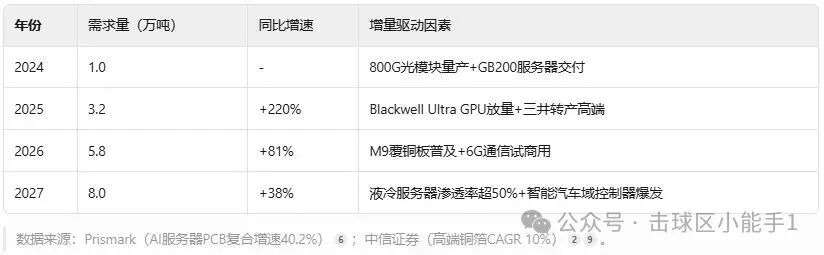
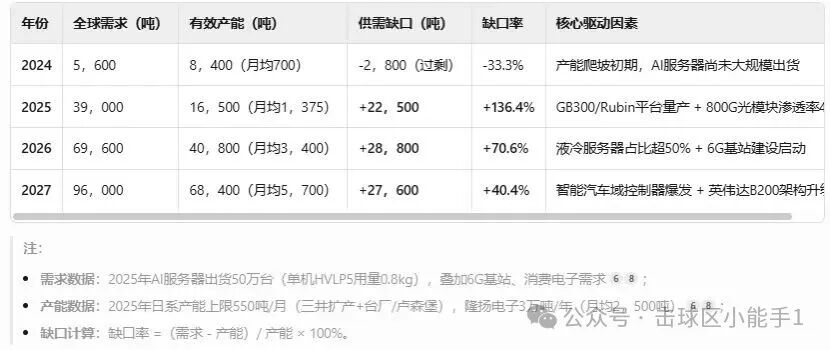
In fact, the current industry situation has already indicated that the GB series will continue to have explosive power. The current expectation is 100,000 to 120,000 cabinets, which will create an even larger supply-demand gap. With production capacity unable to keep up, the expansion cycle being slow, and demand continuing to rise, the situation will only intensify. In a scenario where large customers are not very price-sensitive, the situation of filtering customers through price increases will occur more frequently. Demand +, capacity +, price increase, and with only a few industry players, the difficulty of new entrants is high, and the verification cycle is long. This is the essence of the Davis Double Play. Moreover, with Rubin coming out, it will upgrade to HVLP 5, further increasing the profits of these companies. Therefore, I am very optimistic about: Cuprum Copper Foil, Defu Technology, and Longyang Electronics. This summarizes the current state of the copper foil market well:
Cuprum Copper Foil: Represents the thriving copper foil market, with its HVLP 4 already showing certainty, more of a strong reality. Defu Technology: Represents the present and future of the copper foil market. After acquiring Luxembourg, it drives both domestic and international growth, with HVLP 2-4 available, and HVLP 5 already being researched by Luxembourg, representing both strong reality and strong expectations.
Longyang Electronics: Represents the new generation of HVLP 5. They have the background resources of Taiwanese manufacturers, and their current R&D validation is progressing smoothly with top-notch yield levels. However, this is the next generation Rubin product, representing strong expectations for the future. I genuinely believe that there is a significant expectation gap in the copper foil market, and I am particularly optimistic about Defu. Although we are currently in a JC cycle, it is nearing its end, and the secondary market has basically had no impact, with the remaining issues being resolved through bulk transactions. With the technical support from Luxembourg, Defu can rapidly transform domestic copper foil production lines. If we consider the cooperation in technology licensing, production capacity will gradually shift to domestic production. Defu can help Luxembourg match more low-cost production capacity, and correspondingly, Luxembourg will also see more customer increments, not solely revolving around Doosan. Additionally, Panasonic, as the third-largest CCL manufacturer globally, after Taiguang and Doosan, also has a willingness to cooperate with Luxembourg. Moreover, customers like Doosan, Panasonic, Shengyi, Taiguang, and many others, including NVIDIA’s GB300 products, are currently undergoing validation, and they have even provided a profit range of over 1.1 billion RMB for next year. Therefore, in the future, in a market characterized by the Davis Double Play of capacity expansion + product price increases, exceeding this profit range is quite normal. Giving an industry average PE of 30 is a straightforward matter. Furthermore, Defu also has lithium battery copper foil that can be used for solid-state battery production, as well as new carrier copper foil for silicon-carbon anodes and CATL’s ultra-fast charging products, indicating significant profit potential. From now until next year and beyond, this is a critical moment of high demand for high-end copper foil. How will the market price this? As the key manufacturer of this core incremental growth, how will Defu gain excess market share? I am looking forward to seeing it unfold.