In the already tiresome topic of technological blockades, the US has come up with another bizarre move.
However, this time it is purely for amusement.
Just yesterday, a group of US Congress members began pressuring the Department of Commerce to restrict cooperation between Chinese and American companies on the RISC-V chip architecture.
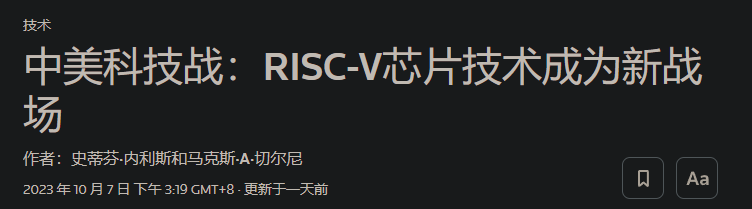
After reading this news, I couldn’t stop laughing; these Congress members are truly embarrassing themselves.
Whatever else they say, I believe it, but restricting RISC-V?
 You might as well believe I am Qin Shi Huang…
Next, let’s discuss why the idea of “restricting RISC-V” is so absurd and what the implications would be if such restrictions were to become a reality.
However, to clarify this matter, we need to spend a little time briefly discussing RISC-V.
If you were paying attention to tech news around 2019, you should have seen the term RISC-V pop up frequently.

You should know that the x86 architecture on computers and the ARM architecture on mobile devices are known as the “two major instruction set architectures” in the world.
The former comes from Intel and is licensed to AMD, forming the basis for personal computers and laptops.
The latter is widely adopted by Apple, Qualcomm, MediaTek, and Huawei HiSilicon, with over 99% of smartphones in the world currently using mobile processors based on the ARM architecture and instruction set.
 But if we had to identify a “third architecture,” aside from the main character this time—RISC-V—there really aren’t any other options.
It is a new architecture created by Berkeley professor Krste Asanović in 2010, and it is currently the “third major architecture” on Earth—though this claim is somewhat inflated:
Mobile devices like smartphones are still dominated by ARM, and RISC-V has no role there.
On computers, Apple uses ARM, and Windows uses x86, leaving RISC-V out of the picture.
Currently, RISC-V has made some inroads into the server market, but statistics show that in the server market, x86 holds 92.6% of the market share, while ARM holds 7.1%.
 And RISC-V’s market share is… less than 0.3%
But that doesn’t prevent RISC-V from winning accolades globally.

The reason lies in the patent model that RISC-V adheres to.
Like Google’s Android system, it is free and open for everyone to modify and use.
You can use it however you want, modify it however you want, without paying a dime.
Note from the reviewer: To clarify a possible misunderstanding, there was news that Google banned Huawei from using Android, which is not entirely accurate. What Google actually banned was the “Google services” within the Android system, as “Google services” are Google’s private property. The open-source Android system itself (AOSP) has never been banned from use, and the Android compatibility layer in HarmonyOS 4.0 has already been updated to the latest Android 13.
Moreover, if you make some new modifications to the RISC-V architecture, the intellectual property for that part belongs to you.
Doesn’t that sound incredible?
In the past, the intellectual property of x86 and ARM architectures was controlled by a few giants.
 x86 was originally developed by Intel for its own use, and later, for certain reasons, it was licensed to AMD.
 Making it free? You might as well let Intel go bankrupt.
And ARM, as a commercial company, relies almost entirely on the architecture licensing fees of billions each year as their only source of income.
In the past two years, to increase licensing, they even ended up in court with Qualcomm, which is quite undignified.
 But RISC-V is quite the opposite.
According to the BSD license used by RISC-V, anyone using, modifying, or redistributing related technical materials does not need to obtain permission from the RISC-V Foundation.
Moreover, you can not only use the basic RISC-V architecture design provided by the RISC-V Foundation for free, but there is also a large open-source community.
If someone designs a chip and actively uploads it to the RISC-V community, you can use it for free!
It is precisely this completely open and unrestricted characteristic that makes RISC-V increasingly favored.

Some may wonder: How does RISC-V make money with this model?
Chip development has been so expensive; are they doing charity?
 On the contrary, RISC-V’s choice of an “open-source model” is precisely to make money.
Here’s how it works:
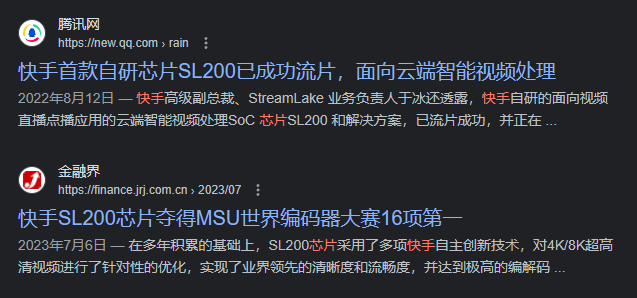
In the past decade, the demand for high-performance custom chips has been increasing—even companies focused on short videos need to develop chips to enhance the viewing experience.
Compared to general-purpose processors on the market, these custom chips can complete tasks faster and more energy-efficiently, and even reduce the cost of chip procurement.
 If these newly developed chips choose the ARM architecture as their foundation, they have to pay ARM a toll before they even start production.
If they don’t choose ARM but opt for other “ancient architectures” like MIPS, they won’t meet performance requirements.
The “no payment” aspect of RISC-V perfectly addresses the pain points of these “new internet companies”:
1. Low startup costs; 2. Rich community resources; 3. The results after modifications can become their proprietary products.
Does this sound familiar? Wasn’t Google’s Android built up this way? By relying on open-source, they quickly attracted many manufacturers to join.
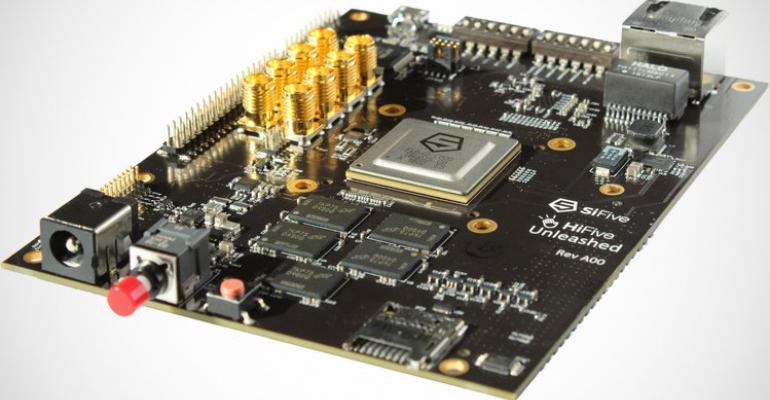
 Moreover, although RISC-V itself is not profitable, the founders of the RISC-V architecture have started their own company to provide “consulting services” to help others design RISC-V chips.
They seem to be doing quite well.
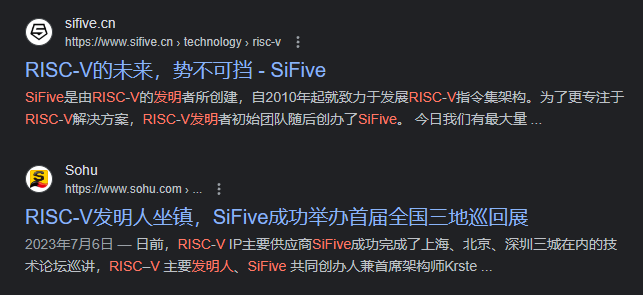
As of now, over a hundred manufacturers, including Huawei HiSilicon, Alibaba T-head, Qualcomm, etc., have launched processors using the RISC-V architecture.

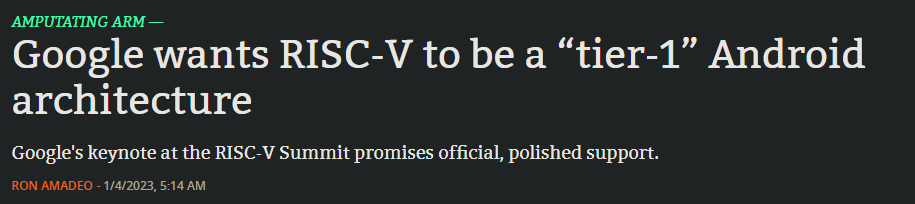
Google also announced this year that Android will place RISC-V on the same level as ARM.
OK, at this point, we have basically clarified what RISC-V is.
And by now, you must have figured out why the US Congress members’ calls to restrict RISC-V are completely unrealistic.
First, it is open-source; unless the RISC-V Foundation announces a shift to closed-source and secret designs in the future, there is no basis for sanctions.
But will RISC-V turn to closed-source?
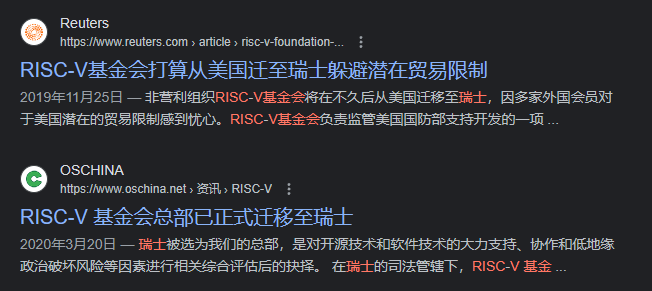
 Don’t be ridiculous; after hearing that they might be affected by sanctions, the founders immediately moved the foundation out of the US.
Currently, the RISC-V Foundation is located in Switzerland, a historically neutral zone…
Secondly, if RISC-V were to announce a shift to closed-source, the impact would still be minimal.
For example, ARM has restricted Huawei from using their designs, but this has not affected the release of the Kirin 9000s, as Huawei has developed a new Kunpeng architecture based on their understanding of previous public designs.
 The world’s first mobile processor with simultaneous multithreading, can you handle that?
Moreover, unlike ARM, which restricts Huawei using public architectures, the public RISC-V architecture imposes fewer restrictions on manufacturers.
Because, just like the early open-source Android, RISC-V is currently experiencing severe ecological fragmentation.

In simple terms, the architecture provided by the RISC-V Foundation is too raw, and each manufacturer has to add their own modifications to use it.
In other words, although the chips are all based on RISC-V designs, they have already transformed into “Qualcomm RISC-V,” “Alibaba RISC-V,” etc., in specific applications.
“RISC-V Compatible” Trademark
In the context of “community mutual benefit,” such fragmentation is very undesirable—it’s hard to share the results produced by each company, leading to a repetition of efforts.
But in the context of trade sanctions—brother, I didn’t even use your stuff, what are you going to sanction me with?
With courage?
However… while the first two directions of sanctions are not very realistic, the US does have one direction of sanctions that could be considered, which is actually the same tactic they used against Huawei back in the day:
Not targeting chip design, but rather the manufacturing side, “prohibiting the use of photolithography machines with US technology to produce RISC-V chips for Chinese companies.”
But… how should I put it?
 The US has already taken such harsh measures against Huawei; why is the Mate 60 Pro still being sold?

In summary, this “restriction on RISC-V” uproar has only caused us to laugh a bit too hard…
These Congress members probably know what’s going on in their hearts; they are likely just trying to make a big news story, posturing for votes.
Just to annoy people.
But on a different note, the fact that US Congress members are starting to try to use open-source architectures is quite interesting… if they can’t do anything, they might as well bite a lighter.
Written by: He Ran Edited by: Miro, Mianxian Cover: Huanyan
Image and data sources:
frandroid.com