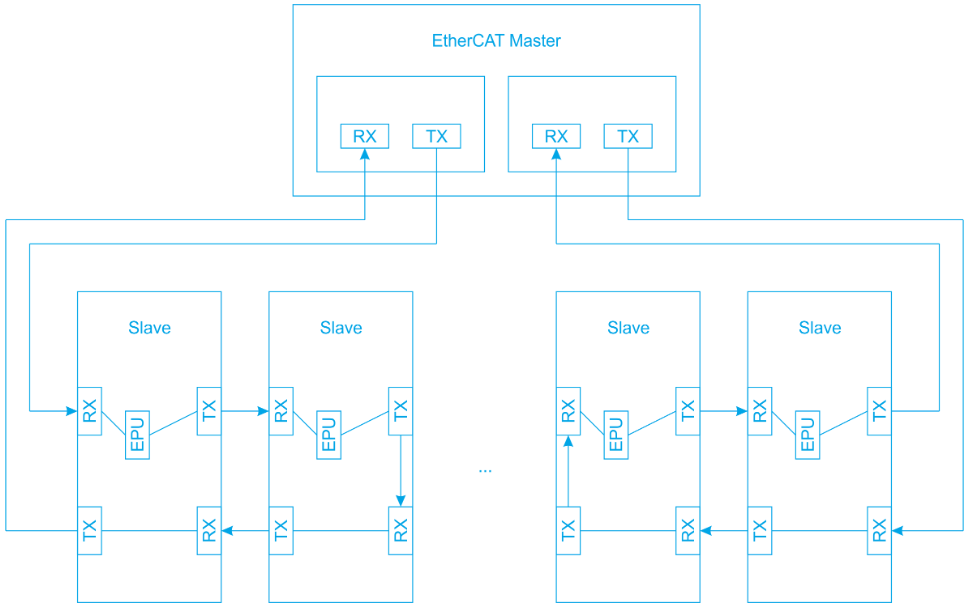
The EtherCAT Processing Unit (EPU) is the logical core of the EtherCAT slave controller, containing registers, memory, and a data processing unit. Any frame must first pass through Port A before entering the EPU. The EPU is responsible for receiving, parsing, and processing the entire EtherCAT data stream.
Cable redundancy requires a second network card. In redundancy mode, both network cards simultaneously send out frames that are initially identical. When a frame passes through an EtherCAT Processing Unit (EPU) of a slave device, data can be exchanged with that slave via the EPU.
• Frames from the first network card enter through Port A as the input port and can exchange data with the slave via the EPU.• Frames from the second network card, still in the ring network, will not load any slave data if their input port is not Port A.• When frames are transmitted from Port A to Port B, data can be exchanged with the slave via the EPU; however, when transmitted from Port B to Port A, no data will be received from any slave.
As shown in the figure below, in a ring topology without cable faults:• The first network card will receive a frame carrying all slave information;• The second network card will receive a frame that appears to be a “loopback” (this frame did not enter any slave through Port A).
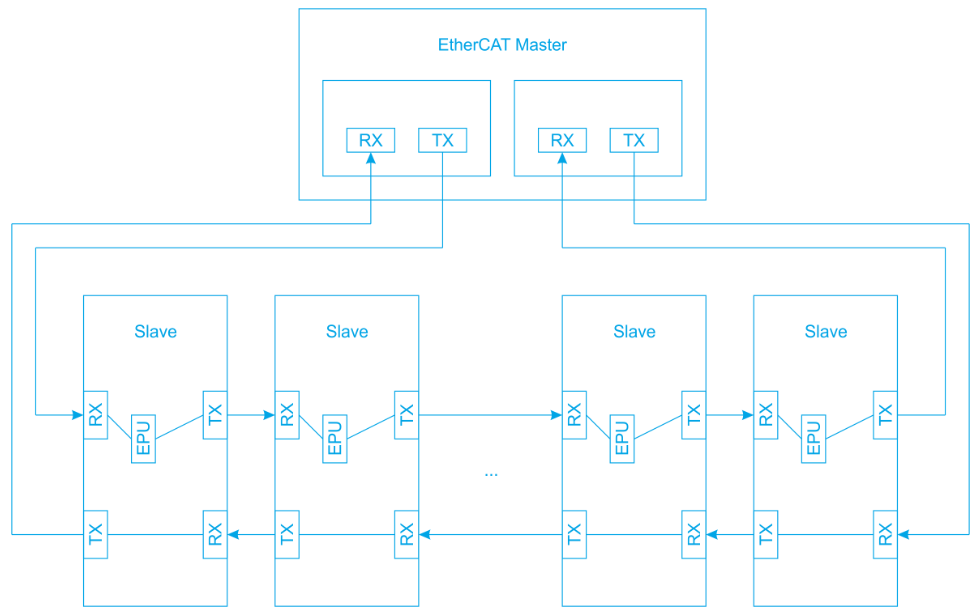
Once a cable fault occurs, the ring topology is broken. Since the ring in the network is no longer closed, the system no longer has redundancy capability. However, the initially set “simple redundancy” mechanism takes effect: the frames sent by the two network cards, which were initially identical, travel along their original ring paths, reaching the last port before the break, and then return to their respective senders.
• The frame from the first network card– enters through Port A, travels forward along the ring until reaching the last port before the break;– if there are slaves along this path, data is exchanged with them via the EPU;– after reaching the last port before the break, it turns around and returns to the network card; no slave data is collected on the return trip.
• The frame from the second network card– is sent in parallel with the first frame, and as it moves towards the break port, its input port is not Port A, so it will not collect any slave data via the EPU;– after reaching the last port before the break, it turns around and returns in the opposite direction; on the return trip, it enters through Port A, and if there are slaves along this path, data is exchanged with them via the EPU.
Ultimately, these two frames—originating from the two network cards—successfully complete the data distribution and collection for all slaves.