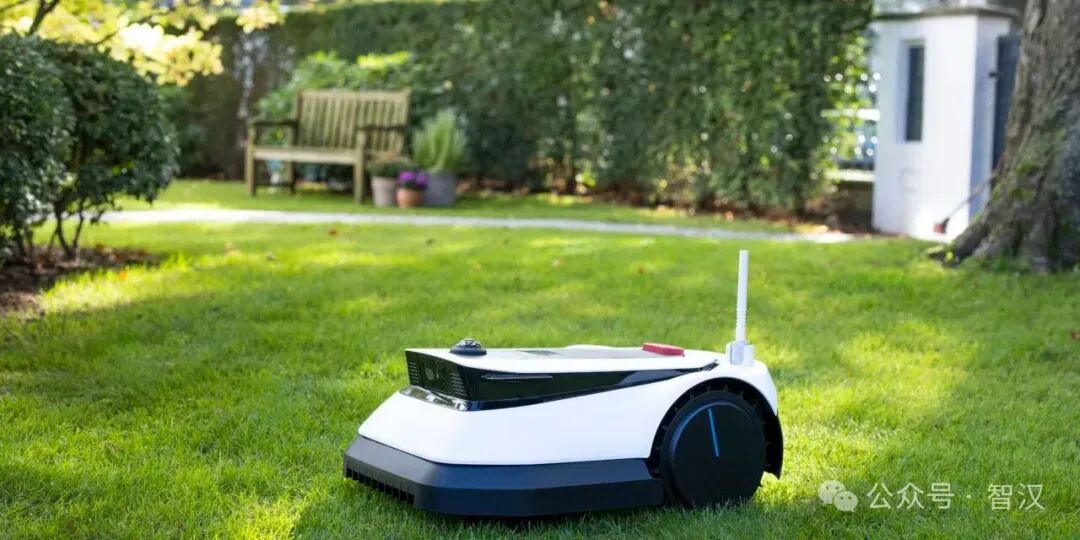
With the rapid development of smart home and Internet of Things (IoT) technologies, lawn mowers are gradually evolving from traditional manual operation to intelligent and precise solutions. Early lawn mowers relied on manual operation, which was time-consuming and labor-intensive, and the constraints of wiring limited the mowing area. Today’s robotic lawn mowers are equipped with obstacle detection sensors that can perform collision detection and simple boundary line limitations, but they are less efficient and easily affected by environmental interference. The introduction of Low Energy Bluetooth (BLE) and Ultra-Wideband (UWB) technology into intelligent lawn mowers brings new possibilities, enabling high-precision positioning, remote control, and autonomous planning of mowing areas, further enhancing user experience and operational efficiency.

The integration ofUWB with Low Energy Bluetooth technology provides dual technical advantages for lawn mowers.BLE, with its low power consumption and stable connection characteristics, becomes an ideal choice for real-time communication between mobileAPP and the robot, allowing users to easily control the robot’s start and stop, mode switching, and other operations via their mobile phones. Meanwhile,UWB technology, with its centimeter-level high-precision positioning capability, can accurately define virtual electronic fences, allowing the robot to operate only within the designated area and avoiding entering non-mowing zones. The combination of both not only optimizes energy consumption but also significantly enhances the intelligence level of the robot, enabling it to autonomously complete mowing tasks in complex environments.
System Architecture
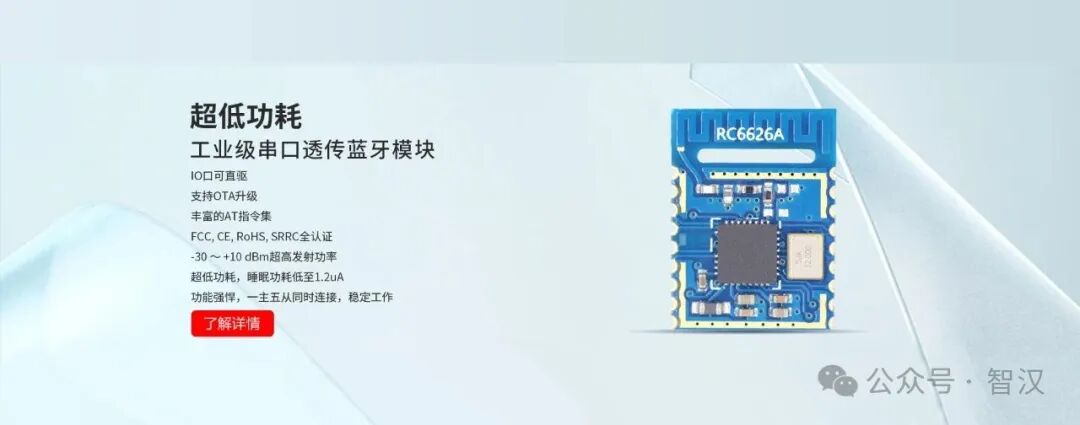
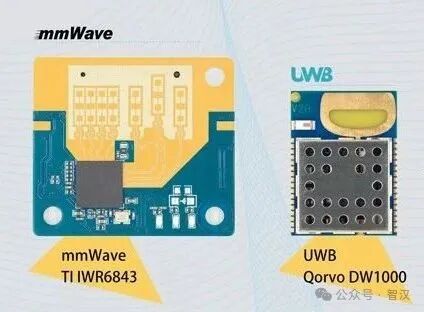
The system architecture of the intelligent lawn mower consists of a hardware layer and a software layer that work together to ensure precise positioning, stable communication, and efficient operation. The hardware layer is centered around a high-performance main control unit (such asARM Cortex-M7) and integrates ultrasonic orToF sensors for dynamic obstacle avoidance, while gyroscopes and accelerometers achieve posture calibration to ensure stable operation of the robot in complex terrains. Rain sensors can detect weather changes, triggering automatic recharging or pausing operations to enhance environmental adaptability. The power system uses efficient brushless motors to drive the blades, balancing cutting performance with low power consumption. The communication layer consists of4G andBLE modules (such as the ZhiHan IoTRC6626A) responsible for interacting with the mobileAPP, supporting remote control and status monitoring; theUWB positioning unit achieves centimeter-level positioning through multi-base station ranging, combined with electronic fence technology to accurately delineate mowing areas. The power management system integrates a large-capacity lithium battery and an intelligent charging module to ensure long-lasting operation.
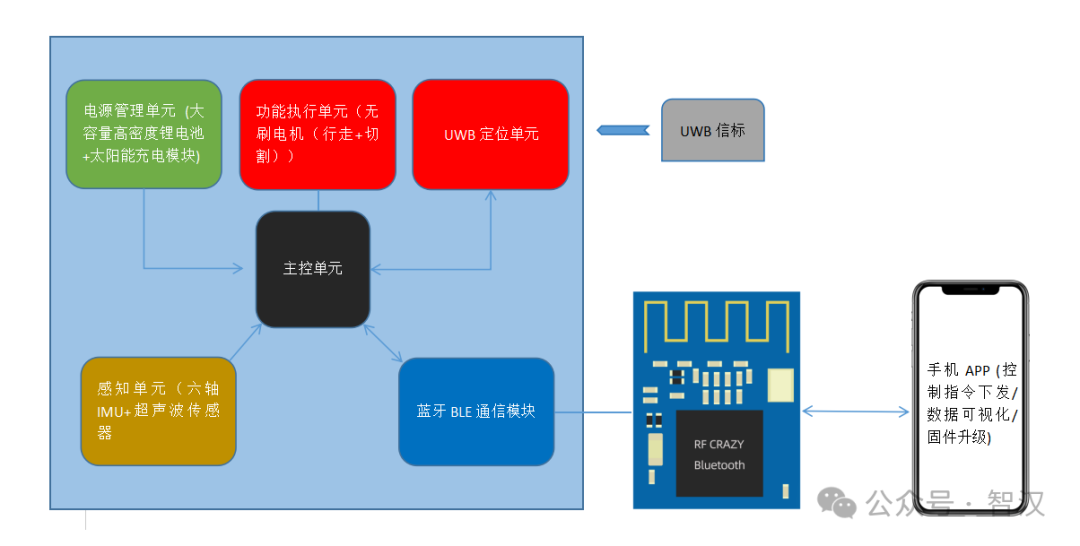
The software layer revolves aroundBLE andUWB technology:TheBLE protocol stack implementsAPP command pass-through (such as direction of travel, mode switching) and reports the robot’s status; theUWB algorithm processes positioning data, combined withSLAM technology to generate dynamic path planning, ensuring full coverage mowing.
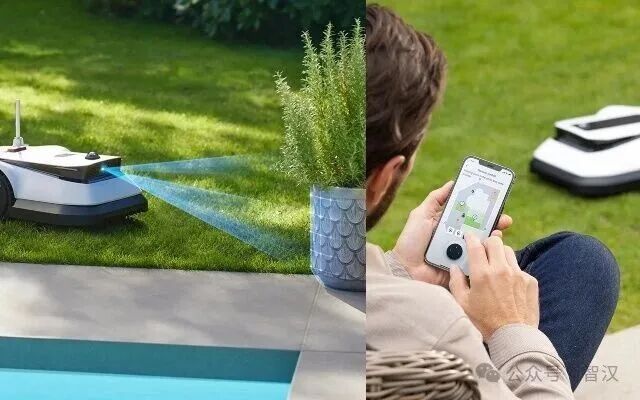
The core advantage of this solution lies in its intelligent control and positioning functions. Users can remotely control the lawn mower through the mobileAPP, utilizingBLE for real-time command transmission, such as adjusting mowing height or switching work modes. At the same time, with the help ofUWB technology, users can intuitively set virtual mowing areas on theAPP, and the lawn mower can accurately locate its position in real-time throughUWB beacons, ensuring it operates only within the specified range. This precise control not only improves mowing efficiency but also reduces energy waste, extending the robot’s battery life.
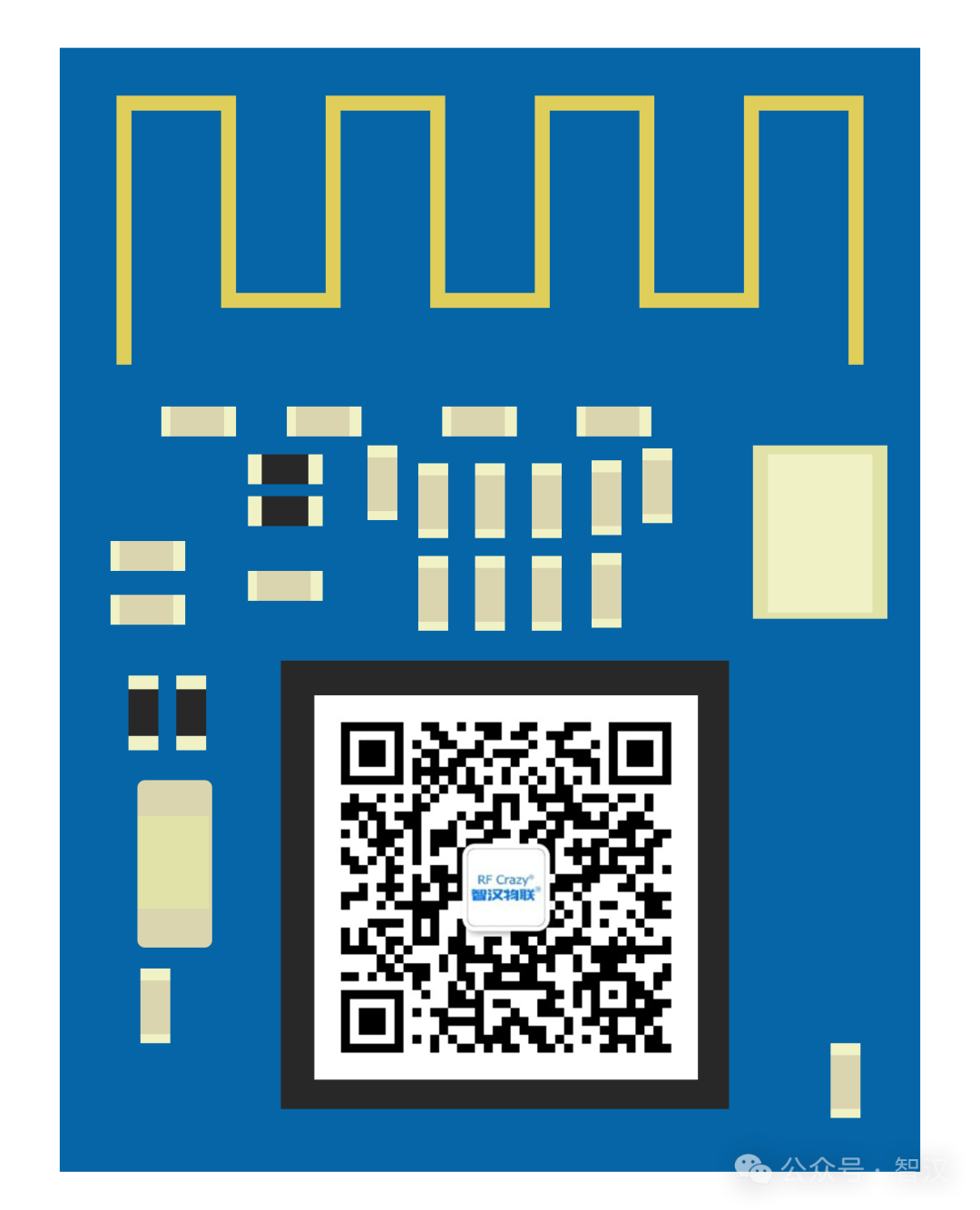
The ZhiHan IoTRC6626A BLE module provides stable and reliable communication support for this solution. This module adopts a standard serial pass-through design, simplifying the development process, while also featuring ultra low power consumption (as low as1.2uA), and supports master-slave integration, one master multiple slaves, and customizable master-slave roles, BluetoothHID proximity discovery, andOTA upgrades. The accompanyingUWB module needs to support high-precision ranging and positioning, capable of working in conjunction with theBLE module to build a complete intelligent mowing system. The maturity and ease of use of both modules provide a solid technical guarantee for the implementation of the solution.
In summary, the intelligent lawn mower solution based on Low Energy Bluetooth andUWB technology represents a new trend in the lawn mower industry. It not only addresses the pain points of traditional lawn mowers, such as inconvenient operation and inaccurate mowing range, but also enhances operational efficiency and user experience through intelligent means. With the continuous development of IoT technology, this innovative solution that integratesBLE andUWB is expected to become the mainstream technical route for future intelligent lawn mowers, bringing more convenience to home and commercial lawn maintenance.