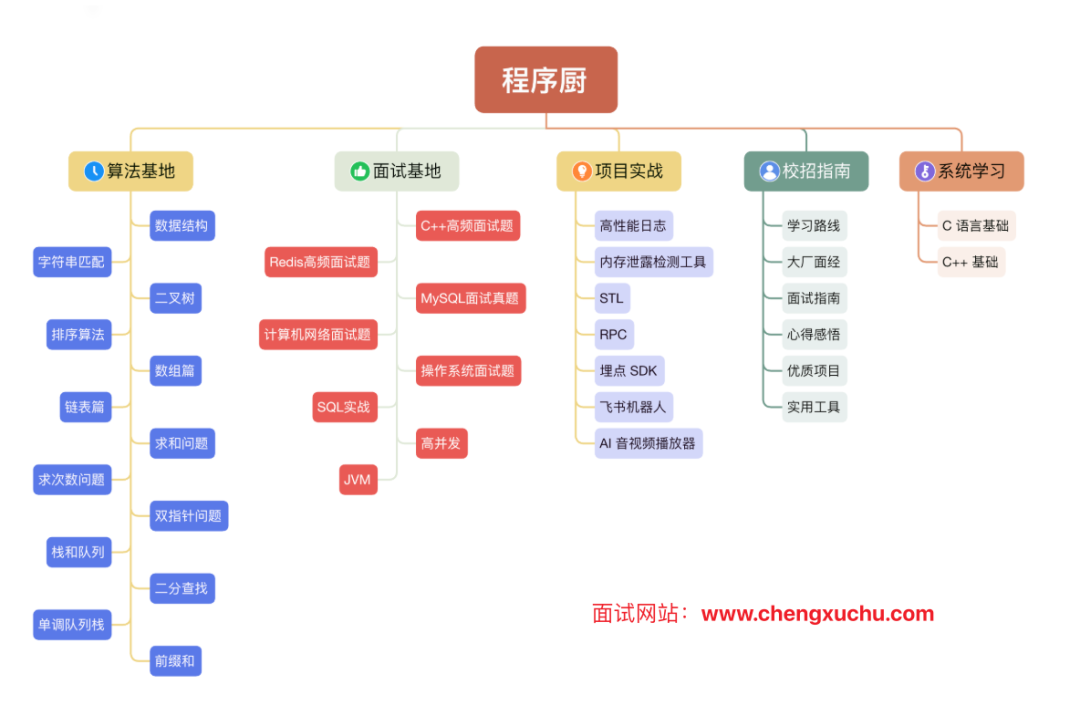
Learning website for Eight-legged essays:https://www.chengxuchu.com
Hello everyone, I am Chef, a programmer who loves cooking and has obtained a chef qualification certificate.
C++ is a system-level language that is close to hardware, and its performance advantages have always been favored by developers. However, writing high-performance C++ code in actual projects is not a simple task, involving multiple aspects such as memory management and compiler optimization. This article attempts to explore several key aspects of C++ performance optimization from a practical perspective, combined with specific examples, to help everyone clarify their thoughts and master effective methods.
Today, I will share some core ideas and techniques regarding C++ performance optimization based on my own practices in projects, hoping to inspire everyone.
📚 The C++ Knowledge Base has been launched on ima! The current content covered by the knowledge base is shown in the image below👇👇👇
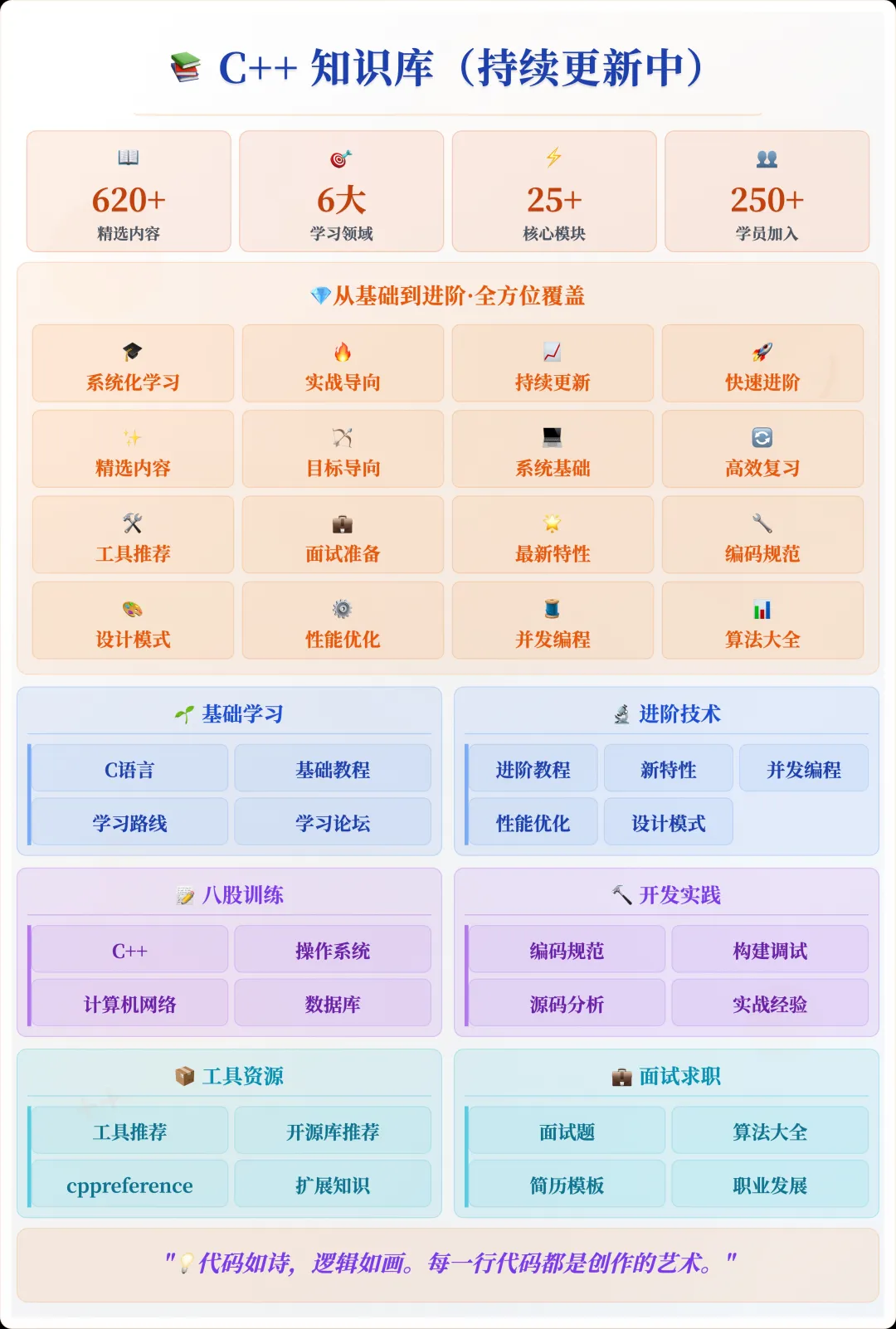
📌 Students interested in the knowledge base can add vx (chuzi345) with the note【Knowledge Base】 or click 👉 C++ Knowledge Base (tap to jump) to view the complete introduction of the knowledge base~
1. Memory Management: The Foundation of Optimization
C++ provides complete control over memory management, which is both an advantage and a risk. Proper memory management can not only improve performance but also avoid potential memory leaks and fragmentation.
1.1 Avoid Unnecessary Dynamic Allocation
The overhead of dynamic allocation (new/delete or malloc/free) should not be ignored. Especially in frequently called code paths, repeated allocation and deallocation of memory can create significant performance bottlenecks. Use stack objects or pre-allocated memory pools whenever possible.
Example:
#include <vector>

struct Data {
    int x;
    double y;
};

void process() {
    // Avoid new every time, use vector pre-allocation instead
    std::vector<Data> buffer;
    buffer.reserve(1000); // Reserve space to avoid frequent resizing

    for (int i = 0; i < 1000; ++i) {
        buffer.emplace_back(Data{i, i * 0.1});
    }
}
Pre-allocating memory avoids multiple memory reallocations during vector automatic resizing, improving efficiency.
1.2 Memory Alignment and Cache Friendliness
The cache behavior of modern CPUs has a significant impact on performance. Ensure that data structures are memory-aligned and optimize access patterns to improve cache hit rates.
struct alignas(64) AlignedData {
    int a;
    double b;
};
<span>alignas(64)</span> ensures that the structure is aligned to 64 bytes, avoiding performance degradation caused by cache line crossing.
Additionally, the order of struct members can also affect alignment and padding bytes. It is recommended to place larger members first and smaller members later to reduce the size of the structure.
2. Avoid Unnecessary Copies
Copy operations often involve significant data copying, which is time-consuming. Modern C++ provides various mechanisms to reduce copying.
2.1 Utilize Move Semantics
C++11 introduced move semantics, which avoids deep copies of temporary objects.
std::vector<int> createVector() {
    std::vector<int> v = {1, 2, 3, 4};
    return v; // Use move constructor to avoid copying
}

void foo() {
    std::vector<int> vec = createVector(); // Move construction
}
The local variable returned here is passed through move construction, enhancing performance.
2.2 Pass by Reference Instead of Value
When passing function parameters, try to use<span>const &</span> to avoid unnecessary copies.
void printString(const std::string& s) {
    std::cout << s << std::endl;
}
2.3 Avoid Implicit Copies
Be cautious of copying elements in standard library containers, and try to use<span>emplace</span> series interfaces to construct directly.
std::vector<std::string> vs;
vs.emplace_back("example"); // Direct construction, avoid temporary objects
3. Compiler Optimization Techniques
The compiler provides various optimization methods, but reasonable utilization is key.
3.1 Choose the Appropriate Compiler Optimization Level
Common optimization options include:
<span>-O0</span>: No optimization, convenient for debugging<span>-O2</span>: Enables most optimizations, suitable for release<span>-O3</span>: Aggressive optimization, may lead to code bloat<span>-Os</span>: Optimize for code size
In actual development,<span>-O2</span> is sufficient to cover the vast majority of performance needs. Use<span>-O3</span> with caution, as it may increase compilation time and binary size.
3.2 Inline Function Optimization
Small functions can be declared as<span>inline</span> to reduce function call overhead.
inline int add(int a, int b) {
    return a + b;
}
However, modern compilers are very intelligent about inline optimization, and usually, there is no need to declare it manually unless the function is very simple and called frequently.
3.3 Use<span>constexpr</span><span> for Compile-Time Computation</span>
<span>constexpr</span> functions can be evaluated at compile time, avoiding runtime overhead.
constexpr int factorial(int n) {
    return n <= 1 ? 1 : (n * factorial(n - 1));
}

constexpr int val = factorial(5); // Compile-time computation
4. Practical Suggestions and Performance Analysis
4.1 Quantify Performance Bottlenecks
Before optimization, it is essential to measure and identify the real bottlenecks. Tools such as:
- perf on Linux
- Visual Studio Performance Profiler
- Google Benchmark (C++ benchmarking library)
Usage example:
#include <benchmark/benchmark.h>

static void BM_StringCreation(benchmark::State& state) {
    for (auto _ : state)
        std::string empty_string;
}
BENCHMARK(BM_StringCreation);
BENCHMARK_MAIN();
Quantitative data guides optimization direction, avoiding blind improvements.
4.2 Focus on Algorithm Complexity and Data Structure Selection
Performance optimization is not only at the code level but also involves the reasonable selection of algorithms and data structures. Reducing complexity often has a more significant effect than micro-optimizations.
Finally, I want to tell everyone:
C++ performance optimization is a comprehensive art that involves memory management, copy control, compiler optimization, and algorithm design. In actual work, it is essential to combine specific scenarios, utilize the standard library and modern C++ features, and leverage performance analysis tools to make reasonable trade-offs to ensure both code quality and execution efficiency.
Recommended reading:
C++ Direct Access to Major Companies
Existential Question: After Learning So Much Technology, Why Can’t I Still Find a Job?
This generation of young people is too difficult… Writing papers in school, polishing resumes after graduation, and during interviews, they have to tell jokes to AI.

Hello, I am Chef! I graduated with a master’s degree from 211, and during the autumn recruitment period, I passed over 30 interviews, ultimately receiving more than 10 offers from Baidu, Tencent, Huawei, Shopee, Bilibili, SenseTime, JD, a military research institute, and one of the Big Four banks, most of which are SP or SSP level.
My tags:
- Former Full-Stack Developer at Tencent, now an entrepreneur: Proficient in C++ development, self-rated 80 points.
- Open Source Project Author: One of my open-source repositories has surpassed 10,000+ stars and has topped the global trending list for a week.
- Campus Recruitment Offer Collector: During the autumn recruitment period, I received over 10 offers, almost all of which were SP or SSP level positions.
- Deeply Understand the Confusion and Pain Points of Autumn Recruitment: Therefore, I started the “Xijia Training Camp”, which has been running for 9 months, helping over 100 students significantly improve their C++ skills and successfully obtain ideal offers.
I particularly understand the confusion and difficulties everyone faces during autumn recruitment, so I hope to provide a clear direction and some practical methods through my experience.If you also want to stand out in the autumn recruitment, feel free to contact me (vx: chuzi345) to learn about the training camp we are running and join me in preparing for this autumn recruitment battle!