Previously, I wrote an article about IBM’s CBM (Component Business Model) methodology (see: In-Depth Analysis of IBM’s Enterprise Architecture Framework Model CBM). Recently, while sorting through the development context of enterprise architecture, I revisited the IBM BSP (Business Systems Planning) method, which is hailed as the “pioneer of enterprise architecture.” I increasingly appreciate its comprehensive system and the depth of its methodology. Especially in terms of layered structure design, BSP clearly distinguished between the conceptual layer, functional layer, and execution layer as early as the 1960s. This top-down, clearly structured architectural logic still holds significant reference value today.
In the BSP method, there is a very representative expression form, which is the “4A×3 Layers” architecture design matrix diagram we see today. This diagram appears simple but actually condenses the core ideas of IBM’s enterprise architecture methodology. By intersecting the four major architecture domains (business, application, data, technology) with the three levels (conceptual, functional, operational), it constructs a clear, complete, and actionable architecture modeling and planning system.
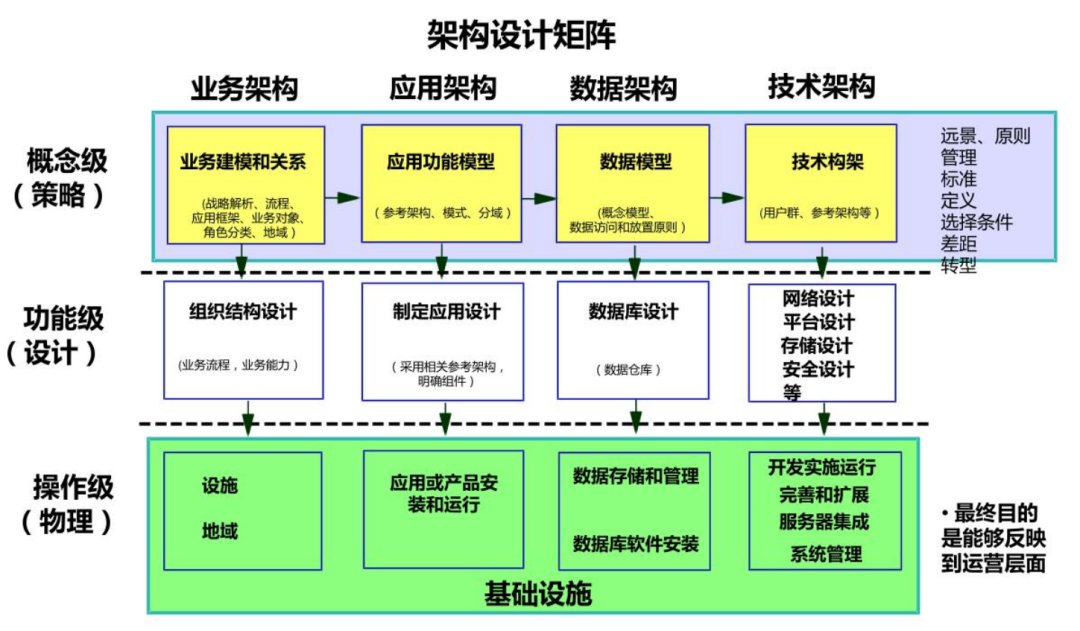
1. Horizontal Axis: Four Major Architecture Domains (4A)
IBM divides enterprise architecture into four core domains, commonly referred to as 4A:
-
Business Architecture: Focuses on enterprise strategic goals, key capabilities, business processes, and organizational roles, serving as the starting point for architecture design.
-
Application Architecture: Responsible for accommodating business requirements and transforming them into achievable system capabilities and functional modules.
-
Data Architecture: Defines data objects, data relationships, governance rules, and data standards, serving as the foundation for achieving information consistency.
-
Technology Architecture: Includes infrastructure, platforms, middleware, security systems, etc., providing support and assurance for the upper-level architecture.
2. Vertical Axis: Three Levels (Conceptual, Functional, Operational)
IBM emphasizes that any architecture design should be divided into strategic thinking, design modeling, and actual execution at three levels:
-
Conceptual Layer, also known as the “strategy layer” or “idea layer,” focuses on the definition of business intent, abstract objects, and overall boundaries. For example, business strategy, capability blueprint, information classification, technical principles, etc., belong to the architecture cognition and governance level.
-
Functional Layer is oriented towards modeling and system design, responsible for transforming concepts into clearly structured, logically complete deliverable models. For example, business process models, system component models, data logical models, technology service architectures, etc., serve as the “engineering drawings” of the architecture.
-
Operational Layer enters the implementation and deployment phase, specifically regarding application system installation, database deployment, platform launch, process operation, etc., representing the physical projection of concept and functional design in reality.
This three-layer architecture not only ensures a gradual translation from strategy to execution but also enables architecture design to possess forward and backward connectivity, vertical integration, and traceable management.
Although similar layered ideas are also reflected in methods like Zachman and TOGAF, IBM’s matrix diagram has the following unique advantages:
-
Higher degree of engineering: Each quadrant corresponds to actual outputs rather than abstract concepts;
-
Strong logical continuity: The relationships between business, application, data, and technology can be mapped in both directions;
-
Greater emphasis on implementation pathways: It is not only a modeling framework but also a practical implementation step guide.
Disclaimer: The interpretation sections are original content from EA Home and are protected by copyright. The “Case” sections are sourced from various library platforms, and the content cannot be traced back to the original source. If there are any misattributions or issues related to images, text links, etc., please contact us for resolution. Thank you!