The 99 multiplication table is a classic case for practicing loop structures, easily implemented through nested loops.
Structure Analysis of the 99 Multiplication Table
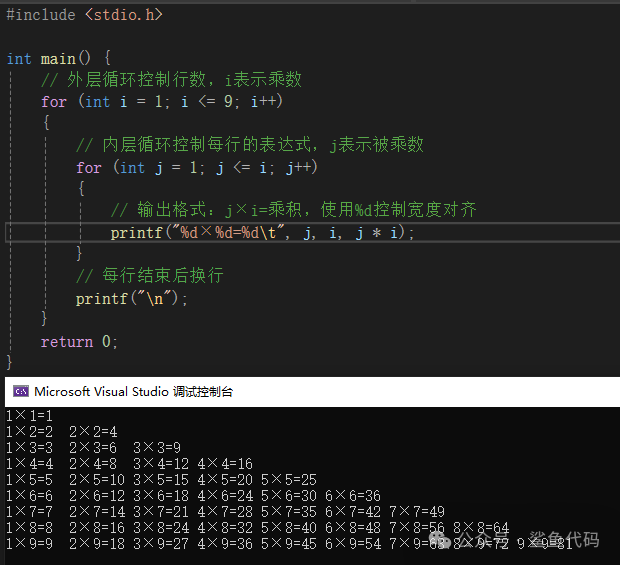
- Row 1: 1×1=1
- Row 2: 1×2=2 2×2=4
- Row 3: 1×3=3 2×3=6 3×3=9
- …
- Row 9: 1×9=9 … 9×9=81
Pattern: The i-th row contains i expressions, each expression is<span>j×i=result</span> (where j ranges from 1 to i)
Implementation Approach
- Use an outer loop to control the number of rows (i from 1 to 9)
- Use an inner loop to control the number of expressions in each row (j from 1 to i)
- In the inner loop, output in the format
<span>j×i=j*i</span> - After completing the output of each row, move to the next line
Code Analysis
-
Outer Loop:
<span>for (int i = 1; i <= 9; i++)</span>
- The variable i represents the multiplier for the current row (from 1 to 9)
- Controls the loop to execute 9 times, corresponding to 9 rows of content
Inner Loop:<span>for (int j = 1; j <= i; j++)</span>
- The variable j represents the multiplicand (from 1 to i)
- The i-th row will execute i times, corresponding to i multiplication expressions
Output Statement:<span>printf("%d×%d=%d\t", j, i, j * i)</span>
<span>%d</span>is used to output integers<span>×</span>is the multiplication symbol<span>\t</span>is a tab character used to align columns for neater output- The result of the expression is calculated by
<span>j * i</span>
Newline Statement:<span>printf("\n")</span>
- After completing the output of each row, a newline is executed to start the next row
Variant Implementation: Inverted Triangle Multiplication Table
To output the inverted triangle form of the 99 multiplication table in reverse order, simply modify the loop conditions: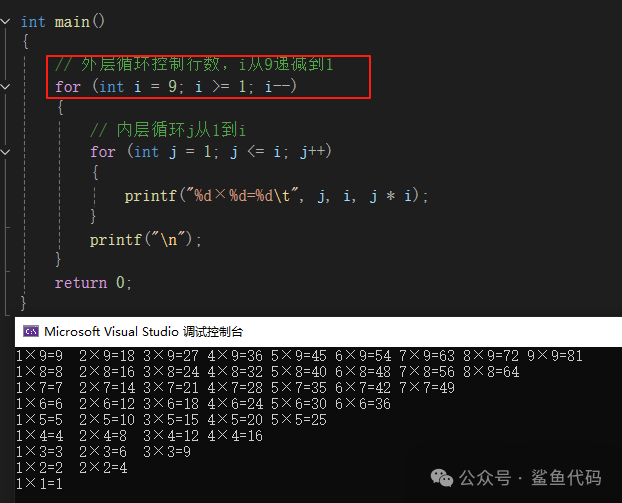
Conclusion
Through the implementation of the 99 multiplication table, we can master:
- The usage of nested loops (outer controls rows, inner controls columns)
- The application of loop variables within loops
<span>printf</span>function’s formatted output (especially the use of<span>\t</span>tab character)- The application of simple mathematical operations in programs
This exercise, while simple, excellently demonstrates the essence of loop structures and serves as a great example for beginners to understand nested loops.