Reporter: Wu Tingting, Editor: Bai Shuang, Proofreader: Lu Xi
Without remote controls, the robot football players rely entirely on autonomous judgment and decision-making to complete the match. Defense, offense, tactical coordination, corner kicks, breakaways, falling and getting back up autonomously… On June 28, the first fully autonomous 3V3 AI robot football match in China kicked off in Beijing Yizhuang.
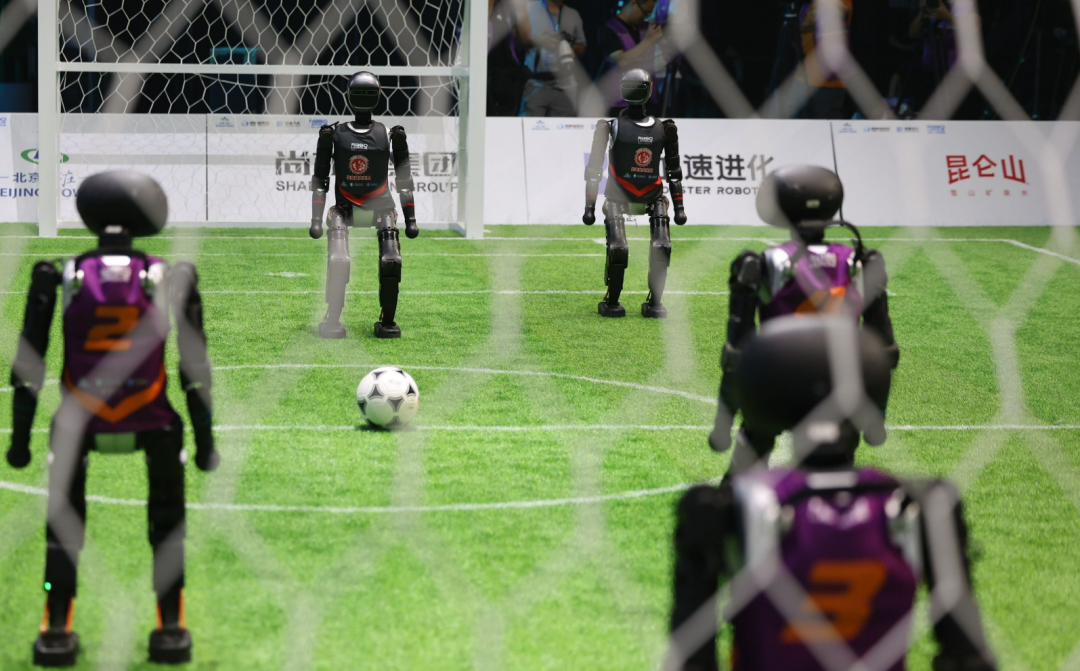
▲Robot players organize an attack. Photo by Wang Zicheng, New Beijing News.
Breaking free from remote controls, robots compete autonomously
At 18:30, the robot football match commenced at the Beijing Smart E-sports Event Center. A scaled-down football field was designed in the center of the venue. Four teams participated: the Blaze team from Beijing Information Science and Technology University, the Power team from Tsinghua University Future Lab, the Fire God team from Tsinghua University, and the Shanhai team from China Agricultural University. From the moment they appeared, the robots no longer relied on engineers’ remote controls, and their autonomous movements earned enthusiastic applause from the audience.
As the whistle blew, the Fire God team and the Shanhai team were the first to step onto the field. Similar to human football matches, the robot football match determined the kickoff rights by a coin toss. The Fire God team player kicked off, and two players from the Blaze team quickly stepped up to defend. During the match, the two teams’ robot players engaged in fierce ball contention, with a Blaze team player falling during the confrontation, while a Fire God team player seized the ball and scored. The reporter noted that the robots could autonomously get back up quickly after falling, returning to the game in no time.
However, some robots sustained ‘serious injuries’ after falling and needed to be carried off for emergency treatment. At one point, the Blaze team had only one player on the field, and the Fire God team seized the opportunity to make multiple breakaway attempts, while the lone Blaze player quickly returned to defense, hoping to intercept the opponent’s crucial goal.
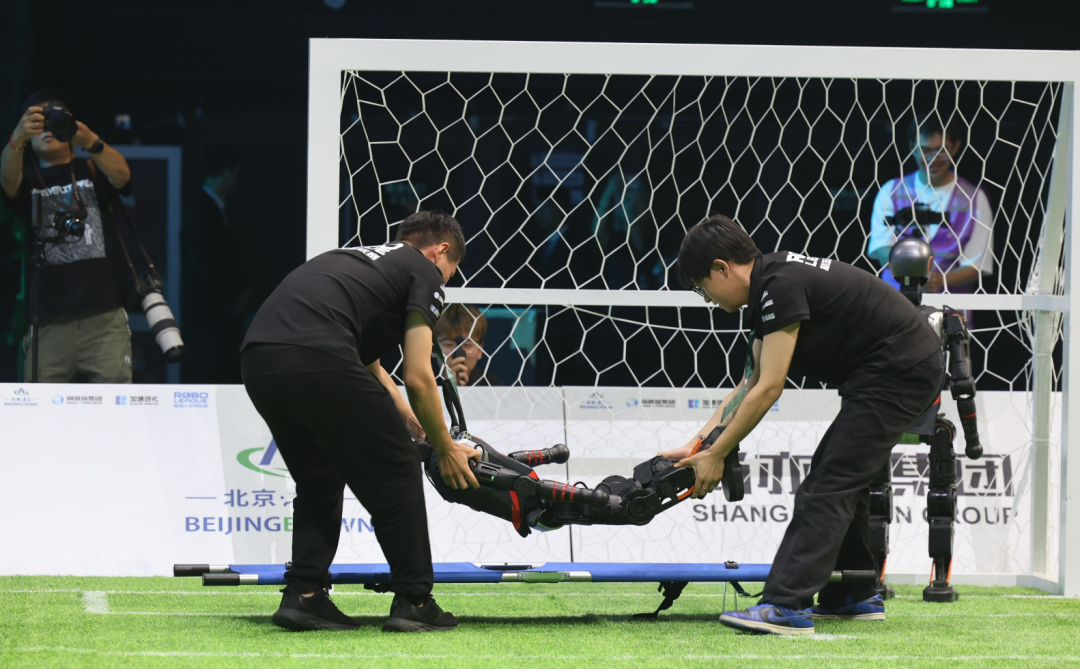
▲Some robot players were ‘injured’ and carried off on stretchers for ‘treatment’. Photo by Wang Zicheng, New Beijing News.
Robots’ autonomous obstacle avoidance and standing capabilities make the match smoother
Following the previous popular robot half-marathon, robot boxing matches and robot football matches have successively kicked off. What are the challenges and differences in conducting various sports competitions with robots? Cheng Hao, Executive Director of the competition organizing committee and founder of Accelerated Evolution Company, stated that whether it is a robot marathon, boxing match, or football match, there is a commonality: robots need to compete, which reflects the reliability of the robot itself.
However, the three types of competitions also have their differences. ‘The robot football match involves multiple machines competing, while the boxing match is a single machine competition. Moreover, this football match is not a ‘remote-controlled match’, but allows robots to rely on AI algorithms to autonomously complete the football game,’ Cheng Hao explained. The football match demonstrates that robots can now move steadily. Additionally, the engineers of each team need to have strong perception and role development capabilities to allow the robot football team to have room for performance.
On-site reporters observed that although it was a robot competition, the match process was very smooth. In this regard, Dou Jing, Executive Director of the competition organizing committee and Deputy General Manager of Shang Yicheng Company, stated that ensuring a smooth match is one of the biggest challenges of event assurance. ‘To ensure the continuity of the match, we must minimize penalties on-site. The premise of reducing penalties has three thresholds—robots must have autonomous obstacle avoidance capabilities, achieve autonomous decision-making, and stand independently. These key nodes provide the necessary conditions for the smoothness and intensity of the match.’
If we consider the human World Cup champion match as a score of 10, how many points can the current robot football match achieve? Cheng Hao said, ‘I think the current robot football players are close to the football level of a five or six-year-old child, and the match is about 1-2 points. However, with the rapid development of technology, a 10-point robot football match will be accelerated to realization.’
Duty Editor: Kang Xixi
 Village Transformed by 200 Cats
 Chinese Journalist Injured in Drone Attack in Russia, Foreign Ministry Responds
 Lei Jun: Xiaomi YU7 Orders Exceed ExpectationsRecent WeChat UpdateReaders often missthe pushto star 🌟 “New Beijing News”to receive the latest and hottest articles in a timely mannerClick “View” to share hot topics 👇